Study in Germany Visa Requirements
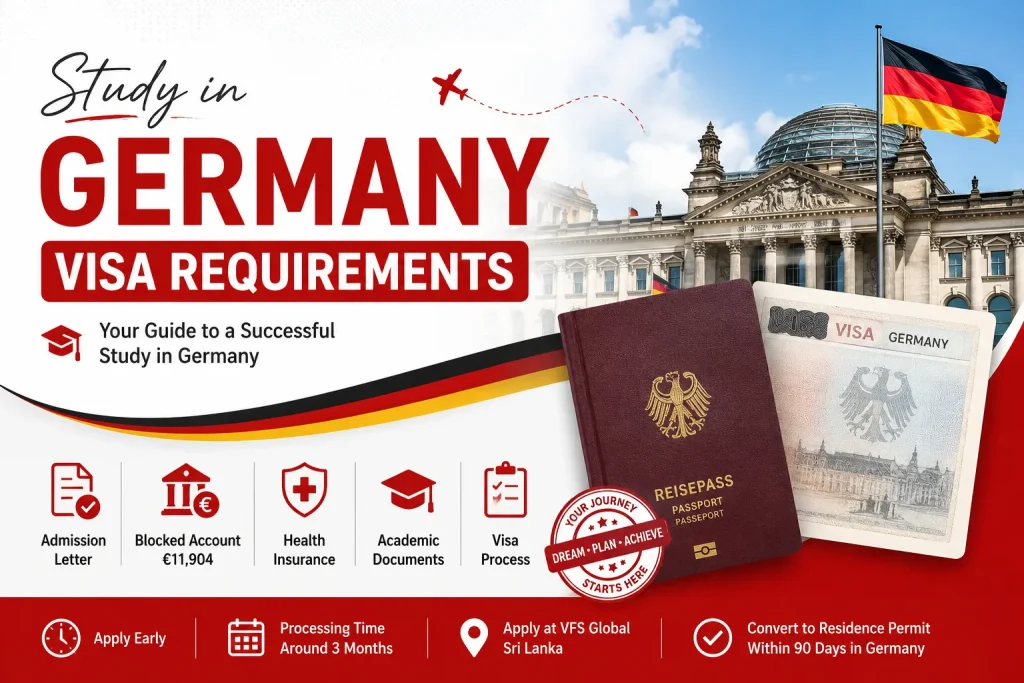
As a Sri lankan student visa, you are going to need a German national visa which is also called a ‘D visa’, to study for more than 90 days. You need a University admission letter and a blocked bank account to show €11,904 money for living costs, valid health and proof of your academic background. Applications are submitted through the VFS Germany Application Centre in Colombo or jaffna and final approval comes from the German Embassy in Colombo. The Visa Fee is payable in Sri lanka Rupees and processing generally takes around three months. Once you land in Gemany, you need to convert this visa into a residence permit within 90 days.
If you want help reviewing your documents or planning your VFS Colombo appointment, GIEC Global Sri Lanka’s counsellors can walk you through every step of your Germany study visa journey. Book a free consultation with our team to get started.
The exact checklist can vary slightly by embassy but most applicants need the following documents ready before booking a visa appointment.
● Valid passport with at least 12 months validity and two blank pages
● Completed and signed national visa application form
● Recent biometric passport size photographs
● Original admission letter (Zulassungsbescheid) from a recognised German university
● Proof of financial resources through a blocked account or equivalent
● Health insurance that meets German requirements
● Academic transcripts and previous degree certificates
● Proof of language proficiency in German or English, usually at B2 level
● Statement of purpose or motivation letter
● Visa fee payment receipt, payable in Sri Lankan rupees at the current embassy exchange rate
Unlike applicants from India, china and Vietnam, Sri lankan students do not need an APS Certificate which makes the document list slightly shorter. Ensure you carry correct documents to avoid last-minute delay at VFS colombo. Requirements can change, so always cross-check the current list on the German Embassy Colombo Website before applying.
Why Sri Lankan Students Choose Germany
Germany has become one of the most popular study destinations for Sri Lankan students. Public Universities in Germany Charge little to no tuition fees, degrees are recognised worldwide and the country offers strong job opportunities in engineering, IT, Business analytics and life science after graduation. For Sri Lankan families, the low cost of tuition compared to the UK, Australia or Canada makes Germany an especially attractive option. But before you can start classes, you need to clear the Germany student visa process, and that is exactly what this guide will help you do.
How to Apply for a Germany Student Visa: Step by Step
Once your documents are ready, the application itself follows a fairly predictable path.
- Secure your admission letter from a German university
- Open a blocked account and deposit the required amount
- Arrange health insurance for your visa appointment
- Fill the national visa application form through the German Embassy Colombo online portal
- Book your appointment at the VFS Germany Application Centre in Colombo or Jaffna
- Attend the appointment with two sets of original documents and pay the fee in Sri Lankan rupees
- Wait for the embassy decision, which generally takes around three months for a national visa
- Travel to Germany after your visa is stamped
- Register your address and apply for a residence permit within 90 days of arrival
Start this process at least 4 to 6 months before your intended semester. VFS appointment slots in Colombo fill up quickly during peak intake seasons, so booking early gives you a much smoother run at the process.
Types of Germany Student Visas
There are three main categories under the German study visa umbrella, and picking the right one matters.
1. German Language Course Visa
For students joining an intensive German language course before starting a degree. Usually valid for 3 to 12 months.
2. Student Applicant Visa (Prospective Student Visa)
For applicants who have applied to German universities but do not yet have a final admission letter. This lets you enter Germany, attend counselling sessions or entrance exams, and convert to a full student visa once you get admitted.
3. Regular Student Visa
For students who already hold an unconditional admission letter, called a Zulassungsbescheid, from a recognised German university, Studienkolleg or preparatory program. This is the visa most applicants need.
Financial Requirement: The Blocked Account Explained
Germany wants proof that you can support yourself financially while studying. The most common way to show this is through a blocked account, known as a Sperrkonto. For 2026, the required amount is €11,904 for one year, which works out to €992 per month. Once you arrive in Germany, you can withdraw only the monthly limit, which keeps your funds spread across the year.
Deutsche Bank stopped offering blocked accounts to new applicants a few years ago, so most students now open one through providers such as Fintiba or Expatrio, which handle the process fully online. Besides a blocked account, some embassies also accept a formal obligation letter from a sponsor in Germany, a scholarship certificate, or a bank guarantee, so check what your local mission accepts.
Health Insurance for Your German Student Visa
Health insurance is required both for your visa approval and for enrolling at a German university. If you are under 30 and joining a state university, you generally qualify for statutory public health insurance, called GKV, which costs around €120 per month. If you are above 30 or joining a private institution, private health insurance may apply instead. Many blocked account providers bundle a preliminary travel insurance for your visa appointment and help you switch to full coverage after arrival.
How to Apply for a Germany Student Visa: Step by Step
Once your documents are ready, the application itself follows a fairly predictable path.
- Secure your admission letter from a German university
- Open a blocked account and deposit the required amount
- Arrange health insurance for your visa appointment
- Fill the national visa application form through the German Embassy Colombo online portal
- Book your appointment at the VFS Germany Application Centre in Colombo or Jaffna
- Attend the appointment with two sets of original documents and pay the fee in Sri Lankan rupees
- Wait for the embassy decision, which generally takes around three months for a national visa
- Travel to Germany after your visa is stamped
- Register your address and apply for a residence permit within 90 days of arrival
Start this process at least 4 to 6 months before your intended semester. VFS appointment slots in Colombo fill up quickly during peak intake seasons, so booking early gives you a much smoother run at the process.
FAQ
You need €11,904 in a blocked account for 2026, released at €992 per month after you arrive in Germany.
Yes. International students can work up to 140 full days or 280 half days per year alongside their studies.
Processing for a national visa generally takes around three months from your VFS appointment date, so apply 4 to 6 months before your semester starts.
You need proof of proficiency in whichever language your course is taught in, German or English, generally at B2 level, along with any university specific requirement.
No. The APS requirement applies to applicants from India, China and Vietnam. Sri Lankan students do not need this certificate.
Applications go through the VFS Germany Application Centre in Colombo or Jaffna, with the final decision made by the German Embassy in Colombo.
You must register your address and apply for a residence permit at the local Ausländerbehörde within 90 days of arrival.