Which University in Italy Is Easy to Get Admission?
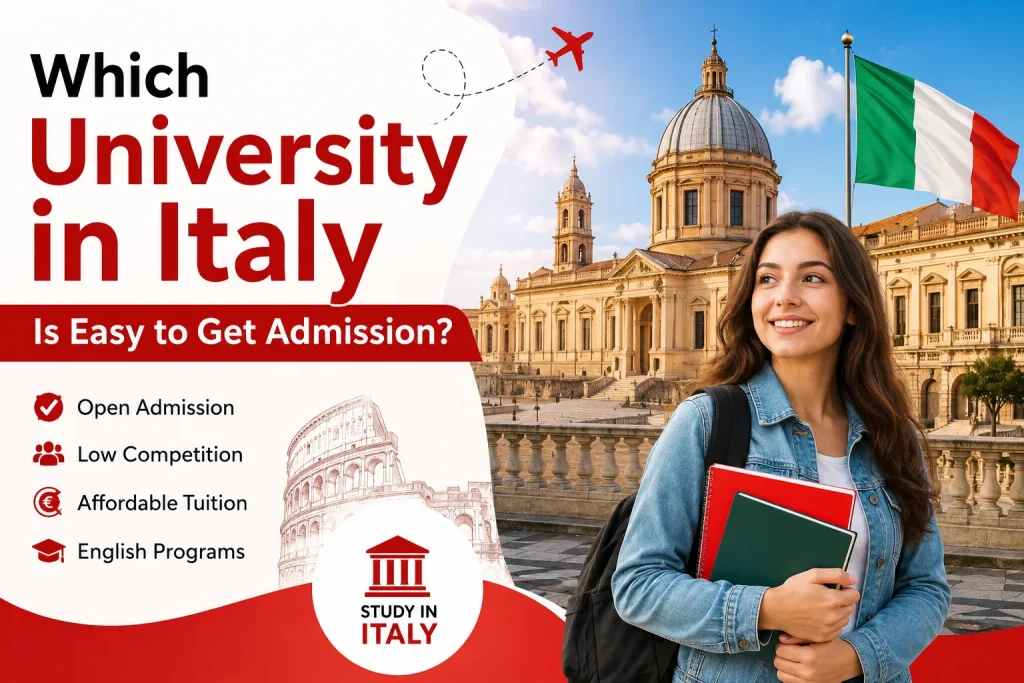
There is no single “easiest” university in Italy for everyone admission depends on your course, not just the institution. Public universities such as the University of Bari Aldo Moro, University of Palermo, University of Camerino, and University of Pisa are widely considered accessible for international students because they run open-access programmes, publish clear entry criteria, and do not set an institution-wide entrance exam for most non-restricted courses. Restricted-access fields medicine, dentistry, architecture, and some engineering tracks remain competitive everywhere in Italy, regardless of which university you choose.
This guide breaks down exactly which universities and programme types meet those conditions, and how to apply through the official Universitaly portal, Italy’s government pre-enrolment system.
Italian Universities Known for Accessible Admission
The table below compares public universities that regularly appear on “easiest to get into” lists for international applicants, based on programme structure rather than institutional prestige alone.
| University | Admission Style | English Programmes | Approx. Annual Tuition (Non-EU) |
|---|---|---|---|
| University of Bari Aldo Moro | Open access for most bachelor's courses; no entrance test for many faculties | Limited | €200 – €1,000 |
| University of Palermo | Open access; simple online application | Yes, growing list | €500 – €1,500 |
| University of Camerino (UniCam) | Open access; low competition, smaller applicant pool | Yes | €500 – €1,500 |
| University of Pisa | Open access for non-restricted courses; entrance test only for limited-enrolment programmes | Yes | €1,000 – €2,000 |
| Ca' Foscari University of Venice | Open access for most courses; income-based fee tiers | Yes | €456 – €956 |
Why Some Italian Universities Are Easier to Enter Than Others
- Open-access vs limited-access programmes: Italian degrees fall into two categories. Open-access courses admit any applicant who meets the basic academic requirement. Limited-access (numero chiuso) courses — mainly medicine, dentistry, veterinary science, and architecture — set a fixed number of seats and require an entrance test such as TOLC or IMAT.
- Smaller, regional universities see less demand: Public universities outside Rome, Milan, and Bologna typically receive fewer international applications, which makes non-restricted courses easier to enter even though the degree carries the same national recognition.
- No application fee at most public universities: Many Italian public universities do not charge an application fee, and entrance-test fees for restricted courses are usually between €25 and €100.
- GPA-based, not exam-based, eligibility: For open-access courses, eligibility is normally based on your secondary school or bachelor’s transcript rather than a standardised admission test.
Admission Requirements Sri Lankan Students Should Prepare
Academic eligibility
For a bachelor’s degree, you need a secondary school qualification equivalent to 12 years of education. Sri Lankan students entering directly after the G.C.E. Advanced Level typically need a Declaration of Value (Dichiarazione di Valore) or a CIMEA comparability statement confirming the qualification is equivalent to the Italian Diploma di Maturità. For a master’s degree, a relevant bachelor’s degree with transcripts is required.
GPA requirements
Most open-access public courses do not set a fixed minimum GPA; instead, eligibility is judged on whether your qualification is recognised as equivalent to the Italian standard. Restricted-access and scholarship-linked courses may set a minimum grade threshold, so it is worth checking how much GPA required for italy study before applying.
English proficiency: IELTS is not always mandatory
Italy’s student visa itself has no fixed IELTS requirement. What matters is whether your chosen university and course ask for it. Many Italian universities accept a Medium of Instruction (MOI) certificate from your previous school if you were taught in English, in place of an IELTS score. Where English-taught programmes do require a test, scores typically range from IELTS 5.5 to 6.0. Sri Lankan students who completed secondary or undergraduate studies in English should check with the admissions office whether an MOI letter can replace the test our detailed breakdown of Study without IELTS in italy covers this in more depth.
Core documents checklist
- Secondary school or bachelor’s certificate and transcripts (apostilled/legalised)
- Declaration of Value or CIMEA statement
- Passport valid for the full study duration
- Proof of English or Italian language proficiency (or MOI certificate)
- Proof of funds — Italy’s student visa requires roughly €6,000+ per year of study
- Health insurance covering the study period
- Universitaly pre-enrolment confirmation
How to Apply: Step-by-Step
- Shortlist open-access programmes. Filter for courses with no entrance test and confirm the English or Italian teaching language.
- Apply directly to the university. Submit transcripts and documents through the university’s own admissions portal.
- Register on Universitaly. Once conditionally accepted, non-EU applicants must complete pre-enrolment through the official Universitaly government portal, managed by Italy’s Ministry of University and Research, before a visa application can proceed.
- Book your visa appointment. Apply for the Type D national visa at the Italian consulate once the university issues your Letter of Eligibility.
- Apply for a residence permit. Within 8 working days of arriving in Italy, apply for the permesso di soggiorno at the local immigration office.
For the country-level rules around visas, work rights, and processing times, see our guide to studying in Italy from Sri Lanka, and compare Italy against other Schengen destinations in our overview of the best European countries for Sri Lankan students.
FAQ
Italian public universities do not publish a single official acceptance rate the way US universities do. However, the University of Bari Aldo Moro, University of Palermo, and University of Camerino are consistently cited as accessible because their open-access courses admit any applicant who meets the basic academic requirement.
Yes. If your previous education was conducted in English, most universities accept a Medium of Instruction certificate instead of IELTS. Where a test is required for an English-taught programme, the typical minimum is IELTS 5.5 to 6.0.
Open-access bachelor’s courses generally require only that your qualification is recognised as equivalent to 12 years of Italian secondary education — there is no universal minimum percentage. Restricted-access courses and scholarship applications may set their own GPA thresholds.
Yes, registering and submitting a pre-enrolment application on Universitaly is free. Some universities charge a small application or entrance-test fee separately, typically between €25 and €100.
Public university tuition for non-EU students typically ranges from €500 to €2,000 per year, with lower tiers available for students who qualify under Italy’s income-based ISEE fee system.