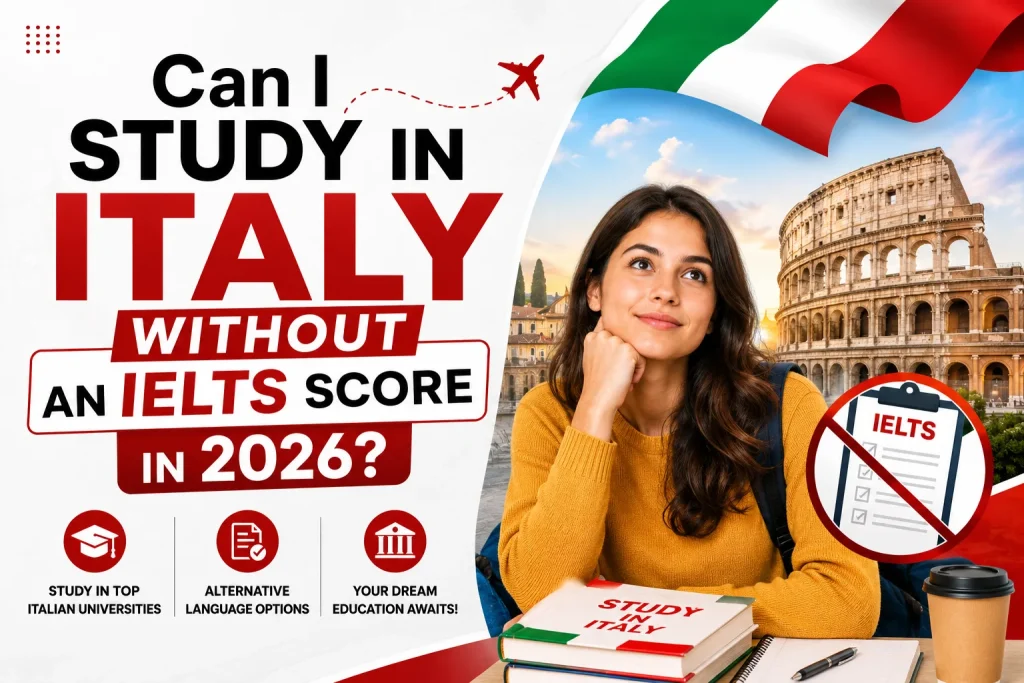
Can I Study in Italy Without an IELTS Score in 2026?
Yes, you can study in Italy without IELTS in 2026 if you choose the right university and program. Most Italian public universities accept a Medium of Instruction (MOI) certificate, an internal English test, a short interview, or scores from PTE, Duolingo, or Cambridge English as alternatives to IELTS. Admission is one part of the journey, while the student visa is a separate step where the embassy looks at your full profile including your acceptance letter, finances, and genuine intent to study. GIEC Global helps Sri Lankan students find the right Italy student visa pathway, prepare the correct documents, and avoid the small mistakes that lead to rejection
Why IELTS Feels Like a Barrier for So Many Students
IELTS has long been treated as the default proof of English ability for students who want to study abroad. Yet the exam brings real costs, limited test dates, and pressure that some students find hard to manage alongside their existing studies or work. Many students who completed their earlier education fully in English wonder why they need to sit another test just to prove something their transcripts already show. This question comes up often for students planning to study in Italy, since Italy has quietly become one of the more flexible European destinations for English taught degrees.
Alternatives to IELTS Accepted by Italian Universities
Most Italian universities that waive IELTS ask for one of the following instead.
- Medium of Instruction (MOI) certificate: an official letter from your previous school or college confirming your earlier education was delivered fully in English.
- University administered English test or interview: a short online assessment or interview conducted by the admissions team.
- PTE Academic: widely accepted as a faster and more flexible alternative to IELTS.
- Duolingo English Test: an online test some universities accept for a quicker turnaround.
- Cambridge English qualifications: such as CAE or CPE for students with a higher proficiency level.
- TOEFL iBT: accepted by many programs as a direct substitute where a formal score is still wanted.
It helps to treat these options as a menu rather than a guarantee. Requirements vary by faculty and by intake, so always confirm the current policy on the university’s own admissions page before you commit to one route.
Step by Step: How to Apply to Study in Italy Without IELTS
1. Shortlist universities and English taught programs
Start by matching your academic background and career goals to English taught bachelor or master programs in fields such as engineering, business, design, or computer science, which are widely available across Italian public universities.
2. Collect your Medium of Instruction certificate early
Request this letter from your previous institution’s registrar as soon as possible, since it can take a few weeks to process and forms the backbone of an IELTS free application.
3. Prepare an alternative test score as a backup
Even where a university does not insist on it, having a PTE, Duolingo, or TOEFL score on file gives you a stronger, more complete file and reduces the chance of a request for extra documents later.
4. Submit the standard admission application
Apply through the university’s own portal with your academic transcripts, passport copy, statement of purpose, and financial documents alongside your English proficiency proof.
5. Attend an interview if requested
Some faculties schedule a short online interview to confirm your comfort with academic English before issuing an offer.
6. Apply for your Italy student visa after receiving the offer
Once you hold a confirmed university acceptance letter, the visa stage begins. This is where working with an experienced Italy student visa consultant becomes valuable, since the embassy reviews your full profile rather than only your English proof.
Italy Student Visa Without IELTS: What the Embassy Actually Checks
A common misunderstanding is treating university admission and visa approval as the same decision. They are not. Once an Italian university accepts you without IELTS, the embassy generally relies on that acceptance letter as proof of language suitability rather than asking for a separate score. What the visa officer does examine closely is your financial proof, genuine intent to study, academic consistency, and complete documentation. Weak finances or a rushed, error filled application can affect your outcome regardless of how strong your MOI certificate is. Treating an alternative test as visa insurance rather than a box ticking exercise is a sensible, low risk habit.
Best Universities in Italy That Accept Students Without IELTS
The following public universities are commonly known to admit international students into English taught programs using MOI certificates, internal tests, or alternative scores instead of IELTS.
- University of Bologna, Italy’s oldest university, known for law, economics, and international relations.
- Politecnico di Milano, popular for engineering, architecture, and design programs.
- Sapienza University of Rome, offering a wide range of English taught master’s degrees.
- University of Padua, recognised for research strength and generous merit scholarships.
- Ca’ Foscari University of Venice, strong in economics and international studies.
- University of Pavia and University of Pisa, both offering flexible English proficiency routes for STEM programs.
Requirements can shift between academic years, so always check current admission pages directly rather than relying only on past intakes.
Tuition Fees and Scholarships in Italy
Public university tuition in Italy is genuinely affordable compared with the UK, USA, or Australia, often ranging between about €900 and €4,000 a year depending on the program and your family income bracket. Regional right to study bodies (DSU) and university specific merit awards can bring this down further, and several government backed and university funded scholarships are open to international students regardless of IELTS status. Students weighing Italy against other European options often compare it with study in Germany or wider study in Europe options, and it is worth reviewing available study abroad scholarships before finalising a country.
Common Mistakes Students Make When Skipping IELTS
- Assuming an IELTS free admission automatically means an IELTS free visa outcome.
- Requesting an MOI certificate too late, causing delays during peak intake periods.
- Applying only to private universities such as Bocconi or LUISS, which usually still require a formal test.
- Submitting incomplete financial documents and assuming language proof alone will carry the application.
- Ignoring the possibility of a B2 level English check after arrival at some Italian universities.
Do You Still Need Some English Preparation?
Skipping IELTS does not mean skipping English preparation altogether. Many Italian universities reserve the right to run a B2 level check once you arrive, and comfortable academic English will help far beyond your admission letter. Students who feel unsure about their current level often benefit from structured IELTS, TOEFL, or PTE coaching even when a university does not strictly demand a score, simply to arrive prepared and confident.
FAQ
IELTS is not a fixed legal requirement for the Italy student visa. The embassy typically relies on your university acceptance letter as proof of language suitability, though individual cases can still involve an interview.
It is an official letter from your previous school or college confirming that your earlier education, including teaching and exams, was conducted entirely in English.
Yes. Sri Lankan students with an English medium academic background can apply using an MOI certificate or an alternative test such as PTE or Duolingo, depending on the university’s own policy.
Not usually. Private institutions such as Bocconi and LUISS generally still expect a formal English test score, so check each private university’s requirements separately.
Some universities run an internal B2 level check after enrolment, so it is wise to keep your English skills sharp even after admission.