 Skip to content

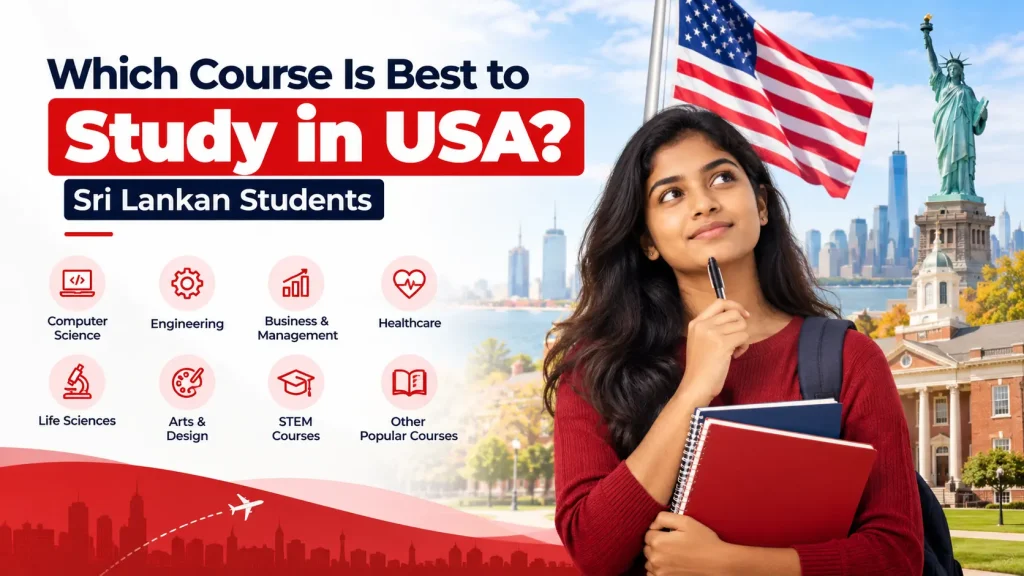
Which Course Is Best to Study in USA? Top Courses for Sri Lankan Students
A common mistake is selecting a course simply because it is popular or because someone has suggested that graduates can easily find a job after completing it. The reality can be different. Some international graduates struggle to secure employment, even after completing a master's degree. Others face difficulties because their degree does not offer the expected career opportunities or because they have not properly considered their education loan and living expenses.
Therefore, the best course to study in the USA is not necessarily the one with the highest demand. It should match your previous education, professional interests, financial situation and long-term career plans.
For students from Sri Lanka, courses such as Computer Science, Data Science, Engineering, Business Analytics, Accounting, Finance and selected Healthcare programs are worth considering. However, each has different entry requirements and career considerations.
Not sure which course is right for you?
Get guidance on suitable USA study programs based on your academic qualifications and career goals.
Get Free Course GuidanceWhich Course Is Best to Study in USA for Sri Lankan Students?
There is no single course that is best for every student. The right option depends on your academic qualifications and what you intend to do after graduation.
For example, a student who completed Mathematics for Sri Lankan A/Ls may have a suitable academic foundation for Computer Science, Engineering or Mathematics-related programs. A student from the Commerce stream may find Accounting, Finance or Business Analytics more relevant. A student with a Biology background may prefer Public Health, Biomedical Sciences or other healthcare-related subjects.
The following courses are worth researching because they offer specialised academic pathways and practical career applications.
1. Computer Science and IT
Suitable for students interested in programming, software development, artificial intelligence, cybersecurity and cloud computing.
Popular specialisations: Computer Science, Software Engineering, Cybersecurity and Information Technology.
2. Data Science and Business Analytics
Suitable for students who enjoy Mathematics, Statistics, analytical problem-solving and working with business or technical data.
Popular specialisations: Data Science, Business Analytics, Applied Statistics and Management Information Systems.
3. Engineering
Suitable for students with a strong interest in Mathematics, Physics, technology, design and solving technical problems.
Popular specialisations: Mechanical, Electrical, Civil, Industrial and Computer Engineering.
4. Business and Finance
Suitable for students interested in financial management, accounting, business operations and corporate decision-making.
Popular specialisations: Accounting, Finance, Supply Chain Management and Business Administration.
5. Nursing and Health Sciences
Suitable for students interested in healthcare delivery, medical research, public health and patient care.
Popular specialisations: Nursing, Public Health, Biomedical Sciences and Health Informatics.
6. Creative Arts and Social Sciences
Suitable for students with interests in communication, social sciences, creative industries and public policy.
Popular specialisations: Psychology, Communication, Graphic Design, Economics and Environmental Studies.
Remember that the quality of the university, course structure, industry connections, available funding and professional recognition can make a significant difference. Do not select a course based only on its title.
Find the right course for your future.
Explore suitable universities and study options in the USA.
Find Your Suitable CourseBest Courses to Study in USA for International Students
Let's look at the major study options in more detail, including what students will learn, who should apply and what they should check before choosing a university.
1. Computer Science
Computer Science is a popular option for international students who want to develop technical skills. Most programs cover programming, algorithms, computer systems, software development, databases and other areas of computing.
Depending on the university, students may also specialise in artificial intelligence, machine learning, cybersecurity, cloud computing or software engineering.
Who should choose this course?
- Students with a Mathematics or Computing background.
- Students who enjoy coding and logical problem-solving.
- Graduates who want to move into software development or technology-related roles.
Before applying, review the programming languages, technical modules, practical projects and internship support offered by the university. A course with a relevant curriculum and meaningful project work may be more useful than a program selected simply because it has a popular name.
2. Data Science
Data Science is a specialised field that combines Statistics, Mathematics, Programming and analytical techniques to understand large datasets. Students learn how to collect, process, analyse and interpret data.
Common subjects include Python, SQL, statistical modelling, machine learning, data visualisation and predictive analytics.
This course may suit students who have a quantitative background and enjoy working with numbers and technology. Students without sufficient Mathematics or Programming knowledge should check the prerequisites before applying for a master's degree.
3. Cybersecurity
Cybersecurity focuses on protecting computer systems, networks, software and information from security threats. It is a specialised technology field with subjects such as network security, digital forensics, ethical hacking, risk management and security operations.
Students interested in this area should check whether the program includes practical laboratories, security projects and recognised industry certifications or preparation opportunities.
4. Engineering
Engineering is another important area to consider when planning to study in the USA. Universities offer specialised programs in different engineering disciplines.
- Mechanical Engineering: Machines, manufacturing, thermodynamics and product design.
- Electrical Engineering: Electrical systems, circuits, electronics and power technology.
- Civil Engineering: Construction, structural design, transportation and infrastructure.
- Industrial Engineering: Manufacturing systems, operations, quality and process improvement.
- Computer Engineering: Computer hardware, embedded systems and software-related technologies.
Students who plan to pursue engineering careers should also check the program's accreditation. ABET accreditation is particularly relevant for certain engineering and computing programs, especially where professional recognition or future licensure is important.
5. Business Analytics
Business Analytics combines business knowledge with data analysis. It helps organisations understand business performance, customer behaviour, financial results and operational problems.
Students may learn SQL, Excel, Python, business intelligence, statistics, data visualisation and decision-making techniques.
This is worth considering for Sri Lankan Commerce students and graduates who want to move into analytical business roles. However, students should not assume that every Business Analytics program qualifies for the STEM OPT extension. The university's exact degree classification and CIP code must be checked.
Best STEM Courses in USA for International Students
STEM stands for Science, Technology, Engineering and Mathematics. Many international students research STEM programs because certain qualifying degrees can provide access to an additional period of post-completion practical training in the United States.
Some STEM-related courses worth exploring include:
- Computer Science and Software Engineering.
- Data Science and Applied Statistics.
- Cybersecurity and Computer Information Systems.
- Electrical and Mechanical Engineering.
- Biomedical Engineering.
- Mathematics and Applied Mathematics.
- Selected Information Systems and Analytics programs.
However, there is an important point that Sri Lankan students should understand: a course does not automatically become STEM-eligible simply because its title includes words such as Technology, Analytics, Information Systems or Data Science.
STEM OPT eligibility is determined using the applicable degree classification and the official STEM Designated Degree Program List. Students should ask the university for the precise Classification of Instructional Programs (CIP) code associated with their intended degree and check it against the Department of Homeland Security's eligibility requirements.
You can review the official information here: DHS STEM OPT Eligibility Guidance.
Planning to study a STEM course in the USA?
Get assistance exploring eligible study programs and university options.
Check Your Study OptionsIs MS in Computer Science in USA Still a Good Choice?
A Master of Science in Computer Science can be a good option for students who already have an appropriate academic foundation or relevant professional experience.
However, it is important to understand that completing an MS in Computer Science does not guarantee a software development job in the USA.
International graduates compete with other local and international applicants. Employers may also consider previous work experience, technical interview performance, practical projects and their ability or willingness to employ someone who requires immigration-related work authorisation.
Before choosing an MS in Computer Science, check the following:
- Does the program require previous Computer Science or Programming subjects?
- Does the curriculum include advanced technical subjects?
- Are there opportunities for research, internships or industry-based projects?
- Does the university provide career support specifically for international students?
- Is the exact degree eligible for the STEM OPT extension?
- Can you afford the entire program without depending on an uncertain future job offer?
Students who have studied an unrelated undergraduate subject should not assume that they can directly enter every Computer Science master's program. Some universities require prerequisite modules, while others offer pathway or conversion-style programs.
Best Business Courses in USA for Sri Lankan Students
Students who have completed Sri Lankan A/L Commerce or an undergraduate degree in Business, Management or Accounting may want to explore business-related programs in the United States.
Accounting
Accounting covers financial statements, auditing, taxation, financial reporting and management accounting. It can suit students who enjoy working with financial information and understanding how organisations manage their money.
Students who eventually wish to pursue a professional accounting qualification should check the relevant licensing and education requirements, including state-specific CPA eligibility rules where applicable.
Finance
Finance programs cover investment analysis, corporate finance, financial markets, risk management and financial planning. Students may choose specialised courses in financial analytics, investment management or quantitative finance.
Supply Chain Management
Supply Chain Management focuses on purchasing, logistics, transportation, inventory, procurement and operations. It can be relevant for students interested in international trade, manufacturing and business operations.
Master of Business Administration (MBA)
An MBA is generally more appropriate for professionals who already have relevant work experience and want to develop their management or leadership skills. It is not automatically the best postgraduate option for every student.
Students considering an MBA should compare the university's teaching quality, industry links, internship opportunities, total tuition fees and employment outcomes. Some MBA programs also have STEM-designated concentrations, but students must verify the exact degree classification rather than assuming all MBA programs qualify.
Best Healthcare and Nursing Courses in USA for International Students
Students with a Biology or science background may consider healthcare and life science programs. The right option depends on whether they prefer clinical work, research or healthcare management.
Nursing
Focuses on patient care, healthcare practice, clinical training and nursing theory.
Check: State nursing board requirements, NCLEX eligibility, clinical placement arrangements and program accreditation.
Public Health
Focuses on disease prevention, population health, epidemiology and health policy.
Check: Research opportunities, practical training and possible specialisations.
Biomedical Sciences
Combines biology, laboratory science, human health and medical research.
Check: Laboratory facilities, research experience and postgraduate career requirements.
Health Informatics
Combines healthcare knowledge with digital systems, medical information and data management.
Check: The balance between healthcare, IT, statistics and practical experience.
One important consideration for Sri Lankan students is that completing a healthcare degree does not automatically provide permission to practise in the United States. Certain clinical occupations require separate examinations, professional registration or state licensing.
Therefore, students who specifically want to become nurses or enter another regulated healthcare profession should confirm licensing eligibility before accepting an offer.
Best Courses to Study in USA After A Levels in Sri Lanka
Students who have completed Sri Lankan GCE Advanced Level examinations can explore undergraduate programs at American colleges and universities. However, admission requirements differ between institutions and courses.
Your A/L subjects, grades, English proficiency, school records and any additional admission requirements will be considered according to the university's own policy.
Here is a practical starting point based on your A/L stream.
- Computer Science
- Mechanical Engineering
- Electrical Engineering
- Data Science
- Applied Mathematics
- Biomedical Sciences
- Public Health
- Biological Sciences
- Biotechnology
- Health Sciences
- Accounting
- Finance
- Business Administration
- Economics
- Supply Chain Management
- Psychology
- Communication Studies
- International Relations
- Graphic Design
- Social Sciences
This is a guide, not an admission guarantee. For example, Engineering and Computer Science programs may require specific Mathematics subjects. Some science programs may have laboratory or subject prerequisites. Students should check the entry requirements of each university before applying.
Best Master's Courses in USA for Sri Lankan Graduates
Sri Lankan students who already hold a bachelor's degree should select their postgraduate program carefully. A master's degree should ideally build on their previous education or provide a clearly explained career progression.
For example:
- BSc in Computer Science: MS in Computer Science, Cybersecurity or Software Engineering.
- BSc in Mathematics: MS in Data Science, Statistics or Applied Mathematics.
- Bachelor's in Business: MS in Business Analytics, Finance or Supply Chain Management.
- Bachelor's in Accounting: MS in Accounting, Finance or Financial Analytics.
- Bachelor's in Engineering: MS in a relevant engineering specialisation.
- Bachelor's in Biology: MS in Biomedical Sciences, Public Health or Biotechnology.
A change of academic direction may be possible, depending on the university's admission policy. However, students should be prepared to explain their academic progression and demonstrate that they have the necessary background for the new course.
Challenges Our Applicants Have Faced When Planning to Study in USA
During our interactions with students planning to study in the United States, we have noticed that many applicants have concerns beyond university admission. They want to understand whether their chosen qualification will support their career goals, what employment opportunities may be available after graduation and whether they can manage the financial commitment.
Some of our applicants have also raised concerns based on the experiences of graduates and international students already studying or working in the USA. These are important considerations that every Sri Lankan student should understand before selecting a university and course.
1. Difficulty Finding Employment After Graduation
One of the concerns raised by our applicants is whether completing a bachelor's or master's degree in the USA will make it easier to secure employment after graduation.
The reality is that international graduates may face difficulties finding suitable employment, even after completing a recognised qualification. Employers consider technical skills, previous work experience, practical knowledge, interview performance and work authorisation requirements.
For example, a student completing a Master's in Computer Science may have good academic results but still need practical programming experience, relevant projects and strong technical interview skills to compete for available positions.
Our recommendation: Before selecting a course, research the potential career paths, practical modules, internship opportunities and career support offered by the university. Start developing relevant professional skills while studying rather than waiting until graduation.
2. Choosing a Course Only Because It Is STEM-Eligible
Another concern we have encountered among applicants is the belief that choosing a STEM course will automatically provide better employment opportunities or guarantee an additional period of work authorisation in the USA.
Although certain eligible STEM degrees can provide access to a 24-month STEM OPT extension, this does not guarantee employment, employer sponsorship or permanent residence.
We advise applicants not to select a course solely because it is advertised as STEM-eligible. The course should also match their previous academic qualifications, interests and career objectives.
Students should verify the exact Classification of Instructional Programs (CIP) code of their intended degree and check its eligibility against the official STEM Designated Degree Program List.
3. Concerns About Education Loans and High Tuition Fees
Many Sri Lankan families make a significant financial investment when sending their children to the United States. Some students use personal savings, family support or education loans to cover tuition fees and living expenses.
One concern raised by our applicants is how they will manage these financial commitments after graduation, particularly when employment opportunities and future earnings are uncertain.
Students should not assume that they will be able to repay their entire education loan through part-time employment or immediately after completing their degree.
Our recommendation: Calculate the complete cost of education, including tuition fees, accommodation, food, insurance, transportation and other expenses. Compare universities based on affordability and available scholarships before making a final decision.
4. Selecting a Course Without Checking Its Practical Value
Another important issue is selecting a course based only on its title or popularity. For example, Business Analytics, Data Science and Information Technology are popular choices among international students. However, not all programs provide the same technical knowledge or practical experience.
Two universities may offer a Master's in Business Analytics, but their course structures may be very different. One program may include Python, SQL, Statistics and industry projects, while another may focus more heavily on general management subjects.
This difference can influence the skills students develop during their studies.
Our recommendation: Always review the complete course curriculum. Look for practical assignments, research opportunities, technical modules, internship arrangements and industry-related projects.
5. Assuming That an Internship or Degree Guarantees a Job
Some applicants believe that completing an internship during their studies will automatically help them secure a full-time position after graduation. However, this is not always the case.
An internship can provide useful professional exposure, but employment decisions depend on the employer's requirements, available vacancies, the candidate's skills and applicable work authorisation rules.
International students should understand the rules governing F-1 employment and practical training before accepting any work opportunity.
Our recommendation: Choose a university with strong academic and career support. Develop your professional network, attend career events, gain relevant experience where authorised and prepare for the job market well before graduation.
Have questions about studying in the USA?
Discuss your academic background, study plans and university options with our team.
Speak to Our Education CounsellorWhat Are STEM OPT Eligible Courses in USA?
STEM OPT is an important consideration for international students who want to understand their permitted post-study practical training options in the United States.
Generally, eligible F-1 students may receive up to 12 months of post-completion Optional Practical Training (OPT). Students who meet the relevant requirements and have a qualifying STEM degree may apply for an additional 24-month STEM OPT extension.
However, STEM OPT is not automatic. Students must satisfy the applicable degree, employer, training and application requirements.
The employer requirements are also important. For example, STEM OPT employment requires an eligible employer enrolled in E-Verify, at least 20 hours of work per week and a completed Form I-983 training plan, subject to the applicable rules.
Before selecting a university, ask these questions:
- What is the exact CIP code of the degree?
- Is this CIP code included in the current DHS STEM Designated Degree Program List?
- Does the university's international student office confirm the program's STEM OPT eligibility?
- What are the practical training and employer requirements?
- What happens if you cannot secure qualifying employment during your authorised training period?
Read the official information: Study in the States – STEM OPT Eligibility.
Also remember that OPT is temporary practical training connected to your field of study. It is not a permanent residence visa, and it does not guarantee H-1B sponsorship or another long-term immigration outcome.
How Should Sri Lankan Students Choose the Right Course in USA?
A good course decision should be based on more than the popularity of a particular subject. We recommend comparing the following factors before submitting applications.
1. Check Your Previous Academic Qualifications
Start with your O/L, A/L or undergraduate qualifications. Check whether you meet the course prerequisites. For postgraduate programs, review the required undergraduate subjects, academic results and any professional experience requirements.
2. Identify the Actual Career You Want
Think about the kind of work you want to do after graduation. For example, students interested in software development should compare Computer Science and Software Engineering programs rather than selecting a general business qualification.
3. Check the Complete Course Curriculum
Two universities may offer the same degree title but teach different subjects. Compare modules, specialist options, laboratory work, research opportunities, assessment methods and practical projects.
4. Research Career Support for International Students
Ask whether the university provides career counselling, job fairs, employer events, technical interview preparation and guidance on authorised practical training. Do not assume that every internship advertised by a university is automatically available to every F-1 student.
5. Verify STEM Eligibility Where Relevant
If additional STEM OPT eligibility is important to your study plans, check the exact CIP code and official eligibility list before making a financial commitment.
6. Compare Universities Based on Affordability
A university with a high tuition fee is not always the best choice. Compare the full cost of attendance, scholarship availability, location, living expenses and the resources available to students.
7. Consider Your Career Plans in Sri Lanka
Not every student plans to stay in the United States after graduation. Some students intend to return to Sri Lanka or build careers in another country.
If this is your plan, investigate whether the qualification is recognised or valued by employers in your intended sector. For regulated careers, check the relevant professional registration requirements in the country where you plan to work.
What Is the Cost of Studying in USA for Sri Lankan Students?
The cost of studying in the United States depends on the university, program, location and type of accommodation. A public university, private university and community college may have very different fee structures.
Students should calculate the total cost rather than comparing tuition fees alone.
Your financial plan should include:
- Annual tuition fees.
- University and administrative fees.
- Accommodation and food expenses.
- Health insurance.
- Books, study materials and equipment.
- Local transport and personal expenses.
- Airfare and other travel expenses.
- Visa-related and other applicable charges.
Sri Lankan students should also consider currency exchange fluctuations when preparing an education budget. A program that looks affordable at the time of admission may become more expensive if the exchange rate changes.
Do not assume that part-time employment will cover your tuition or living expenses. F-1 students are subject to specific employment restrictions, and future employment income is not guaranteed.
Students can explore university scholarships, merit-based awards, graduate assistantships and other institutional financial support. However, competition and eligibility requirements vary, and financial aid deadlines may coincide with admission deadlines.
Useful official resource: EducationUSA – Finance Your U.S. Studies.
Ready to plan your USA education journey?
Submit your details to explore suitable courses and universities.
Start Your USA Study ApplicationWhat Should Sri Lankan Students Check Before Applying for a USA Student Visa?
Getting admission to a university is only one part of the study abroad process. Students must also understand the F-1 student visa requirements.
After receiving admission from an eligible institution, the university generally issues Form I-20 for an eligible academic program. Students then follow the applicable SEVIS and student visa procedures.
The US Department of State explains that student visa applicants may need to demonstrate their academic preparation, their intent to depart the United States upon completion of their course and how they will pay their educational, living and travel expenses.
For this reason, your choice of course should be academically appropriate and supported by a realistic financial plan.
An applicant should be able to explain:
- Why they selected the particular course.
- How the course relates to their previous qualifications.
- Why they selected the university.
- How they will finance their education and living expenses.
- How the qualification fits their genuine long-term career plans.
Students should apply to an appropriate SEVP-certified institution and follow the latest visa instructions.
Official resource: US Department of State – Student Visa Information.
Final Recommendation: Which Course Should You Choose?
For Sri Lankan students planning to study in the USA, Computer Science, Engineering, Data Science, Business Analytics, Accounting, Finance and selected Healthcare programs are all worth considering.
However, we would not recommend choosing a course simply because it is popular among other international students. Your previous academic qualifications, career interests and financial situation should guide your decision.
For example, a student with a Mathematics background and an interest in coding may find Computer Science a better option than a general Business degree. A Commerce student who enjoys financial analysis may benefit more from Accounting, Finance or Business Analytics. A Biology student interested in healthcare may consider Public Health or Biomedical Sciences, depending on their future career plans.
Most importantly, understand that studying in the USA is an educational investment. A degree does not guarantee a job, a particular salary, employer sponsorship or permanent residence. Research the course carefully, compare universities and prepare for the financial responsibilities before making your final decision.
Planning to Study in USA from Sri Lanka?
Choosing the right course and university is an important step towards achieving your international education goals. A proper assessment of your A/L results, previous qualifications, preferred subject, study budget and career plans can help you identify suitable options.
The team at GIEC Global Sri Lanka can help you explore suitable study options and understand the university application process.
Start planning your US education journey with a course shortlist that matches your academic background and future goals.
Get Started TodayGet Free Guidance to Study in USA from Sri Lanka
Looking for the right course and university in the USA? Share your details with GIEC Global Sri Lanka. Our team can help you explore suitable study programs based on your academic qualifications, preferred course and budget.
Submit your enquiry below to get started.
Frequently Asked Questions About the Best Courses to Study in USA
1. Which course is best to study in USA for Sri Lankan students?
Computer Science, Engineering, Data Science, Business Analytics, Accounting, Finance and selected Healthcare programs are worth considering. The best choice depends on your previous education, career interests, university options and financial situation.
2. What are the best courses to study in USA after A/Ls?
After Sri Lankan A/Ls, students can explore undergraduate programs in Computer Science, Engineering, Business, Accounting, Finance, Biological Sciences, Psychology and other subjects. Admission depends on the university's academic requirements and the student's A/L qualifications.
3. Which course is best in USA after Commerce A/Ls?
Students from the Commerce stream can consider Accounting, Finance, Economics, Business Administration, Supply Chain Management and Business Analytics. The right option depends on whether they prefer financial, analytical or management-related careers.
4. Which courses can Science students study in USA?
Science students can explore Engineering, Computer Science, Mathematics, Biomedical Sciences, Biological Sciences, Biotechnology and Public Health, depending on their A/L subjects and university entry requirements.
5. Is Computer Science a good course to study in USA?
Computer Science can be a suitable choice for students interested in programming, software development, AI and cybersecurity. However, completing a degree does not guarantee employment. Students should develop practical skills, complete projects and research employment opportunities before choosing a university.
6. Is Data Science a good master's degree in USA?
Data Science may suit graduates with a background in Mathematics, Statistics, Computing or related subjects. Before applying, check the programming, statistical and mathematical prerequisites as well as the curriculum and practical project opportunities.
7. Which STEM courses are available in USA?
Common STEM fields include Computer Science, Engineering, Mathematics, Statistics and certain biological and physical science programs. The exact STEM OPT eligibility of a specific degree depends on its CIP code and the official DHS list.
8. Do all STEM courses qualify for a 24-month STEM OPT extension?
No. A course must meet the applicable STEM degree requirements, including the relevant CIP classification. Students must also satisfy the employer and training requirements. Always verify the exact course with the university's international student office.
9. Can Sri Lankan students study Nursing in USA?
Yes, eligible international students can explore Nursing programs in the USA. However, they should verify university admission, clinical placement arrangements, professional accreditation and the relevant state nursing board's requirements before applying.
10. Is an MBA a good course to study in USA?
An MBA can be valuable for professionals with relevant work experience who want to develop management, leadership, finance or business skills. Students should compare tuition fees, curriculum, employer connections and career outcomes before selecting a program.
11. Can I get a job in USA after completing my master's degree?
Graduates may be eligible for practical training under OPT if they meet the requirements. However, securing a job depends on the student's skills, experience, field of study, employer requirements and work authorisation. A job offer is not guaranteed.
12. Is STEM OPT available for Business Analytics students?
Some Business Analytics programs may qualify, while others may not. The degree's exact CIP code is important. Students should confirm the code and eligibility directly with the university before accepting admission.
13. What is the most affordable course to study in USA?
There is no single cheapest course across all US universities. Total costs vary according to the institution, program duration, location and accommodation. Students should compare the complete cost of attendance and available scholarships rather than choosing only by subject.
14. Are scholarships available for Sri Lankan students in USA?
Yes. Some US universities offer merit scholarships, need-based support where available, graduate assistantships and other financial awards to eligible international students. Requirements and funding amounts differ between institutions, so students should check the university's official scholarship information and deadlines.
15. How can I choose the right university and course in USA?
Compare the course curriculum, admission requirements, total tuition and living expenses, accreditation, practical learning opportunities, university support and relevant STEM OPT eligibility. Your choice should also match your previous education and realistic career goals.
