
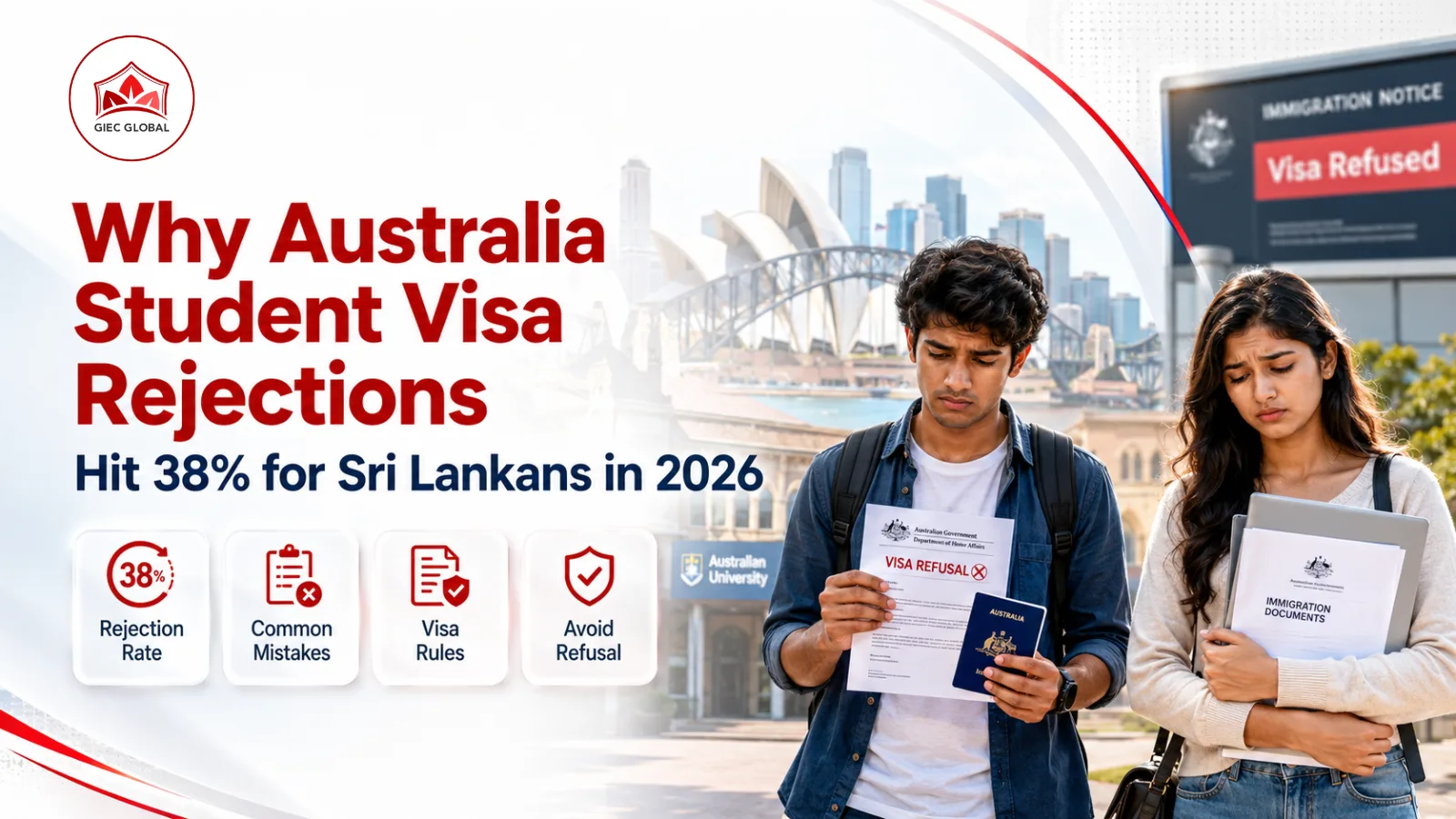
Why Australia Student Visa Rejections Hit 38% for Sri Lankans in 2026
What changed, why applications are being refused, and how to apply the right way — explained by GIEC Global.
What's Really Behind the Rise in Rejections?
If you’ve been following the news around Australia study visas lately, you’ve probably noticed the same headline everywhere — rejection rates for Sri Lankan applicants have climbed to their highest point in years.
The truth is, this isn’t about Australia closing its doors. The Department of Home Affairs has tightened how it reviews every application, with far more attention on genuine intent, financial proof, and consistency across documents.
Understanding exactly what changed is the first step to making sure your application doesn’t become part of next year’s statistic.

Not sure if your profile is at risk of refusal?
Book a Free Visa Risk AssessmentThe Real Reasons Sri Lankan Applications Get Refused
- A weak or generic Genuine Student (GS) statement that reads like a template
- Financial evidence that doesn't add up — unexplained deposits or mismatched sponsor income
- Unclear study progression between qualifications
- Long, unexplained gaps between school and the visa application
- Health and character documents submitted late or incompletely
- A course or provider that doesn't match the applicant's stated career goals
- Applying without proper guidance through unregistered agents
Officers assess your application as a whole story — your education history, finances, and reasons for choosing Australia all need to point in the same direction. One inconsistency is often enough to raise doubt.
The Genuine Student Requirement — Why It Now Decides Most Outcomes
In late 2024, Australia replaced the old Genuine Temporary Entrant (GTE) requirement with the Genuine Student (GS) requirement — a change now responsible for a large share of 2026 rejections among Sri Lankan applicants.
| Factor | Before (GTE) | Now (GS Requirement) |
|---|---|---|
| Main focus | Intention to return home | Genuine reason for the course/provider |
| Assessment style | General intent questions | Detailed, evidence-backed statement |
| Career link | Loosely assessed | Clear, logical link required |
| Financial scrutiny | Standard | Higher, with source-of-funds checks |
| English test level | Course entry level only | Reviewed against course & career fit |
Get your Genuine Student statement reviewed before you submit.
Request a GS Statement ReviewFinancial Documentation Mistakes That Quietly Sink Applications
Money is where most Sri Lankan applications lose credibility — not because families don’t have the funds, but because the paperwork doesn’t tell a clean, believable story.
Sponsor documentation is another frequent issue. Income, savings history, and relationship to the applicant all need to be documented clearly and consistently across every form.
Almost all of these issues are fixable — but only if they’re caught before submission, not after a refusal letter arrives.
Avoid a financial refusal before it happens.
Book a Free Document CheckHow to Strengthen Your Application Before You Apply
- Start preparing finances at least 4–6 months before applying
- Choose a course that logically connects to previous studies and career goals
- Write a personal, evidence-backed Genuine Student statement
- Keep every document consistent across all forms
- Address study or employment gaps directly and honestly
- Work with a registered, experienced consultancy
There is no such thing as a "guaranteed" visa. Any agent promising a 100% guarantee is a red flag — genuine consultants build a strong, honest case instead.
Applying Alone vs. Applying with GIEC Global
| Aspect | Applying on Your Own | Applying with GIEC Global |
|---|---|---|
| GS statement | Self-written, often generic | Personalised & reviewed by specialists |
| Financial documentation | No professional review | Checked against DHA expectations |
| Course & provider selection | Based on rankings/ads | Matched to your background & goals |
| Application tracking | Manual, no visibility | Managed end-to-end with updates |
| Risk of refusal | Higher | Significantly reduced |
Ready to Apply With Confidence?
Get a free, honest assessment of your Australia student visa application from GIEC Global Education and Migration – Sri Lanka.
Book Your Free Consultation TodayFAQs
What are the main Australia student visa requirements for Sri Lankan applicants?
You’ll need a confirmed enrolment (CoE) from a registered provider, proof of sufficient funds for tuition and living costs, health insurance (OSHC), health and character checks, and a Genuine Student statement explaining why you’ve chosen this course and provider.
Why is the Australia student visa rejection rate rising in 2026?
The Department of Home Affairs has increased scrutiny under the newer Genuine Student framework, focusing more closely on financial consistency, course-to-career logic, and the quality of an applicant’s personal statement — which has led to more refusals for applications that lack detail or consistency.
Can I apply for an Australian student visa without IELTS?
Yes, some providers accept alternative English proficiency tests (like PTE or TOEFL) or offer English-medium pathway programs for students who don’t meet the direct IELTS requirement. The right option depends on the course and institution you’re targeting.
What documents do I need to apply for an Australia study visa?
Core documents include your Confirmed Enrolment (CoE), passport, financial evidence, academic transcripts, English test results, OSHC, a Genuine Student statement, and health and character certificates. Additional documents may be required depending on your profile.
How do I choose the best agent for an Australia student visa in Sri Lanka?
Look for a consultancy that’s transparent about requirements, doesn’t promise guaranteed outcomes, reviews your financial documents in detail, and has direct experience with Genuine Student statements — rather than one that simply processes paperwork.
Are there scholarships available for Sri Lankan students going to Australia?
Yes, several Australian universities and the Australian government offer partial and full scholarships for Sri Lankan students, usually based on academic merit or specific course areas. Eligibility and amounts vary by institution.
What's the most affordable pathway to study in Australia?
Choosing a regional campus, a diploma-to-degree pathway program, or a course with lower international tuition fees can significantly reduce overall costs. A consultant can help match your budget with course and provider options that keep your GS statement realistic too.