 Skip to content

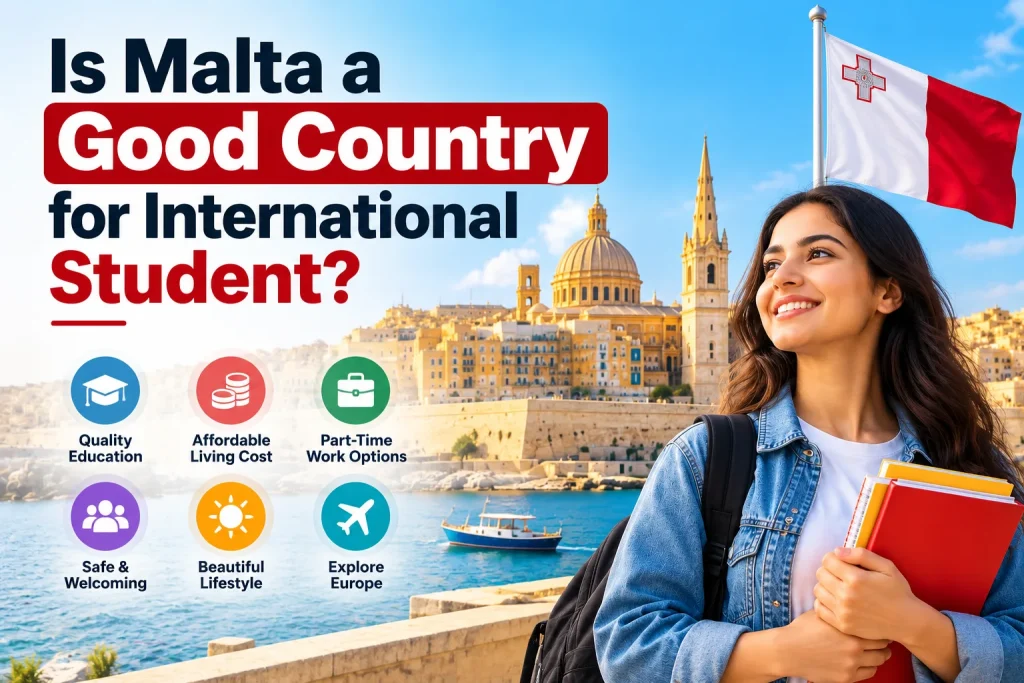
Is Malta a Good Country for International Students? A Complete 2026 Guide
Malta has become an attractive destination for international students who want to study in an English-speaking European country. With internationally recognised qualifications, English-taught courses, a welcoming multicultural environment, and the chance to experience European life, Malta is an option for students from countries such as India and Sri Lanka.
However, before choosing Malta, many students ask an important question: Is Malta a good country for international students?
The answer depends on your academic goals, budget, career plans and expectations after graduation. Malta offers clear advantages, such as part-time work opportunities during studies and a post-study permit to look for work after graduation. At the same time, it has a smaller job market and stricter rules than some students expect. Understanding both sides can help you make a confident, well-informed decision. If you are unsure whether Malta suits your profile, our study abroad consultants at GIEC Global can guide you.
In this guide, we explain what Malta offers international students, including universities, tuition fees, cost of living, the visa process, part-time work rules, post-study options and career prospects, along with the real challenges students should consider before applying.
Why Malta Is Attracting International Students
English is an official language
English and Maltese are both official languages, and nearly all university courses are taught in English. Daily life, from shopping to dealing with government offices, is easy in English. For Indian students, this removes the need to learn a new language such as German, French or Italian before or during their studies.
An EU member with recognised qualifications
Malta is a full member of the European Union and the Schengen Area. Degrees from licensed Maltese institutions are aligned with the European Qualifications Framework (EQF), which means your qualification is recognised across Europe. As a Schengen residence permit holder, you can also travel to other Schengen countries for short visits during holidays.
Growing international student community
International enrolment in Malta's higher education sector has been rising steadily, and students come from dozens of countries every year. This creates a multicultural campus environment where you can build a global network of friends and professional contacts.
Strong niche industries
Malta's economy is driven by fast-growing sectors such as iGaming, FinTech, financial services, information technology, artificial intelligence, cybersecurity, healthcare, tourism and hospitality. Many of these industries actively recruit English-speaking international talent.
Mediterranean lifestyle and safety
With around 300 days of sunshine a year, beautiful beaches, UNESCO World Heritage sites and a relaxed island pace, Malta offers a high quality of life. It is also widely considered one of the safer countries in Europe for students.
Top Universities and Colleges in Malta
Malta's higher education sector is small but diverse, with one public university and a number of licensed private institutions.
University of Malta (L-Università ta' Malta)
The University of Malta is the country's only public university and its oldest institution of higher learning. Located in Msida, it has 14 faculties, along with numerous research institutes and centres. It offers bachelor's, master's and doctoral programmes in fields such as medicine, engineering, ICT, business, law, arts and sciences. The university is part of the Erasmus+ programme, which allows students to spend a semester or year at a partner university in another European country.
Licensed private institutions
Malta also has several licensed private higher education providers, including the American University of Malta, GBS Malta, and others offering programmes in business, management, computing, hospitality and healthcare. Some private colleges deliver degrees in partnership with universities in the UK and other countries. Private institutions often have smaller classes, more flexible intakes and a stronger focus on practical, industry-ready skills.
Institute of Tourism Studies (ITS)
For students interested in hospitality, culinary arts and tourism management, the Institute of Tourism Studies is a well-known option, closely linked to Malta's large tourism industry.
Always check that your chosen institution and programme are licensed and that the qualification is recognised by MQRIC (the Malta Qualifications Recognition Information Centre). Higher education programmes for student visas generally need to be at MQF Level 5 or above.
Popular Courses for International Students in Malta
- Computer Science, Software Development and Data Science
- Artificial Intelligence and Cybersecurity
- Business Administration and MBA
- Finance, Accounting and FinTech
- iGaming Management
- Hospitality, Tourism and Culinary Arts
- Healthcare Management and Nursing
- Medicine and Surgery
- Marine Sciences and Environmental Studies
- Digital Marketing and Communications
Tuition Fees in Malta for International Students
EU and EEA students study free at the University of Malta for most programmes, but students from India and other non-EU countries pay tuition fees. Fees vary widely depending on the institution, level and subject.
| Institution Type | Approximate Annual Tuition (Non-EU) | Notes |
|---|---|---|
| University of Malta (public) | Around €1,080 to €10,800+ | Specialised courses such as medicine can cost considerably more |
| Private higher education institutions | Around €4,000 to €15,000 | Fees vary by provider and programme |
| Foundation programmes | Varies by provider | For students who do not meet direct entry requirements |
Additional costs may include application fees, assurance deposits, bench fees for lab-based programmes and examination fees. Always confirm the latest fee for your specific programme on the institution's official website.
Scholarships
The University of Malta offers tuition fee waivers of 40% to 100% for high-achieving non-EU students accepted into eligible Master by Research and PhD programmes. Some private institutions also offer merit-based discounts. In addition, Malta has a tax-credit scheme under which graduates on eligible courses who go on to work in Malta may be able to reclaim a portion of their tuition fees, reported to be up to 70%. Check eligibility carefully before relying on it.
Cost of Living in Malta for Students
Malta is one of the more affordable English-speaking destinations in Western Europe. Most international students spend between €700 and €1,100 per month, excluding tuition. Here is a typical breakdown:
| Expense | Approximate Monthly Cost |
|---|---|
| Shared apartment (per person) | €350 to €550 (higher near the coast and university areas) |
| Private studio | €650 to €950 |
| Groceries | €200 to €350 |
| Utilities (electricity, water, internet) | €50 to €150, higher in summer and winter |
| Public transport | Free for eligible full-time students with a Tallinja Card |
| Mobile phone | €10 to €20 |
| Personal and leisure | €80 to €150 |
Money-saving tips
- Live in inland towns rather than Sliema, St Julian's or Msida, where rent is highest. This can cut rent by 30% to 40%.
- Register for a student Tallinja Card to travel free on the island's bus network.
- Shop at discount supermarkets and cook at home during the week.
- Budget extra for electricity, as older buildings can be costly to heat or cool.
Malta Student Visa Process for Indian Students
Indian students planning to study in Malta for more than 90 days need a national Type D long-stay visa, followed by a study residence permit after arrival.
Key requirements
- An offer letter for a full-time programme at a licensed institution leading to a recognised qualification (generally MQF Level 5 or above for higher education)
- Proof of tuition fee payment
- Proof of sufficient funds; University of Malta guidance asks for bank statements showing at least €950 for each month of your intended stay, excluding tuition, with at least three months of transaction history
- Comprehensive health insurance
- Proof of accommodation
- Valid passport
- English proficiency proof such as IELTS, TOEFL or an equivalent accepted by your institution
- Academic transcripts and certificates, with translations done only by approved translators where required
Step-by-step process
- Choose your programme and institution: Shortlist licensed institutions and confirm that the course is recognised.
- Apply for admission: Submit your application before the deadline. For the University of Malta's October intake, non-EU applicants who need a visa usually face an early deadline around July.
- Receive your offer letter: Accept the offer and pay the required tuition or deposit.
- Arrange funds and insurance: Prepare bank statements and buy health insurance that meets visa rules.
- Apply for the Type D visa: Submit your application through the designated visa application centre, such as VFS Global in India.
- Travel to Malta: Once your visa is approved, book your flight and accommodation.
- Apply for your residence permit: After arrival, apply to Identità for your study residence permit (e-Residence card).
- Register at your institution: Complete enrolment and start your studies.
Can International Students Work in Malta?
Yes, but Malta's system is more regulated than many students expect. Here is how it works for non-EU higher education students:
- You can work up to 20 hours per week during term time, and you may be able to work more during official holidays.
- You usually need to wait about 90 days after arrival before starting paid work.
- You need a student employment licence, which your employer applies for through Jobsplus. The licence is tied to a specific employer, so you cannot simply switch jobs without a new approval.
- Licences are often issued for short periods and must be renewed in line with your residence permit.
- You must maintain good attendance (commonly at least 75%) and satisfactory academic progress, as these affect both your residence permit and your work rights.
Common part-time jobs include roles in hospitality, retail, customer service, language schools and administration. Pay usually starts around Malta's minimum wage, which is roughly €5.74 per hour in 2026, with many student roles paying €6 to €9 per hour. Part-time work helps with living expenses, but you should not plan to cover your tuition fees through part-time earnings.
Post-Study Work Opportunities in Malta
After successfully completing a programme at MQF Level 5 or above, eligible graduates can apply for a post-study residence permit valid for up to 9 months to look for work in Malta. Important points to remember:
- It is a one-time, non-extendable permit, so plan your job search carefully.
- You must apply before your student residence permit expires.
- Once you find a job, you can move to a Single Permit (combined work and residence permit) or, for highly qualified roles, an EU Blue Card.
- First-time Single Permit applicants are now required to complete a mandatory online pre-departure course about living and working in Malta.
Compared with countries that offer two- or three-year post-study work visas, Malta's window is shorter. This means students should start networking, applying for internships and building their CV well before graduation.
Can you get PR in Malta after studying?
Studying in Malta does not directly lead to permanent residency. Malta's Permanent Residence Programme is investment-based. However, after building up years of legal residence through employment, non-EU nationals may become eligible for long-term residence status under EU rules. Your path to settling in Malta is therefore tied to securing and keeping skilled employment after graduation.
Pros and Cons of Studying in Malta
| Advantages | Challenges |
|---|---|
| English-speaking country with English-taught courses | Small number of universities and limited course variety |
| EU degree recognised across Europe | Small job market compared with larger EU countries |
| Lower tuition and living costs than the UK or Ireland | Salaries are lower than in Western European capitals |
| Part-time work allowed up to 20 hours per week | 90-day waiting period and employer-specific work licences |
| Post-study permit of up to 9 months | Shorter post-study window than many competing countries |
| Schengen travel opportunities | Rising rents in popular coastal areas |
| Safe, sunny and multicultural lifestyle | Hot summers, crowded tourist season and traffic congestion |
| Growing sectors like iGaming, FinTech and IT | No direct study-to-PR pathway |
Who Should Choose Malta?
Malta can be an excellent choice if you:
- Want a European degree taught entirely in English
- Have a moderate budget and want lower costs than the UK, Ireland or Australia
- Are interested in IT, iGaming, FinTech, business, hospitality or healthcare
- Prefer a smaller, safer and more relaxed study environment
- Want to explore Europe while studying
Malta may not be the best fit if your main goal is a long post-study work visa, a direct pathway to permanent residency, or access to a very large job market with high salaries. In that case, countries such as Germany, Ireland, Australia or Canada might align better with your goals.
Common Mistakes Students Make When Choosing Malta
Not checking accreditation
Enrolling in an unlicensed institution or a programme that is not recognised can lead to visa refusal and a degree that holds little value. Always verify accreditation first.
Showing insufficient funds
Weak bank statements, sudden large deposits or less than the required monthly amount are common reasons for visa rejection.
Assuming you can work immediately
Many students arrive expecting to start work in their first week. In reality, there is a waiting period and an employer-led licence process.
Underestimating accommodation costs
Rents near the university and the coast can be high. Budget realistically and consider inland towns.
Missing deadlines
Non-EU applicants often face earlier deadlines because of visa processing time. Applying late can cost you an entire intake.
Ignoring post-study planning
With only a 9-month job search window, students who wait until after graduation to start networking often struggle to find work in time.
How GIEC Global Helps You Study in Malta
Studying abroad is a big investment, and the right guidance makes all the difference. At GIEC Global, we support Indian students at every step of their Malta journey:
- Honest profile evaluation to check whether Malta suits your goals
- Course and university shortlisting based on your academics, budget and career plans
- Verification of accreditation and recognition
- Application and documentation support
- Financial documentation guidance to meet visa requirements
- Complete student visa assistance
- Pre-departure briefing on accommodation, part-time work rules and life in Malta
Our experts stay updated on the latest visa rules and institution requirements, so your application is built on accurate information. Speak with a GIEC Global counsellor to plan your study abroad journey with confidence.
Conclusion
So, is Malta a good country for international students? For many Indian students, the answer is yes. Malta offers an English-speaking environment, EU-recognised degrees, affordable tuition and living costs, part-time work rights, a post-study job search permit, and a safe, sunny lifestyle in the heart of the Mediterranean. At the same time, it has a small job market, a shorter post-study window and no direct route to permanent residency, so it works best for students who plan carefully and choose courses linked to Malta's growing industries. With the right course, a realistic budget and expert guidance, Malta can be a smart and rewarding first step into a European career.
Frequently Asked Questions
Is Malta good for Indian students?
Yes, Malta is a good option for Indian students who want an affordable, English-taught European education. It is especially suitable for courses in IT, business, hospitality, healthcare and FinTech.
How much does it cost to study in Malta?
Tuition for non-EU students generally ranges from around €1,080 to €15,000 per year depending on the institution and course, while living costs typically range from €700 to €1,100 per month.
Is IELTS required to study in Malta?
Most institutions require proof of English proficiency, such as IELTS or TOEFL. Requirements vary by university and programme, so check the specific entry criteria for your course.
Can I work while studying in Malta?
Yes. Non-EU higher education students can usually work up to 20 hours per week after a waiting period of around 90 days, once their employer obtains a student employment licence from Jobsplus.
How long can I stay in Malta after graduation?
Eligible graduates can apply for a one-time post-study residence permit valid for up to 9 months to look for work. After finding a job, you can apply for a Single Permit or an EU Blue Card.
Can I get permanent residency in Malta after studying?
There is no direct study-to-PR route. Long-term residence becomes possible only after several years of legal residence through employment, while Malta's Permanent Residence Programme is investment-based.
Is Malta safe for international students?
Malta is generally considered a safe country with a welcoming attitude toward international students. As in any destination, students should take normal precautions, especially in busy nightlife areas.
Is a Malta degree valid in India and other countries?
Degrees from licensed Maltese institutions are aligned with the European Qualifications Framework and recognised across the EU. For recognition in India or elsewhere, choose a recognised university and check any profession-specific requirements.
Which is the best university in Malta for international students?
The University of Malta is the country's leading public university and is especially well known for medicine. Private institutions such as the American University of Malta and GBS Malta are also popular for business and computing courses.
