 Skip to content

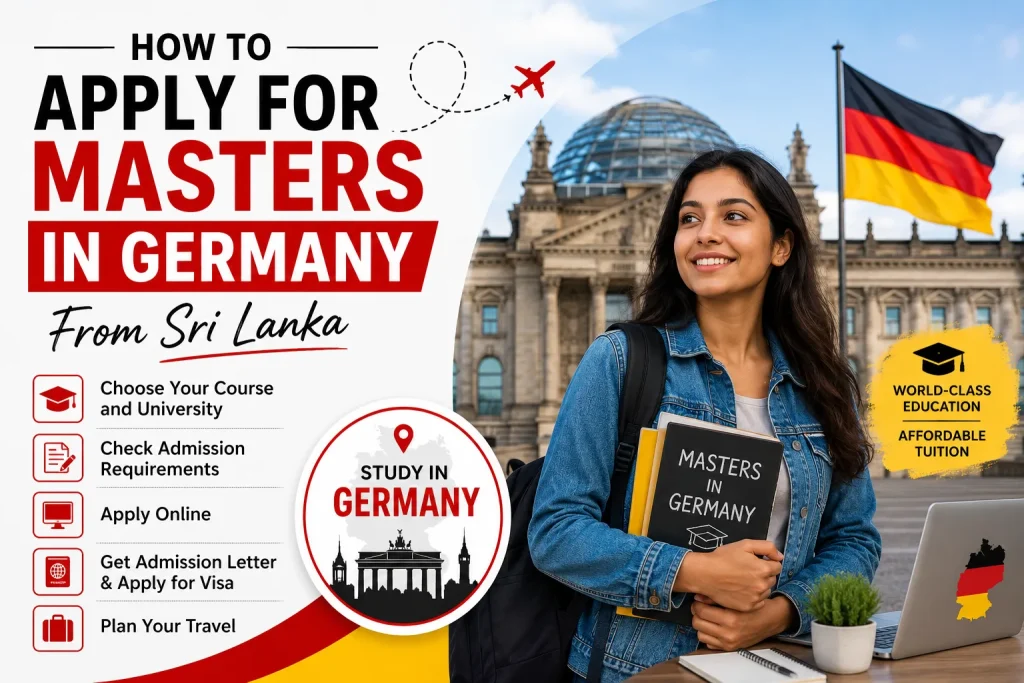
How to Apply for Masters in Germany from Sri Lanka
Germany has quietly become one of the smartest destinations for Sri Lankan students who want a globally respected master’s degree without the tuition-fee shock of the UK, Australia, or the US. Public universities charge little to no tuition, over 1,500 master’s programmes are taught fully in English, and graduates get an 18-month post-study visa to look for work. But the application process is genuinely different from a UK or Australian application — it runs through a portal called uni-assist, needs a blocked bank account before you even see a visa officer, and every deadline is set by the university, not by an agent.
Why Study a Master’s in Germany from Sri Lanka?
Here’s why so many Sri Lankan students choose to study in Germany:
- Low or no tuition. Most courses at state universities charge no tuition fees, while private universities may charge much higher fees.
- Many English-taught programmes. Germany offers more than 2,000 programmes taught fully or mainly in English, called International Programmes.
- Time to find a job after you graduate. After your degree, you can stay in Germany for up to 18 months to look for a job that matches your studies.
- You can work while you study. Since 1 March 2024, international students from outside the EU can work 140 full days or 280 half days per year.
- Less paperwork than some neighbours. Sri Lanka is not on Germany’s APS list, which currently covers India, China, Vietnam and Mongolia.
Step-by-Step: How to Apply for a Master's in Germany
Step 1: Shortlist Your Universities and Programme
Start with the DAAD International Programmes database, which lists every English-taught master’s in the country and lets you filter by subject, city, and tuition. Decide early whether you want a research-focused Universität or a practice-oriented Fachhochschule (University of Applied Sciences) — the second type tends to have closer industry ties and shorter, more job-focused programmes.
Step 2: Check Deadlines — Germany Runs on Two Intakes
Intake | Application Window | Typical Deadline |
Winter Semester (starts October) | May – July | 15 July (varies by university) |
Summer Semester (starts April) | December – January | 15 January (varies by university) |
Most master’s programmes only run one intake a year (usually winter), so always check the specific programme page rather than assuming both windows are open.
Step 3: Prepare Your Document Set
- Bachelor’s degree certificate and full transcript of records (certified copies, translated into English or German if the originals are in Sinhala or Tamil)
- IELTS/TOEFL score report sent electronically to the university or uploaded to uni-assist
- Letter of Motivation / Statement of Purpose — German admission committees read these closely and expect a clear academic and career rationale, not a generic essay
- 2 academic or professional letters of recommendation
- Updated CV in the tabular “Europass” style most German universities expect
- Passport copy and passport-size photographs
- Proof of work experience or extracurricular certificates, where relevant to the programme
Step 4: Apply via uni-assist or Directly to the University
Roughly half of German universities process international applications through uni-assist, a centralised portal that pre-checks your documents for a fee (around €75 for the first application, plus a smaller fee per additional programme at the same intake). The remaining universities want direct applications through their own portal. Always confirm which route your target university uses before you start uploading documents — using the wrong one is one of the most common avoidable delays.
Step 5: Track Your Application and Respond to Conditional Offers
It’s common to receive a conditional offer (Zulassungsbescheid) that depends on a pending final transcript or an English test retake. Reply within the stated window and forward the missing document as soon as it’s ready — most universities give a firm cut-off date after which the seat is released to someone else.
Step 6: Open a Blocked Account (Sperrkonto)
Once you have an admission letter, open a blocked account with a recognised provider such as Fintiba or Expatrio. For the 2026 intake, the required deposit is €11,904 for the year, released to you in monthly instalments of €992 after you arrive in Germany. This is your own money — it isn’t a fee — but German missions treat it as the standard proof that you can support yourself, and an incomplete or mismatched blocked-account application is one of the most common reasons visa appointments get pushed back.
Step 7: Arrange German Health Insurance
Public health insurance (roughly €120–€130/month for students under 30) is mandatory before your visa appointment. Providers like TK, AOK, or Barmer issue a confirmation letter that goes into your visa file alongside your blocked account confirmation.
Step 8: Book Your Visa Appointment (VFS Global Colombo)
Sri Lankan applicants submit their national visa (long-stay, “D” visa) application through VFS Global’s Colombo application centre, which processes appointments on behalf of the German Embassy. Book your slot as soon as your admission letter, blocked account confirmation, and health insurance are ready — appointment availability tightens sharply in the months before the winter intake, so early booking matters more than any other single step in this process.
Step 9: Attend the Visa Interview and Submit Biometrics
Bring the original and a photocopy of every document: passport, admission letter, blocked account confirmation, health insurance, academic transcripts, and the completed national visa application form. Processing typically takes 6–12 weeks from the date of your appointment, though it can run longer during peak intake months, so build in buffer time rather than booking your flight the week classes start.
Step 10: Travel, Enrol, and Register Your Address
After arriving in Germany, you must register your address (Anmeldung) at the local citizens’ office within two weeks, activate your blocked account for monthly withdrawals, and complete university enrolment (Immatrikulation) to receive your student ID and semester ticket.
Am I Eligible to Apply for a Master's in Germany from Sri Lanka?
Before shortlisting universities, check these four boxes:
- Recognised bachelor’s degree: A three- or four-year bachelor’s degree from a UGC-recognised Sri Lankan university or an accredited private institution. Most German universities expect a minimum of 60–65% (roughly a 2:1 equivalent); competitive programmes at TUM, RWTH Aachen, or LMU Munich often look for 70%+.
- Subject relevance: Non-consecutive master’s programmes (an MBA, for example) accept a broader academic background; consecutive programmes usually require your bachelor’s to be in a closely related field.
- English proficiency: IELTS (usually 6.0–6.5 overall) or TOEFL for English-taught programmes. Some universities waive this if your entire bachelor’s degree was taught in English — always check the specific programme page, since policies differ university to university.
- No APS certificate required: This is the detail most generic guides get wrong. The Academic Evaluation Centre (APS) document-verification step is mandatory only for applicants whose academic qualifications are from India, China, or Vietnam. Sri Lankan applicants do not need an APS certificate for either university admission or the student visa.
Cost of a Master's in Germany: What to Actually Budget
Tuition: Most state universities charge no tuition, but Baden-Württemberg charges non-EU students €1,500 per semester. Since winter 2024/25, TUM charges non-EU master’s students €4,000 or €6,000 per semester. Every student also pays a semester contribution of about €100 to €350.
Blocked account: For a German student visa in 2026, you need €11,904 in a blocked account (Sperrkonto). This is your own money, paid back to you at €992 per month after you arrive.
Living costs: DAAD estimates about €1,150 per month for rent, food, transport, insurance and other costs. That’s more than the €992 monthly payout, so plan to cover the difference with savings or part-time work.
Health insurance: Public health insurance for students costs roughly €140 to €152 per month in 2026.
Rupee amounts below use about LKR 385 per euro. The euro was trading at around LKR 386 in August 2026, and rates change daily.
| Cost | In EUR | In LKR (approx.) |
|---|---|---|
| Tuition at most public universities | €0 | LKR 0 |
| Semester contribution | €100 – €350 per semester | LKR 38,500 – 135,000 |
| Tuition in Baden-Württemberg | €1,500 per semester | LKR 577,500 |
| Tuition at TUM (master’s) | €4,000 – €6,000 per semester | LKR 1.54 – 2.31 million |
| uni-assist fee | €75 first, €30 each extra | LKR 28,900 / 11,600 |
| Blocked account (2026) | €11,904 per year | LKR 4.58 million |
| Health insurance | €140 – €152 per month | LKR 53,900 – 58,500 |
| Visa fee | €75 | LKR 28,900 |
| Living costs | about €1,150 per month | about LKR 443,000 |
Common Germany Student Visa Interview Questions
Visa officers often ask detailed questions about why you want to study, the modules in your course and your future plans, and vague answers can lead to refusal. Practise answering these:
- Why did you choose Germany instead of the UK, Australia or staying in Sri Lanka?
- Why this university and this programme?
- Which modules will you study in your first semester?
- How does this master’s connect to your bachelor’s degree or work?
- How will you pay for your studies and living costs?
- Where will you live in Germany?
- What will you do after you graduate?
- Have you started learning German?
- Can you explain any gap in your studies or work?
Common Mistakes Sri Lankan Applicants Make
- Not checking whether their 3-year degree is accepted before applying
- Using uni-assist when the university wants a direct application, or the other way round
- Uploading a transcript without the class or grading scale
- Sending the same generic SOP to every university
- Choosing TUM or Baden-Württemberg universities without budgeting for tuition
- Opening the blocked account late, which delays the visa
- Trusting agents who “guarantee” a visa (only the embassy decides)
FAQ
No. The APS academic-verification step is only mandatory for applicants whose qualifications are from India, China, or Vietnam. Sri Lankan applicants skip this step entirely for both admission and the visa.
€11,904 for the year, which works out to €992 released to you each month after you arrive. This is your own money, held with a provider like Fintiba or Expatrio, not a fee paid to the government.
Some universities waive IELTS if your bachelor’s degree was taught entirely in English, but this varies by institution and programme, so it’s worth confirming directly on the programme page rather than assuming a waiver applies.
Typically 6–12 weeks from your VFS Global Colombo appointment, though processing can extend during the peak months before the winter intake, so it’s safest to book as early as possible.
It depends on the university. Roughly half process international applications through uni-assist; the rest use their own portal. Always check the specific programme’s application page before starting
Yes. Non-EU students, including Sri Lankans, can work up to 120 full days or 240 half days per year without needing a separate work permit.
