 Skip to content

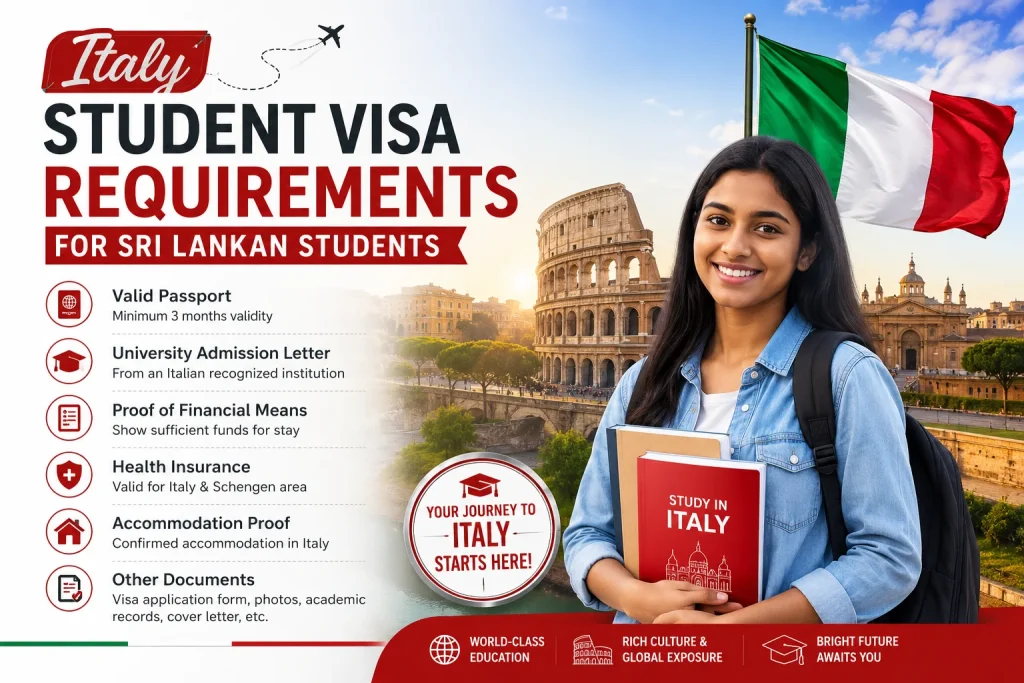
Italy Student Visa Requirements for Sri Lankan Students
Reviewed by Suman Prem, Registered Migration Agent (MARA, MARN 2418548) · Updated October 2026
Sri Lankan students who study in Italy for more than 90 days need a Type D national study visa. You apply at the Italian Embassy in Colombo through VFS Global. Your first step is Universitaly pre enrolment. You must show funds of €10,179.85 a year which is about LKR 3.9 million. Processing can take up to three months. This guide explains the Italy student visa checklist, cost, steps and mistakes to avoid. Processing typically takes 15 to 30 working days but can stretch to 60 days in busy intake periods, so most consultants recommend applying at least two to three months ahead. Total government costs usually add up to roughly €350–400 once you include the €50 visa fee, the €76 residence permit, admin charges, and basic insurance.
| Item | What Sri Lankan students need to know |
|---|---|
| Visa type | Type D national study visa for courses longer than 90 days |
| Where to apply | Embassy of Italy in Colombo through VFS Global |
| First step | Universitaly pre enrolment validated by your university |
| Proof of funds | €10,179.85 per year (about LKR 3.9 million) |
| Visa fee | €50 reported by Italian missions (about LKR 19,000) |
| Language | B2 level in the language of your course |
| Processing time | Up to three months |
| After arrival | Apply for a residence permit within 8 working days |
What Is an Italy Student Visa?
An Italy student visa allows a non-EU national to enter Italy specifically to study. Italy issues two categories, and which one you need depends purely on how long your course runs:
- Type C (Short-Stay Visa): for courses, language schools, or summer programmes lasting up to 90 days.
- Type D (National / Long-Stay Visa): for bachelor’s, master’s, single-cycle master’s, PhD, and other academic programmes lasting longer than 90 days. This is what almost all Sri Lankan degree-seeking students need, and the focus of this guide.
Sri Lankan applicants apply through the Italian Embassy in Colombo, usually via VFS Global, which handles document collection and biometrics but does not decide the outcome — that decision sits with the Embassy itself.
Italy Student visa checklist 2026
This list follows the Embassy of Italy in Colombo study visa checklist. Submit originals with a set of A4 photocopies. The Embassy can ask for more documents at any time.
Personal documents
- Visa application form signed by you with one recent ICAO compliant colour photo attached
- Passport with at least two blank pages and validity of three months beyond your return date to Sri Lanka
- Copy of your passport bio page and a copy of your ID
- Covering letter that explains your travel plan and purpose
Study documents
- Proof of Universitaly enrolment for Bachelor’s, Master’s, single cycle Master’s and PhD courses
- Acceptance letter from the Italian university showing course length and structure and accommodation details
- Dichiarazione di Valore legalised by the Embassy or a CIMEA certificate
- Receipt for your tuition payment
- Proof of language level B2 or above in the language of your course
Money documents
- Financial guarantees that meet the amount set by the Italian Interior Ministry or proof of a scholarship
- Bank letter confirming foreign exchange will be issued on receipt of the visa
- Most recent credit card statements
- If a sponsor pays: a letter explaining the relationship and proof of their job or business and three months of bank statements and certified valuations of their assets
Travel documents
- Proof of accommodation in Italy
- Health insurance for at least 30 days with a plan to join the Italian scheme on arrival
- Confirmed flight reservation
- Copies of visas from the last two years for Schengen countries or the UK or Ireland or the USA or Canada or Australia or New Zealand if you have them
Italy student visa price in Sri Lanka: fees and total cost
Cost item | Amount | Notes |
|---|---|---|
Proof of funds | €10,179.85 (about LKR 3.9 million) | Must stay in your account or your sponsor’s account. It is not a fee. |
Visa application fee | €50 (about LKR 19,000) | Reported by Italian missions. Confirm at the Embassy and VFS. |
VFS service fee | Check VFS Colombo | Charged separately from the visa fee. |
Dichiarazione di Valore or CIMEA | Varies | Depends on the provider you use. |
Translations and MFA certification | Varies | Needed for Sinhala or Tamil documents. |
Health insurance | Varies | Cover for at least the first 30 days. |
Residence permit in Italy | Government and postal fees | Paid after arrival. Amounts change so check before you travel. |
Tuition | Depends on the university | Use the figure from your offer. |
How to apply for an Italy student visa from Sri Lanka step by step
- Choose your course and apply to Italian universities. Get your acceptance letter.
- Register on Universitaly and submit your pre enrolment. Upload what the portal asks for.
- Wait for the university to validate it. A pre enrolment marked under condition cannot be used for the visa.
- Start your Dichiarazione di Valore or CIMEA certificate. Also start Ministry of Foreign Affairs certification for translations.
- Prepare your funds and documents. Build your file using the checklist above.
- Get your VFS appointment. Follow the booking route given in the Embassy notice for your application.
- Attend the appointment and give your biometrics. Carry originals and A4 copies.
- Wait for the decision. Do not buy a non refundable ticket before approval.
- Travel to Italy and apply for your residence permit within 8 working days of arrival.
Italy student visa IELTS requirements and language rules
Whether you need Italian or English test scores depends entirely on your programme’s language of instruction:
Italian-taught degree programmes (Laurea, Laurea Magistrale, Laurea Magistrale a ciclo unico): applicants must generally show B2-level Italian proficiency through a recognised certifying body — PLIDA (Società Dante Alighieri), CILS (Università per Stranieri di Siena), CELI (Università per Stranieri di Perugia), CertIt (Università Roma Tre), or Ce.Co.L (Università per Stranieri di Reggio Calabria).
English-taught programmes, which are increasingly common in Italy, typically ask for an IELTS score between 5.5 and 6.0, though this varies by university and course.
Common Reasons Italy Student Visas Get Rejected
- Applying before Universitaly is validated. The visa file is incomplete without it.
- Using the old funds figure. The amount changed for 2026/27.
- Last minute deposits. Funds with no history raise questions.
- Late Dichiarazione di Valore or CIMEA. This step often decides your timeline.
- Uncertified translations. Sinhala or Tamil papers need MFA certified English translations.
- Mismatched details. Names and dates and course details must match across all papers.
- Short insurance cover. You need at least 30 days of cover.
Italy student visa agency in Sri Lanka: how GIEC Global helps
GIEC Global Sri Lanka supports students from our Galle office. We help you pick a course and register on Universitaly. We also check your funds and documents and prepare your file for the Embassy appointment. We cannot promise a visa because the decision is made by the Embassy of Italy. You can also read about our Study in Italy service or compare other options in Study in Europe. Students also ask about Germany and the Netherlands and Malta. Looking for funding? See study abroad scholarships.
FAQ
The Italian Ministry of University and Research sets the amount at €10,179.85 per year for the 2026/27 and 2027/28 academic years. That is about LKR 3.9 million at around LKR 385 per euro. The funds should be legal and traceable and ideally held in your own account or a close family sponsor’s account with full documents. Confirm the latest figure with the Embassy or VFS before you apply.
The visa application fee reported by Italian missions is €50, which is about LKR 19,000 at current rates. VFS may charge a separate service fee. Your residence permit in Italy has its own government and postal fees. Always check the fee list on the Embassy and VFS pages before you pay.
Yes for Bachelor’s, Master’s, single cycle Master’s and PhD courses. The Embassy of Italy in Colombo lists proof of Universitaly enrolment on its study visa checklist. Your pre enrolment must be validated by the university. If it still shows as under condition you cannot apply for the visa.
The Embassy of Italy in Colombo says processing can take up to three months and that applications cannot be rushed. Apply as early as you can and do not book flights before a decision.
The Embassy checklist asks for proof of language knowledge at B2 level or above in the language of your course. For English taught programmes this is usually shown with IELTS or a similar test. The exact score is set by each university and course. For Italian taught programmes you need B2 Italian from a recognised certificate such as PLIDA or CILS.
It is an official statement that explains the value of your Sri Lankan qualifications in the Italian system. The Colombo checklist asks for it legalised by the Embassy or, as an alternative, a CIMEA certificate. Ask your university which one it accepts and start early because it can take weeks.
Students on a study permit can generally work part time up to 20 hours a week during term. Rules can change so confirm the current limit when you arrive. Work income should not replace the funds you must show for the visa.
You will get the reasons for refusal. Most problems come from funds that look unclear or missing documents or mismatched paperwork. Fix the issues first and then reapply if your course dates still allow it. A free file review before you reapply can save time.
Yes. GIEC Global Sri Lanka helps students choose a course and register on Universitaly. We also check documents and funds before you book your Embassy appointment. The final decision always stays with the Embassy of Italy in Colombo.
