 Skip to content
UK Student Visa Rules 2026: New Financial and English Requirements for Sri Lankans
If you are a Sri Lankan student planning to apply for a UK student visa in 2026, there are some important changes you need to know before you start your application. The UK government has updated its student visa rules, and these changes touch almost every part of the process — from how much money you need to show in your bank account, to the English test score you must achieve.
These updates matter because even a small mistake, like showing the wrong bank balance or missing an English score requirement, can lead to a visa refusal. In this blog, we break down the new UK student visa rules for 2026 in simple terms, so you know exactly what to prepare before you apply for a UK study visa.
Whether you are applying for a bachelor’s programme, a master’s degree, or planning to bring a partner along, this guide covers what has changed and what stays the same.

Confused about the new rules? Talk to our UK study visa consultants at Giecglobal Education and Migration – Sri Lanka for a free eligibility check.
Get Free Eligibility CheckWhat Has Changed in the UK Student Visa Rules for 2026?
The UK student visa (officially called the Student Route) still works on a points-based system, where applicants need to score 70 points in total. Points come from three main areas: your Confirmation of Acceptance for Studies (CAS) from your university, your proof of funds, and your English language score. What has changed for 2026 is how much money you need to show and how strong your English score must be.
On top of that, the visa application fee has gone up, and the amount you pay for the Immigration Health Surcharge (IHS) has also increased. Students switching from a student visa to a work visa, or planning to bring a spouse, will also notice stricter conditions this year.
For Sri Lankan students, this means the planning stage matters more than ever. Getting your documents, bank statements, and English test scores right the first time can save you from delays or a rejected application.
New Financial Requirement for UK Student Visa Applicants
One of the biggest changes for 2026 is the amount of money you must show to prove you can support yourself while studying in the UK. This is called the maintenance requirement, and it depends on where in the UK your university or college is located.
- You must hold the required amount in your bank account for at least 28 consecutive days before you apply
- The money must be in your own account, or in a parent or legal guardian’s account, with proper supporting letters
- This amount is on top of your tuition fees, which must also be shown as paid or payable
- Funds that are not held for the full 28 days, or that show sudden large deposits, can raise questions during visa checks
- If your course is longer than 9 months, the maintenance amount is normally counted for a maximum of 9 months
Why the 28-day rule matters
Many visa refusals happen simply because students did not hold their funds for the full 28-day period. If your bank balance drops below the required amount even for one day within that window, your application can be affected.
This is one of the most common and avoidable mistakes we see among Sri Lankan applicants.
UK Student Visa Financial and English Requirements at a Glance
| Requirement | Details for 2026 |
|---|---|
| Funds for studying in London | Around £1,529 per month |
| Funds for studying outside London | Around £1,171 per month |
| Fund holding period | 28 consecutive days |
| English level for degree courses | CEFR B2 |
| English level for below-degree courses | CEFR B1 |
| Accepted English test | Home Office-approved SELT, such as IELTS for UKVI |
| Visa application fee | Around £558 |
| Immigration Health Surcharge | Around £776 per year |
Not sure how much you need to show for your specific course?
Contact GIEC Global's team of UK study visa consultants for exact figures based on your university and city.
New English Language Requirement for UK Study Visa
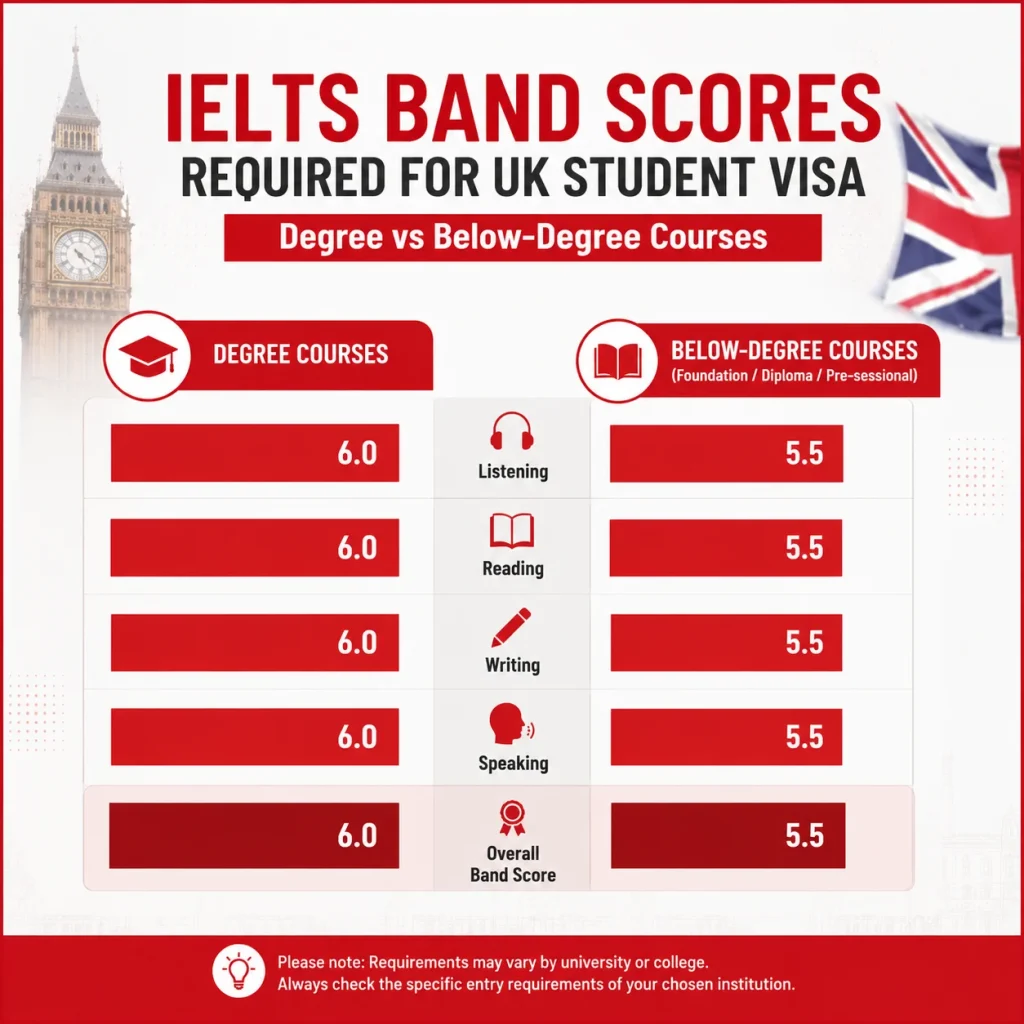
Along with the financial changes, the English language requirement has also become stricter. Since January 2026, students applying for degree-level courses need to meet CEFR Level B2 in all four skills — reading, writing, listening, and speaking. Earlier, many applicants could apply with a B1 level, so this is a real step up for anyone planning a bachelor’s or master’s degree in the UK.
Courses that are below degree level, such as certain diplomas or foundation programmes, still only require CEFR B1. But most Sri Lankan students applying for undergraduate or postgraduate study will fall under the B2 requirement, so it’s worth preparing early rather than waiting until the last minute.
Some universities also set their own English score requirements that are higher than the visa minimum, especially for competitive courses like law, medicine, or business. So there can be two different bars to clear: the visa requirement and your chosen university’s own condition.
Can You Get a UK Visa Without IELTS?
Many students search for “UK without IELTS visa” hoping to skip the test altogether. While it is not possible to avoid proving your English ability completely, there are a few situations where a separate IELTS exam may not be needed:
- If your previous education was taught and assessed fully in English, some universities may accept this as proof, subject to their own policy
- Certain universities run their own internal English assessments that can be accepted instead of an external test
- Some professional or academic qualifications already meet the required CEFR level and may be accepted directly
Always confirm with your university first
Rules around accepting alternative English proof vary from one university to another, and from one intake to another. Before you assume you don't need an English test, check directly with your chosen university's admissions team, or ask your consultant to verify this on your behalf.
Applying without proper proof when it is required is one of the fastest ways to get your application delayed.
Student Visa to Spouse Visa: What Sri Lankan Students Should Know
Bringing a partner or child to the UK while on a student visa has become much harder under the new rules. Dependant visas are now mostly limited to students on PhD programmes, other doctoral-level courses, or government-sponsored scholarships. This is an important point for anyone planning a family move alongside their studies.
| Situation | Can you bring a dependant? |
|---|---|
| Bachelor's degree student | Not eligible |
| Master's degree student | Not eligible |
| PhD or doctoral-level student | Eligible, subject to conditions |
| Government-sponsored scholarship student | Eligible, subject to conditions |
| Switching from student visa to a work or spouse visa later | Possible, but has its own separate eligibility rules |
Planning your UK journey with a partner or family in mind?
Speak to GIEC Global's consultants about the right course and visa pathway for your situation.
Frequently Asked Questions
How much money do I need to show for a UK student visa in 2026?
It depends on your study location. Students going to London generally need to show around £1,529 per month, while those studying outside London need around £1,171 per month, held for 28 consecutive days.
What English score do I need for a UK student visa now?
For most degree-level courses, you now need to meet CEFR Level B2. Courses below degree level still require CEFR B1. Always check IELTS for UKVI band score equivalents with your consultant.
Can I apply for a UK student visa without IELTS?
In some cases, yes, if your previous education was in English or your university runs its own internal English assessment. This depends entirely on your university’s policy, so it’s best to confirm before applying.
Can I bring my spouse or children on a UK student visa?
Only if you are enrolled in a PhD, another doctoral-level programme, or a government-sponsored scholarship. Bachelor’s and master’s students are currently not eligible to bring dependants.
How long does it take to process a UK student visa application?
Processing times can vary depending on your location and the time of year, but it’s best to apply as early as possible once you receive your CAS to avoid delays closer to your course start date.
What is a CAS and why do I need it?
CAS stands for Confirmation of Acceptance for Studies. It is a reference number given by your university once they confirm your admission, and it is required to apply for your student visa.
Why should I use a consultant for my UK study visa application?
An experienced consultant helps you avoid common mistakes, like incorrect fund holding periods or missing English proof, that often lead to refusals. GIEC Global’s consultants guide Sri Lankan students through the full process, from course selection to visa approval.
