 Skip to content
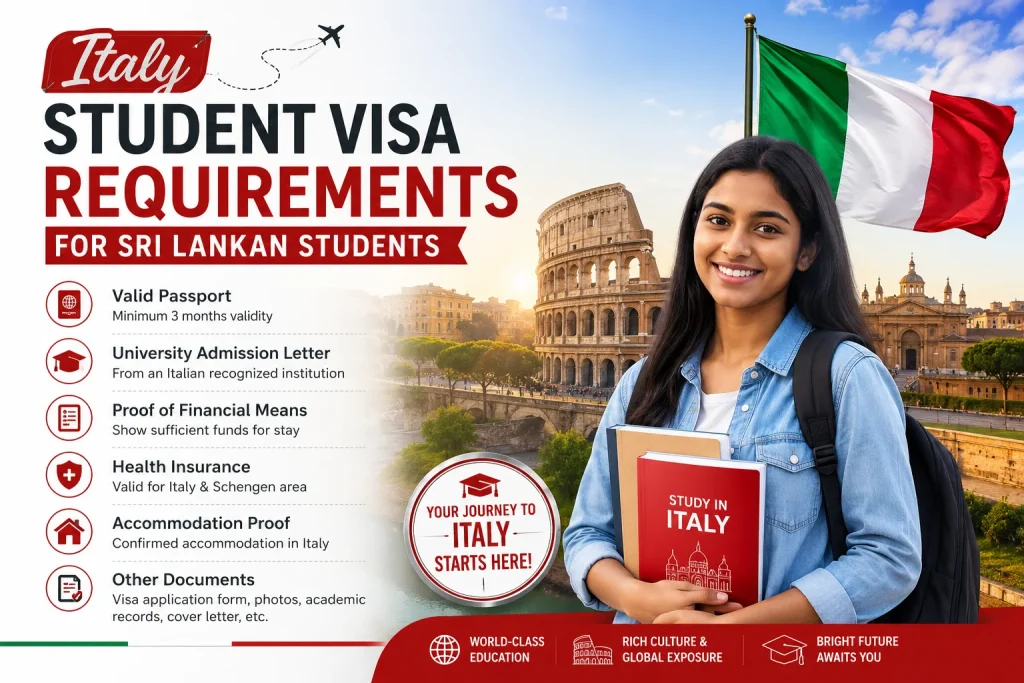
Italy Student Visa Requirements for Sri Lankan Students
Sri Lankan students studying in Italy for more than 90 days need a Type D national study visa from the Italian Embassy in Colombo, applied for through VFS Global. Along with your university acceptance letter, you’ll need a legalised Dichiarazione di Valore (or CIMEA certificate) for your existing qualifications, proof of funds of roughly €450–515 per month (about LKR 174,000–199,000 at current rates), health insurance, confirmed accommodation, and B2-level Italian for degree programmes taught in Italian English-taught courses generally ask for IELTS 5.5–6.0 instead. Processing typically takes 15 to 30 working days but can stretch to 60 days in busy intake periods, so most consultants recommend applying at least two to three months ahead. Total government costs usually add up to roughly €350–400 once you include the €50 visa fee, the €76 residence permit, admin charges, and basic insurance.
What Is an Italy Student Visa?
An Italy student visa allows a non-EU national to enter Italy specifically to study. Italy issues two categories, and which one you need depends purely on how long your course runs:
- Type C (Short-Stay Visa): for courses, language schools, or summer programmes lasting up to 90 days.
- Type D (National / Long-Stay Visa): for bachelor’s, master’s, single-cycle master’s, PhD, and other academic programmes lasting longer than 90 days. This is what almost all Sri Lankan degree-seeking students need, and the focus of this guide.
Sri Lankan applicants apply through the Italian Embassy in Colombo, usually via VFS Global, which handles document collection and biometrics but does not decide the outcome — that decision sits with the Embassy itself.
Italy Student visa checklist 2026
The Italian Embassy in Colombo publishes a formal visa checklist for study applications. At minimum, Sri Lankan applicants need to prepare:
- Completed and signed visa application form
- Two recent passport-size colour photographs (white background)
- Current passport with at least two blank pages, valid for at least 3 months beyond your intended return, plus copies of the current and any previous passport’s bio-data page
- A covering letter explaining your travel plan and purpose of visit
- Dichiarazione di Valore (Declaration of Value) for your academic certificates, legalised by the Italian Embassy in Colombo — or a CIMEA certificate if your institution accepts it instead
- Documented proof of the study course, professional formation, or cultural activity you intend to undertake
- Financial guarantees meeting the minimum threshold set under Article 4, comma 3 of Italy’s T.U. 268/1998, or evidence of a scholarship from the Italian institution
- Proof of acceptance/enrolment from the Italian school, university, or institution, specifying course duration, structure, and accommodation details
- Receipt confirming payment of tuition fees
- Proof of accommodation arrangements in Italy
- For Bachelor’s, Master’s, and single-cycle Master’s programmes: proof of Italian language proficiency at B2 level or above (PLIDA, CILS, CELI, CertIt, or Ce.Co.L certificates)
- Health/medical insurance covering at least the first 30 days, with a commitment to enrol in the Italian insurance scheme on arrival
- A letter from your bank confirming issuance of foreign exchange, plus recent credit card statements
- Confirmed flight ticket reservation
- Proof of previous travel to Schengen countries, the UK, Ireland, USA, Canada, Australia, or New Zealand, if applicable
If a third party is sponsoring you, the sponsor must additionally provide a letter explaining the relationship and reason for support, proof of their employment or business income, three months of bank statements, and valuations of any assets they own. All documents in Sinhala or Tamil must be submitted with an official English or Italian translation, legalised by the Embassy of Italy in Colombo.
Financial Requirements: How Much Money Do You Need to Show?
Italy requires every long-stay applicant to prove “mezzi di sussistenza” — sufficient means of subsistence — for the length of their stay. For Sri Lankan applicants, the figures below provide a useful guide, but the exact euro amount is set by the Italian authorities and may be revised. Always confirm the current threshold before applying.
| Requirement | Typical Amount | Details |
|---|---|---|
| Monthly living-expense proof | €450 – €515 / month | Roughly LKR 174,000 – 199,000 based on the figures provided. Confirm the current EUR/LKR exchange rate and applicable threshold before applying. |
| Visa application fee (Type D) | €50 | Standard long-term student visa fee. |
| Residence permit (Permesso di Soggiorno) | €76 | Paid after arrival in Italy. |
| Administrative fees | €76.46 | May include postal kit, tax stamp and residence-permit issuance costs. |
| Basic health insurance | ≈ €150 / year | Estimated cost for standard coverage. Ensure the required initial period is covered before travelling to Italy. |
Acceptable Proof of Funds
Applicants can generally demonstrate their financial capacity using documents such as:
- Personal or parental bank statements, preferably showing savings built up over time rather than one large recent deposit.
- A bank letter confirming the issuance of foreign exchange, where applicable.
- Salary slips and EPF/ETF statements if the applicant or relevant sponsor is employed.
- A sponsor's bank guarantee (“Fideiussione Bancaria”) prepared in the applicant's favour, where accepted by the relevant authority.
Step-by-Step: How to Apply for an Italy Student Visa from Sri Lanka
- Secure admission. Apply to your chosen Italian university and receive a formal letter of acceptance specifying your course, duration, and any scholarship details.
- Start your Dichiarazione di Valore or CIMEA process early. Submit your academic certificates for legalisation as soon as you have your offer letter.
- Gather your documents. Collect, translate (if needed), and prepare originals plus A4 photocopies of everything on the checklist above.
- Book your VFS Global appointment. Sri Lankan applicants submit their visa application through the VFS Global Visa Application Centre in Colombo.
- Attend your appointment. Submit your documents, complete biometrics, and answer questions about your study plans, finances, and accommodation.
- Wait for the decision. Processing typically takes 15 to 30 working days, occasionally extending to 60 days during busy periods.
- Collect your visa and travel to Italy.
- Apply for your Permesso di Soggiorno. Within 8 working days of arrival, submit your residence permit application at the local post office.
Language Requirement: Italian B2 or IELTS?
Whether you need Italian or English test scores depends entirely on your programme’s language of instruction:
Italian-taught degree programmes (Laurea, Laurea Magistrale, Laurea Magistrale a ciclo unico): applicants must generally show B2-level Italian proficiency through a recognised certifying body — PLIDA (Società Dante Alighieri), CILS (Università per Stranieri di Siena), CELI (Università per Stranieri di Perugia), CertIt (Università Roma Tre), or Ce.Co.L (Università per Stranieri di Reggio Calabria).
English-taught programmes, which are increasingly common in Italy, typically ask for an IELTS score between 5.5 and 6.0, though this varies by university and course.
Common Reasons Italy Student Visas Get Rejected
Refusals tend to cluster around a handful of avoidable issues. On visa forums and community discussion threads, Sri Lankan and other South Asian applicants describe the same patterns again and again — not exotic problems, just gaps that careful preparation would have caught:
- Missing or rushed Dichiarazione di Valore: applicants who leave this until the last minute often find their visa timeline collapses around it.
- Unconvincing or “unseasoned” funds: a bank balance that jumps up right before the interview reads very differently to an officer than steady savings built up over months.
- Mismatched paperwork: small inconsistencies between the university’s acceptance letter and the financial or accommodation documents.
- Incomplete insurance coverage: forgetting that the first 30 days must be covered before you even board your flight.
- Untranslated or unlegalised documents: Sinhala or Tamil paperwork submitted without the required certified English/Italian translation.
After You Arrive: Permesso di Soggiorno and Work Rights
Your visa gets you into Italy, but it isn’t the end of the paperwork. Within 8 working days of landing, you must apply for your Permesso di Soggiorno (residence permit) at a designated post office using the “kit giallo” application pack. This permit, not the visa sticker in your passport, is what legally lets you stay in Italy for your full course duration, open a bank account, and eventually renew your status. Once it’s active, you can work part-time generally up to 20 hours a week during term time, and full-time during official university holidays.
FAQ
You’ll generally need to show funds of around €450–515 per month for the duration of your course, in addition to your tuition fees. The exact figure is set by the Italian Interior Ministry and can change, so confirm the current threshold with the Embassy or VFS Global before applying.
Yes, in most cases. It’s an official declaration confirming how your Sri Lankan qualifications are recognised within the Italian education system, legalised by the Italian Embassy. Some universities accept a CIMEA certificate instead — check with your specific institution, but plan for this step to take several weeks.
Typically 15 to 30 working days, though it can extend to around 60 days during busier intake periods or if additional documents are requested. Applying two to three months ahead of your course start date is a safe buffer.
Do I need IELTS or Italian language certification?
Can I work while studying in Italy on a student visa?
What happens if my Italy student visa is rejected?
Talk to GIEC Global Sri Lanka
Our team helps Sri Lankan students prepare their Dichiarazione di Valore, financial documentation, and full visa file for Italian universities. Fill in the form below and our team will get back to you.
Module ID attribute is required!
This article is for general informational purposes only and does not constitute legal or immigration advice. Visa rules, fees, and financial thresholds are set by the Italian government and Italian Embassy in Colombo and are subject to change without notice. Please confirm current requirements with the Embassy or VFS Global before making any travel or financial decisions.
It depends on your course. English-taught programmes usually ask for an IELTS score of around 5.5–6.0. Degree programmes taught in Italian generally require B2-level Italian proficiency from a recognised certifying body such as PLIDA, CILS, or CELI.
Can I work while studying in Italy on a student visa?
What happens if my Italy student visa is rejected?
Talk to GIEC Global Sri Lanka
Our team helps Sri Lankan students prepare their Dichiarazione di Valore, financial documentation, and full visa file for Italian universities. Fill in the form below and our team will get back to you.
Module ID attribute is required!
This article is for general informational purposes only and does not constitute legal or immigration advice. Visa rules, fees, and financial thresholds are set by the Italian government and Italian Embassy in Colombo and are subject to change without notice. Please confirm current requirements with the Embassy or VFS Global before making any travel or financial decisions.
Yes. Once your residence permit is active, you can work up to 20 hours a week during term time and full-time during official university holidays.
What happens if my Italy student visa is rejected?
Talk to GIEC Global Sri Lanka
Our team helps Sri Lankan students prepare their Dichiarazione di Valore, financial documentation, and full visa file for Italian universities. Fill in the form below and our team will get back to you.
Module ID attribute is required!
This article is for general informational purposes only and does not constitute legal or immigration advice. Visa rules, fees, and financial thresholds are set by the Italian government and Italian Embassy in Colombo and are subject to change without notice. Please confirm current requirements with the Embassy or VFS Global before making any travel or financial decisions.
You’ll receive a written reason for refusal. Most rejections trace back to financial documentation, an incomplete Dichiarazione di Valore, or mismatched paperwork — all of which are fixable before a stronger reapplication.
