 Skip to content
How Many Intakes for Canada Study?
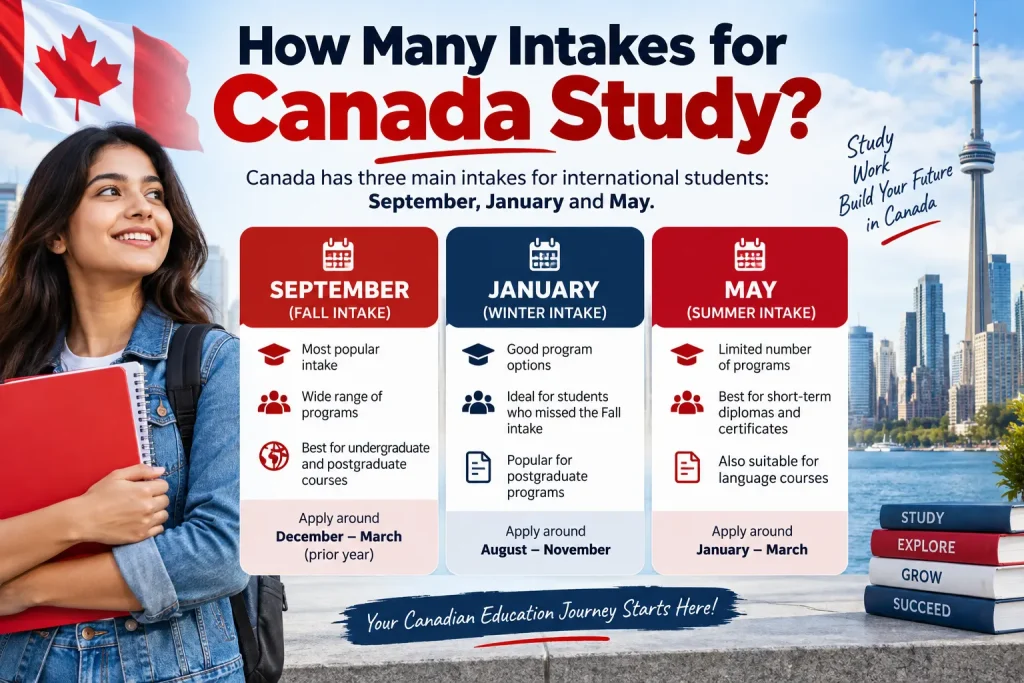
Canada has three intakes every year: Fall in September, Winter in January and Summer in May. Fall is the main intake and pulls the largest share of international students because it opens the widest choice of courses, scholarships and placement cycles.
Most Sri Lankan students target the September intake, keep the January intake as a strong backup, and use the May intake only for short diploma or certificate courses.
Since the Student Direct Stream closed in November 2024, every applicant from Sri Lanka now uses the regular study permit route, so plan for roughly eight to twelve weeks for a decision. Canada is also processing fewer study permits under a 2026 national cap, which makes choosing the right intake and applying early more important than ever.
How Many Intakes Does Canada Have for International Students?
Canada has three intakes for international students. In order of size they are the Fall intake, the Winter intake and the Summer intake. Some colleges label these as semesters, and a few call the May session the Spring or Summer intake, but the calendar is the same across the country.
- Fall intake (September): the primary and largest entry point. It attracts close to seventy percent of all international students and offers almost every program.
- Winter intake (January): the second largest option, with fewer seats but plenty of strong programs, especially at postgraduate level.
- Summer intake (May): the smallest window, mostly reserved for short diplomas, certificates, language courses and a handful of specialised programs.
So when someone asks how many intakes there are in Canada, the short answer is three. The more useful answer is that not every program runs in all three. Many degree courses only start in September, which is why the intake you pick shapes the course you can study.
Canada Intake Months Explained: September, January and May
Canada generally has three main intakes for international students: September, January and May. Each intake has different application timelines and program availability. The September intake usually offers the widest choice of programs and institutions.
| Intake | Start Month | Apply Around | Best For | Program Choice |
|---|---|---|---|---|
| Fall (Primary) | September | December to March (prior cycle) | Bachelor's, Master's and most diploma programs | Widest |
| Winter (Secondary) | January | August to November | Postgraduate programs and students who missed Fall | Moderate |
| Summer (Limited) | May | January to March | Short diplomas, certificates and language courses | Smallest |
Fall Intake in Canada (September)
The September intake is the one most families in Sri Lanka aim for, and for good reason. Nearly every university and college accepts applications for it, which means the full range of bachelor’s, master’s and diploma programs is open. Institutions such as the University of Toronto, the University of British Columbia, McGill and the University of Alberta all treat September as their main entry point.
Fall also carries the most scholarship money. Universities align the bulk of their merit and need based funding with the September start, so applying for Winter or Summer often means fewer aid options. On top of that, a September start lines you up neatly with co op cycles, internships and the graduate job market, which matters if your longer plan involves a Post Graduation Work Permit.
The trade off is competition. Because so many students apply, popular programs fill early and study permit offices are busiest in the months before September. If you want the September intake, an early and complete file is your best advantage.
Winter Intake in Canada (January)
The January intake is the natural fallback if the September window closes before you are ready. It is smaller, yet it is far from a consolation prize. Universities like McGill, UBC, Dalhousie and McMaster take international students in January, and postgraduate options in particular stay healthy.
The Winter intake suits three groups. First, students who missed a Fall deadline. Second, students who needed extra time to sit a language test or gather documents. Third, applicants who want a slightly calmer processing period, since visa offices are often less crowded than in the summer rush. Aim to apply by November for a January start.
The main thing to watch is program availability. Some specialised degrees only run in September, so confirm your exact course opens in January before you commit. If it does, the January intake gives you a genuine fresh start without waiting a whole year.
Summer Intake in Canada (May)
The May intake, sometimes called the Spring or Summer session, is the smallest of the three. It mostly hosts short diplomas, certificate courses, language programs and a limited set of postgraduate or fast track pathways. Full degree programs are rarely offered in May.
For Sri Lankan students it can still be handy. If you want a shorter certificate, a pathway that leads into a September degree, or a quick way to enter without waiting for the next Fall, the May intake fills that gap. Application windows usually run from January to March. Just be aware that scholarships and program choice are the most limited of any intake
Which Intake Is Best for Canada from Sri Lanka?
For most Sri Lankan students the honest answer is the Fall intake. It gives the broadest course list, the strongest scholarship pool and the cleanest link to work and residency pathways after graduation. If your target program and your paperwork can be ready in time, September is the safest strategic choice.
That said, the best intake is the one you can apply for properly. A rushed September file with weak proof of funds is riskier than a calm, well prepared January file. Applicants often worry that a January or May start looks weaker to a visa officer. It does not. A study permit decision rests on your documents, your funds and a genuine study plan, not on which month classes begin. Pick the intake that lets you submit a complete, honest application.
A second common worry is the gap between finishing school and starting classes. If you complete your A Levels and your nearest realistic start is the following September, that gap is normal and does not hurt your case as long as you can explain how you spent the time.
How the 2026 Study Permit Cap Changes Your Intake Planning
This is the part many older guides miss. Canada now runs a national cap on study permits, and it directly affects how you should plan your intake. For 2026 the government expects to issue about 408,000 study permits, made up of roughly 155,000 for new arrivals and 253,000 for extensions. That is about seven percent below the 2025 target and sixteen percent below 2024, so seats are genuinely tighter than they were.
Two rules flow from this cap and both shape your timing:
- Provincial Attestation Letter (PAL): most new students at the undergraduate, graduate certificate or diploma level must include a PAL with the study permit application. The PAL confirms that your seat counts against a province’s share of the cap. Without a required PAL, the application is returned without being assessed. Your institution requests the PAL on your behalf after you accept the offer and pay the deposit, so this step depends on you moving early in the cycle.
- Master’s and doctoral exemption: from 1 January 2026, students starting a master’s or doctoral degree at a public designated learning institution no longer need a PAL. This is aimed at attracting graduate talent and shortens one step for those applicants.
The practical takeaway for a Sri Lankan applicant is simple. Provinces release their attestation letters on their own schedules, and in the busiest provinces they can run out before the year ends. Locking in your offer letter and PAL as early in the cycle as possible protects your intake. You can read the government breakdown of the 2026 allocations on the official IRCC allocations notice.
Do Master's and PhD Students Follow the Same Intakes?
Yes, master’s and doctoral programs follow the same September, January and May calendar, with September remaining the main entry point. What differs is the paperwork. From 1 January 2026, master’s and doctoral students at public institutions are exempt from the PAL requirement, which removes one bottleneck from their timeline.
Doctoral applicants get a further advantage. Canada has introduced a fourteen day processing standard for many doctoral study permit applications filed from outside the country, including accompanying family members. If you are heading for a research degree, that faster lane can change how tightly you plan your intake.
Undergraduate and graduate certificate or diploma students do not share these exemptions, so they must still secure a PAL for each application. If you are weighing a diploma against a master’s, the permit rules are now part of that decision, not just the course itself.
FAQs
Canada has three intakes a year for international students: the Fall intake in September, the Winter intake in January and the Summer intake in May. September intake is the largest and offers the most programs, while Summer is the smallest and mostly covers short courses.
Accordion Content
For most Sri Lankan students the Fall intake in September is best. It offers the widest course choice, the most scholarships and the smoothest link to work and residency pathways. The best intake overall, though, is the one you can apply for with a complete, honest and well funded application.
Yes. The January intake is a strong second choice, especially at postgraduate level. It has fewer seats and slightly fewer programs than September, but many respected universities accept international students in Winter. Apply by around November for a January start.
Yes, but it is limited. The May intake mainly offers short diplomas, certificates, language programs and a few fast track pathways rather than full degrees. Apply between January and March, and expect fewer scholarship options than in Fall or Winter.
Plan to begin about eight to twelve months before your intended start month. This gives you time to sit a language test, secure your Letter of Acceptance, arrange proof of funds, obtain a Provincial Attestation Letter where required and allow eight to twelve weeks for study permit processing.
No. A study permit decision is based on your documents, your proof of funds and a genuine study plan, not on whether you start in September, January or May. A well prepared application in any intake is stronger than a rushed one in the most popular intake.
You can apply for the next intake, usually the January window, or ask your institution to defer your offer to the next term. Deferral rules vary by university, so check your offer letter and contact admissions before the stated deadline.
Often yes, if your institution allows it and you request it before the deferral deadline. Be careful if your study permit was already issued for a fixed start date, as a delay may require you to update or reapply, and late arrival policies can be strict.
Most new undergraduate, graduate certificate and diploma students need a Provincial Attestation Letter for every intake. Master’s and doctoral students at public institutions are exempt from 1 January 2026. Your institution requests the letter for you after you accept the offer and pay the deposit.
Outside Quebec you generally need to show about CAD 20,635 for living costs for the first year, plus your first year tuition and travel money. Many students meet part of this through a Guaranteed Investment Certificate. Always confirm the current figure with IRCC before you apply.
Yes. After A Levels you can apply to bachelor’s programs or diploma pathways at a designated learning institution, usually for the September or January intake. After O Levels, foundation and pathway programs are the common route. Your exact eligibility depends on the institution and program you choose.
