 Skip to content
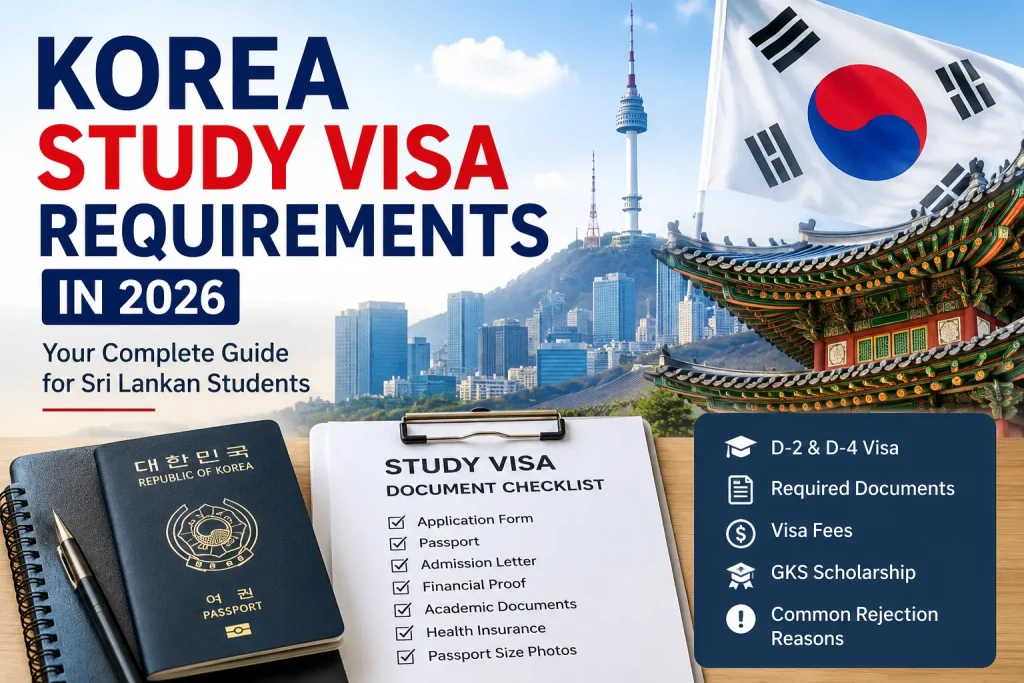
Korea Study Visa Requirements in 2026: My Complete Guide for Sri Lankan Students
Sri lanka is no longer the hidder gem it used to be. More sri lanka students are moving to korea because of its growing scholarship options, its safety and the fact that Seoul was recently named the world's top student city. To Study in south Korea you need to apply for either a D-2 visa (degree programs) or a D-4 visa (Korean language training) through the Korean Embassy in Colombo. In my experience, you need a Certificate of Admission, proof of at least USD 9,000 to 10,000 in your bank account, a clean police report, a medical report, and a genuine study plan. Korean immigration is checking study plans more strictly in 2026, so I always tell my students applicants to make theirs specific and honest, not copied from the internet. Processing usually takes 15 working days or more, and visa fees are paid in Sri Lankan rupees at the embassy. Below, I break down every document, every fee, and every mistake I have seen Sri Lankan students make, so you do not repeat them.
What Is the Korea Study Visa? D-2 vs D-4 Explained
In my experience, the first confusion every Sri Lankan student has is which visa they actually need. South Korea uses two main study visa categories, and picking the wrong one on your application can delay everything.
- D-2 Student Visa: This is for full degree programs, associate, bachelor, master, or doctoral, at a recognised Korean university.
- D-4 Visa: This is for Korean language training, usually a 6 month to 1 year course at a university language institute. Many of my Sri Lankan students take this route first if their Korean is not strong enough for a Korean taught degree.
If your program is taught fully in English, you generally do not need the D-4 stage at all. If you plan to study in Korean, I usually recommend the D-4 to D-2 pathway, since it also gives you time to settle into the culture before your degree starts.
Korea Study Visa Requirements in 2026 for Sri Lankan Applicants
Based on what the Korean Embassy in Colombo currently asks for, here is the document checklist I give every student. Note that missing even one document can result in your application being rejected outright, the embassy is very clear about this.
| Document | What You Need to Know |
|---|---|
| Visa application form and photo | Completed form with a recent 3.5 x 4.5 cm colour photo |
| Passport | Valid for at least 6 months beyond your intended stay |
| Certificate of Admission (CoA) | Original, issued by your Korean university with payment receipt |
| Academic transcripts and certificates | Attested by the Ministry of Foreign Affairs of Sri Lanka |
| Bank statement | Original, last 3 months, showing sufficient funds, plus a bank manager confirmation letter |
| Medical report | Tuberculosis screening including chest X ray and sputum test from a designated hospital |
| Police clearance report | From Sri Lanka Police, covering from your date of birth to the present |
| Study plan | A genuine, personalised explanation of why you chose this course and university |
| Financial sponsor documents | If parents are sponsoring you, their bank statement, ID, and a signed consent letter |
I always cross check this list against the official visa requirement page of the Korean Embassy in Colombo before submitting, since embassies do update their document lists without much notice.
How Much Money Do You Need to Show for a Korea Student Visa?
This is one of the questions I get almost every single day. In my experience, most Sri Lankan applicants need to show around USD 9,000 to 10,000, or the equivalent in LKR, sitting in a bank account for at least one month before the visa interview. On top of this, I tell my students to budget realistically for living costs, which usually range from USD 800 to 1,200 per month depending on the city, plus health insurance of roughly USD 200 to 500 per year once you arrive. Seoul is naturally more expensive than smaller university towns like Daejeon or Cheongju, so where you study affects how much you should show as backup funds.
Why Your Study Plan Matters More in 2026
Here is something I have not seen covered clearly in most guides, and it is one of the biggest changes I have noticed this year. Korean immigration authorities have been holding universities accountable for genuine international student intake, and as a result, they are reading study plans far more carefully in 2026 than before. A generic, copy paste study plan is now a real liability, not just a formality. In my experience, students who write a specific, honest plan, one that explains exactly why they chose their course, what they hope to do after graduation, and how it connects to their background, get approved far more smoothly than students who submit a template style essay. I now spend extra time with every client rewriting this document from scratch, because immigration officers are trained to spot copied content immediately.
TOPIK, IELTS, and Language Requirements
If your program is taught in Korean, most undergraduate courses expect a TOPIK Level 3, while graduate programs often ask for TOPIK Level 4 or higher. Highly competitive programs, like law or medicine at top universities, can ask for TOPIK Level 5. If you are applying to an English taught program, you generally submit IELTS or TOEFL scores instead, and TOPIK is not compulsory. That said, in my experience, even including a short Korean language study plan in your application helps your case, since it shows genuine long term intent to integrate, which immigration officers do notice.
GKS Scholarship for Sri Lankan Students
A lot of Sri Lankan families ask me whether they can study in Korea without spending a large amount upfront, and the answer is often yes, through the Global Korea Scholarship, known as GKS. This is a fully funded scholarship from the Korean government covering tuition, a monthly stipend, and airfare, and Sri Lankan students are eligible to apply through the Korean Embassy in Colombo each year. I always recommend my students apply for GKS at the same time as regular university applications, since the scholarship deadline is usually earlier than the general intake deadline, and missing it means waiting another full year.
Visa Fees and Processing Time from Colombo
In my experience helping students submit through the Korean Embassy in Colombo, visa processing usually takes a minimum of 15 working days, though it can take longer depending on the visa type and how complete your file is. Fees are paid in Sri Lankan rupees, converted from the USD fee based on the embassy's current exchange rate, so the exact LKR amount can shift slightly month to month. One thing I always tell my clients, the embassy currently does not offer an express or fast track visa service for students, so applying early is not optional, it is essential.
Common Reasons Korea Study Visa Applications Get Rejected
Reading through real student experiences and forum discussions from applicants across South Asia, along with my own casework, I have noticed the same handful of mistakes come up again and again. Here is what I warn every client about before they submit anything.
- Weak or unclear financial proof: A bank balance that looks recently deposited in a lump sum raises red flags rather than reassuring the officer.
- Generic study plans: A vague essay that could apply to any student anywhere is one of the fastest ways to get flagged in 2026.
- Missing attestations: Academic documents not properly certified by the Ministry of Foreign Affairs are a common and completely avoidable rejection reason.
- Incomplete police or medical reports: Reports that do not cover the full required period, or that come from an unapproved clinic, get sent back.
- Choosing a university with a poor compliance record: Some Korean universities have faced visa restrictions from immigration for enrolling students who later left their programs. I always check a university's current standing before recommending it.
After You Arrive: ARC, Health Insurance, and Work Rights
Once you land in Korea, in my experience, the next steps matter just as much as the visa itself. You must apply for an Alien Registration Card, known as the ARC, at your local immigration office, usually within 90 days of arrival. You will also be enrolled in Korea's National Health Insurance system. If you hold a valid D-2 visa, you are permitted to work part time, generally up to 20 hours per week during the semester and full time during vacation periods, though this usually also requires TOPIK Level 2 or higher and permission from your immigration office. I always remind students that working beyond your permitted hours, or without permission, is treated as a serious visa violation in Korea, with penalties that can include heavy fines, deportation, and a re entry ban of up to five years.
Comparing Korea to Other Study Destinations
I regularly get asked how Korea compares to other countries Sri Lankan students consider, especially in terms of visa difficulty and cost. If you are weighing your options, I have written a detailed comparison in my guide to the best countries to study abroad for Sri Lankan students, and if Europe is also on your list, my breakdown of the best European countries for Sri Lankan students covers similar visa and cost factors. Students who are still undecided between Korea and other affordable options sometimes also ask me about the Netherlands, which I cover in my study in Netherlands from Sri Lanka guide.
Why Choose GIEC Global?
Technically you can apply for a Korea study visa on your own but the visa rejection risk would be high. In my experience, the students who come to me after a rejection almost always made one of the mistakes I listed above, and by then they have lost months and sometimes an entire intake. I personally review every document before it goes to the embassy, I help rewrite study plans so they sound like the student's own genuine voice rather than a template, and I keep track of which Korean universities currently have a clean compliance record with immigration. If you already have an offer or are still choosing a university, I would rather catch a weak document now than have you find out at the embassy counter. You can see how I support Sri Lankan students through the full Korea process, from university shortlisting to visa submission, on my study in South Korea from Sri Lanka page.
Frequently Asked Questions
1. Can Sri Lankan students apply for a Korea study visa in 2026?
Yes. Sri Lankan students can apply for a D-2 visa for degree programs or a D-4 visa for Korean language training through the Korean Embassy in Colombo. In my experience, this remains one of the more accessible study destinations for Sri Lankans compared to some Western countries.
2. How much bank balance do I need for a Korea student visa?
Most of my students show around USD 9,000 to 10,000, or the LKR equivalent, held in their account for at least one month. Requirements can vary slightly depending on your program and the embassy's discretion.
3. How long does the Korea study visa take to process from Sri Lanka?
In my experience, processing usually takes a minimum of 15 working days through the Korean Embassy in Colombo, though it can take longer if documents are incomplete or if it is a busy intake period.
4. Do I need IELTS or TOPIK for a Korea study visa?
If your program is taught in English, you generally need IELTS or TOEFL, not TOPIK. If your program is taught in Korean, you will usually need TOPIK Level 3 or higher, depending on your course level.
5. What is the GKS scholarship, and can Sri Lankans apply?
The Global Korea Scholarship, or GKS, is a fully funded scholarship from the Korean government covering tuition, a monthly stipend, and airfare. Sri Lankan students are eligible, and I always recommend applying early since deadlines fall before regular university intakes.
6. Can I work part time on a Korea student visa?
Yes, if you hold a D-2 visa, you can generally work up to 20 hours per week during the semester and full time during vacations, though you usually need TOPIK Level 2 or higher and permission from immigration first.
7. What is the difference between a D-2 and D-4 visa?
The D-2 visa is for full degree programs, bachelor, master, or doctoral. The D-4 visa is for Korean language training courses. In my experience, many students use the D-4 as a stepping stone before switching to a D-2 for their actual degree.
8. Why do Korea study visa applications get rejected?
From what I have seen, the most common reasons are weak or unclear financial proof, generic study plans, missing document attestations, and incomplete medical or police reports. Choosing a university with visa compliance issues can also hurt your application.
9. Do I need a medical report for a Korea study visa?
Yes. You need a tuberculosis screening from a designated hospital, including a chest X ray, sputum test, and a doctor's examination letter, submitted with your visa application.
10. What happens after I arrive in Korea with my student visa?
You need to apply for an Alien Registration Card at your local immigration office, usually within 90 days of arrival, and enrol in Korea's National Health Insurance. I always walk my students through this checklist before they even board their flight.
Ready to Start Your Korea Study Visa Application?
I personally review every applicant's documents before they go to the embassy. Fill in the short form below and I will get back to you with a free document checklist.
