 Skip to content

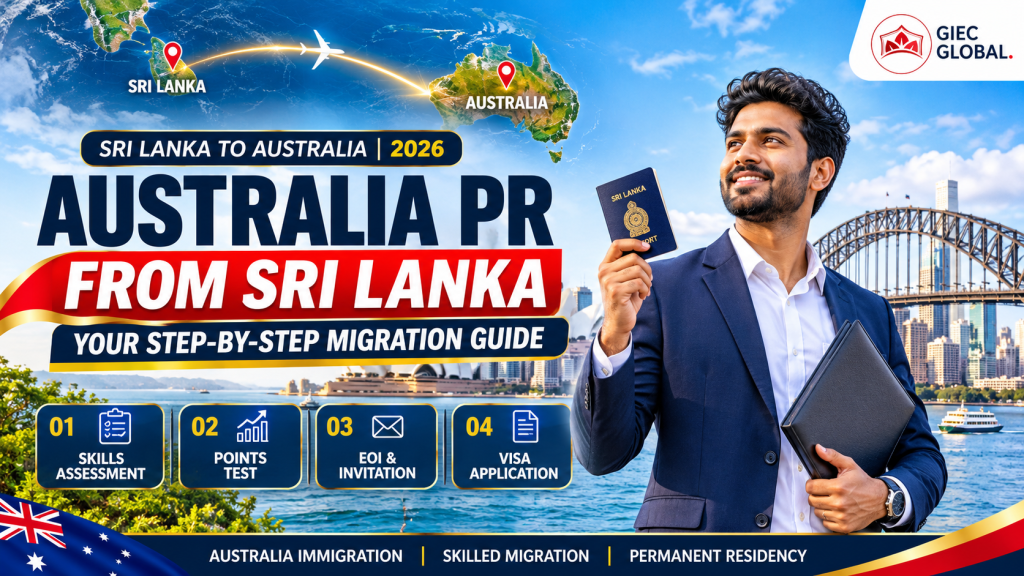
Getting Australia PR from Sri Lanka is realistic for skilled professionals, but it is a process, not a single form. You choose an occupation, prove your skills, reach the points target, wait for an invitation and then apply for the visa. Each step has its own rules, fees and waiting time.
The rules also moved in 2026. Australia confirmed a points test reform in the Federal Budget, visa fees went up on 1 July 2026, and the government is giving more weight to skills it needs. This guide explains what is official, what is still rumour, and what a Sri Lankan applicant should do next.
It is written for graduates, engineers, IT and trade professionals, nurses, accountants and couples who are thinking about Australia immigration for the first time.
Key takeaways
- Yes, Sri Lankans can get PR in Australia. The main route is a points-tested skilled visa (subclass 189, 190 or 491).
- Core requirements: an eligible occupation, a positive skills assessment, English of at least Competent level, 65+ points and an invitation. You must be under 45 when invited.
- 2026 update: the points test will be reformed, but a start date and new points values are not official yet. The current test still applies.
- Start now: check your score, begin your skills assessment and book your English test.
Can Sri Lankans Get PR in Australia in 2026?
Yes. Skilled visas are not shared out by country, so Sri Lankan citizens apply on the same terms as everyone else. What decides your result is your own profile: occupation, age, qualifications, English score and work experience.
There are three broad routes for immigration to Australia from Sri Lanka:
- Skilled points-tested visas: 189, 190 and 491. This guide focuses on them.
- Employer sponsorship: if an Australian employer sponsors you, read about the 482 visa and the 186 visa.
- Partner and family: if your spouse is an Australian citizen or permanent resident, see the 309 partner visa.
If you do not have an Australian job offer or a partner, the skilled route is usually where you start.
What Changed for Australia PR from Sri Lanka in 2026
Three things matter most this year: the points test reform, higher fees and a stronger preference for skills Australia needs. The table below separates what is confirmed from what is not.
| Topic | Status as of 18 November 2026 |
|---|---|
| Points test will be reformed (Federal Budget 2026–27) | Confirmed. The aim is to favour younger, better educated and higher-skilled migrants. |
| New points values and pass mark | Not confirmed. Draft details were expected later in 2026, so watch Home Affairs. |
| Start date of the new test | Not confirmed officially. Some agents mention 1 July 2027. |
| Visa application charges | Increased from 1 July 2026. Check the Home Affairs fee estimator before lodging. |
| Permanent Migration Program | Reported at 185,000 places for 2026–27, with more focus on people already in Australia. |
What does this mean for you? Offshore applicants from Sri Lanka face more competition, so a strong English score, a clean skills assessment and the right occupation matter more than before. We explain the reform in more detail in our guide on the Australia PR points test changes for Sri Lankans.
Not sure where you stand under the current rules? We will walk through your profile with you.
Get Free ConsultationAustralia PR Requirements for Sri Lankans
These are the basic Australia PR requirements for Sri Lankans applying under the 189, 190 or 491 visa:
- Age: under 45 when you receive an invitation.
- Occupation: your job must be on the skilled occupation list for the visa you want. Check our Australia immigration skills list for Sri Lankans.
- Skills assessment: a positive result from the assessing authority for your occupation.
- English: at least Competent level (for example IELTS 6 in each band). Higher scores earn points.
- Points: at least 65 to submit an Expression of Interest (EOI), although invitations often need more.
- Nomination: a state or territory nomination for the 190 and 491. The 189 needs none.
- Health and character: a medical examination and police certificates.
Meeting the minimum is not the same as getting invited. Invitation rounds are competitive, and the cut-off depends on your occupation.
How to Migrate to Australia from Sri Lanka: Step by Step
Here is the order we recommend for Australia PR from Sri Lanka, and for anyone asking how to migrate to Australia from Sri Lanka through the skilled route.
Step 1: Choose an eligible occupation
Match your real work history to an occupation on the list. Pick the one that fits your qualification and duties, not the one that looks easiest. A mismatch can fail your skills assessment.
Step 2: Check your points
Use the Australia PR points calculator and then confirm on the official Home Affairs calculator. Be honest about work experience and age.
Step 3: Take your English test
IELTS, PTE Academic, TOEFL iBT, OET and Cambridge are accepted. If you want to reach Proficient or Superior level, you can prepare with IELTS coaching in Sri Lanka or PTE preparation.
Step 4: Get your skills assessment
Apply to the right assessing body for your occupation. This is often the slowest step, so start early. Details are in the section below.
Step 5: Lodge an EOI in SkillSelect
An EOI is free. You enter your details, points and visa choices, and Home Affairs ranks you against other applicants. You can select more than one visa type in the same EOI.
Step 6: Receive an invitation or nomination
For the 189, you wait for an invitation round. For the 190 and 491, a state or territory must nominate you first. Each state has its own rules and often asks for proof of your intent to live there.
Step 7: Apply for the visa
Once invited, you have 60 days to lodge the visa application in ImmiAccount. This is how to apply for an Australian visa from Sri Lanka: online, with every document uploaded and certified or translated where needed.
Step 8: Health checks, police certificates and biometrics
Complete your medical with an approved panel doctor and obtain police certificates from every country where you lived for 12 months or more in the last 10 years. Home Affairs may also ask for biometrics.
Step 9: Wait for the decision
Respond to any request for more information within the deadline. Once the visa is granted, you can plan your move to Australia from Sri Lanka and meet your first-entry date.
Want a clear plan for each of the nine steps? Talk to a counsellor. No pressure.
Book a Counsellor CallAustralia PR Points Calculator: How Sri Lankan Applicants Score
The points test is the heart of Australia skilled migration from Sri Lanka. The table below shows the main categories under the current test. Always confirm on the official Home Affairs points table before you lodge.
| Category | Points |
|---|---|
| Age 25–32 | 30 (highest) |
| Age 18–24 or 33–39 | 25 |
| Age 40–44 | 15 |
| English: Proficient (IELTS 7 each band) | 10 |
| English: Superior (IELTS 8 each band) | 20 |
| Bachelor degree (or equivalent) | 15 |
| Doctorate | 20 |
| Skilled work outside Australia, 3 to under 5 years / 5 to under 8 years / 8+ years | 5 / 10 / 15 |
| Skilled work in Australia, 1 to under 3 years / 3 to under 5 / 5 to under 8 / 8+ | 5 / 10 / 15 / 20 |
| NAATI credentialed community language (CCL) | 5 |
| Professional Year in Australia | 5 |
| Partner with skills and English, or single applicant | 10 (partner with Competent English only: 5) |
| State nomination (190) / Regional nomination (491) | +5 / +15 |
Remember that overseas and Australian work points are capped at a combined maximum of 20.
NAATI CCL for Sinhala and Tamil speakers
If you speak Sinhala or Tamil at a high level, the NAATI CCL test can add 5 points. Check the current language list and test dates on the NAATI website, because availability can change.
How a Sri Lankan engineer might score
Take a 30-year-old civil engineer with a bachelor degree (15), IELTS 7 in each band (10) and four years of skilled experience (5). That is 30 + 15 + 10 + 5 = 60. Add a NAATI CCL (5) and the score reaches 65. A 190 nomination would add 5 more. This is a simple example, not a promise of an invitation.
Skills Assessment for Australia PR: ACS, Engineers Australia and More
A skills assessment proves your qualification and experience match the Australian standard for your occupation. The authority depends on your job:
- ACS (Australian Computer Society): most IT occupations.
- Engineers Australia: engineers. See our guides for civil engineers and mechanical engineers, or the wider Australia visa for engineers page.
- VETASSESS: many professional and general occupations.
- Trades Recognition Australia: several trades.
- Other bodies: accounting, nursing, teaching and similar fields have their own authorities.
Each body sets its own fee, document list and timeline. Employment letters must match your CV on dates, titles and duties, and your payslips and EPF or ETF records should support them.
Unsure which assessing body fits your occupation? Check it with our team before you pay any fee.
Get Free ConsultationAustralia Visa Sri Lanka Applicants Use: 189, 190 and 491
All three visas are points-tested. This table shows the main differences for Sri Lankan applicants.
| Feature | Subclass 189 | Subclass 190 | Subclass 491 |
|---|---|---|---|
| Type | Permanent | Permanent | Provisional, 5 years |
| Nomination | None | State or territory | State, territory or eligible relative |
| Extra points | 0 | +5 | +15 |
| Where you live | Anywhere in Australia | Usually must live in the nominating state for a period | Designated regional area |
| Path to PR | Direct | Direct | Move to PR (subclass 191) after meeting regional living and income conditions |
Learn more on our pages for the 189 visa, the subclass 190 visa and the subclass 491 visa. For a deeper look at choosing between them, see our guide on 190 versus 189 nominations.
Documents Sri Lankans Need for Australia PR
Prepare these early for your Australia PR from Sri Lanka application, because certificates from government offices can take weeks.
- Valid passport and National Identity Card
- Birth certificate, and marriage certificate if you include a spouse
- Degree certificates and full academic transcripts
- Skills assessment outcome letter
- English test report (IELTS TRF, PTE score report or equivalent)
- Employment reference letters, payslips, EPF or ETF statements and tax records
- Sri Lanka Police Clearance Certificate, plus police certificates from any other country where you lived
- Medical examination results (through the Home Affairs health process)
- Certified translations for any document not in English
Keep names, dates of birth and job titles identical across all documents. Small mismatches are a common reason for delays.
Australia PR from Sri Lanka: Cost in LKR and Processing Time
Costs are quoted in Australian dollars (AUD), so your cost in Sri Lankan rupees depends on the exchange rate on the day you pay. Multiply each AUD amount by the current rate to get an LKR figure.
| Cost item | What to know |
|---|---|
| Skills assessment | Fee set by the assessing body. Check the current fee on its website. |
| English test | Charged in LKR or USD by the test provider. Prices vary by test and centre. |
| EOI in SkillSelect | Free. |
| Visa application charge (189, 190, 491) | Reported at AUD 6,135 for the main applicant and AUD 3,070 for each additional adult from 1 July 2026. Confirm with the Home Affairs fee estimator. |
| State nomination | Some states charge a fee, others do not. Check each state. |
| Medicals, police certificates, translations | Vary by provider and number of applicants. |
How long does Australia PR take?
There are two separate waits: the time in the SkillSelect pool before an invitation, and the time Home Affairs takes to decide your visa after you lodge. Home Affairs publishes the second figure as two numbers: the time within which 50% and 90% of recent applications were decided.
| Stage | Typical timing |
|---|---|
| Skills assessment | Several weeks, depending on the authority |
| Waiting for invitation or nomination | Varies by occupation, points and state demand |
| Visa lodgement after invitation | Within 60 days of the invitation |
| Visa decision (published figures, Oct 2026) | 189: about 2 months for half, 8 months for 90%. 190: about 4 and 16 months. |
Need a realistic budget and timeline for your own case?
Plan My Australia PRMistakes Sri Lankan Applicants Make (and How to Avoid Them)
Most refusals and delays in Australia PR from Sri Lanka cases come from avoidable errors. Watch for these.
- Claiming points they cannot prove. Home Affairs can check your claims, and wrong claims can cause refusal.
- Choosing the wrong occupation. Your duties must match the occupation description.
- Delaying the skills assessment. It is the longest preparation step.
- Ignoring English. Moving from Proficient to Superior is a 10-point gain you control.
- Trusting rumours. Many websites publish unofficial points tables. Use Home Affairs.
- Expecting a guarantee at 65 points. A pass mark is not an invitation.
- Inconsistent documents. Dates, names and job titles must match everywhere.
Start Your Australia PR from Sri Lanka Plan in 2026
Australia PR from Sri Lanka rewards early preparation. The reform will change the points test, but the foundation stays the same: a suitable occupation, a skills assessment, strong English, an honest points score and well-organised documents.
Use the next few weeks to check your score, shortlist your occupation and book your English test. Then review your options in our complete Australia immigration guide, and speak to a registered migration agent before you lodge anything.
Ready to check your Australia PR profile? Share your details and our Sri Lanka team will guide you.
Get Free ConsultationFrequently Asked Questions
1. Can Sri Lankans get PR in Australia?
Yes. Sri Lankan citizens can apply for permanent residency through skilled visas such as the 189, 190 and 491, as well as employer-sponsored and partner visas. You need an eligible occupation, a positive skills assessment, English ability, enough points and an invitation. There is no separate quota for Sri Lankan nationals.
2. How can I immigrate to Australia from Sri Lanka?
Most skilled applicants follow this order: choose an occupation, check points, take an English test, complete a skills assessment, lodge an EOI, receive an invitation or state nomination, and then apply for the visa. Employer sponsorship and partner visas are alternatives if you have a job offer or an Australian partner.
3. How do I apply for an Australian visa from Sri Lanka?
You apply online through an ImmiAccount on the Home Affairs website. For skilled PR, you first submit an EOI in SkillSelect. After an invitation, you have 60 days to lodge the visa application, upload documents, pay the application charge, complete health checks and respond to any requests from Home Affairs.
4. What are the Australia PR requirements for Sri Lankans?
You need to be under 45, work in an eligible occupation, hold a positive skills assessment, have at least Competent English, score 65 or more points and receive an invitation. The 190 and 491 also need state or territory nomination. You must also pass health and character checks.
5. What is the minimum points score for Australia PR?
The current minimum to lodge an EOI is 65 points. However, invitations often go to applicants with higher scores, depending on the occupation and visa type. The government has confirmed a points test reform, but no new pass mark has been officially announced, so check Home Affairs for updates.
6. What is the age limit for Australia PR from Sri Lanka?
You must be under 45 when you receive an invitation to apply. Age also affects points: 25 to 32 earns the highest score of 30 points, 33 to 39 earns 25, and 40 to 44 earns 15. If you are close to a new age band, plan your timeline carefully.
7. Which English score do I need for Australia PR?
The minimum is Competent English, for example IELTS 6 in each band. Proficient English (IELTS 7 each) adds 10 points and Superior English (IELTS 8 each) adds 20. PTE Academic, TOEFL iBT, OET and Cambridge are also accepted, and Sri Lankan citizens do not get a special exemption.
8. Do I need a skills assessment for Australia PR?
Yes, for the 189, 190 and 491 visas you need a positive skills assessment in your nominated occupation before you can lodge a valid EOI. The assessing body depends on your job. Start early, because document collection and processing can take several weeks.
9. Which skills assessment is used for IT and engineering?
IT occupations are generally assessed by the Australian Computer Society (ACS). Engineers are assessed by Engineers Australia. Other professions use bodies such as VETASSESS, accounting bodies or nursing and teaching authorities. Always confirm the correct authority for your exact occupation code before applying.
10. Do NAATI CCL points apply to Sinhala and Tamil speakers?
Yes, a successful NAATI Credentialed Community Language result can add 5 points if the language is available for testing. Sinhala and Tamil speakers should check the current NAATI language list and test schedule. The points are only valid if your CCL credential is held when you are invited.
11. What is the difference between the 189, 190 and 491 visas?
The 189 is a permanent visa with no nomination. The 190 is also permanent but needs state nomination and adds 5 points. The 491 is a five-year regional provisional visa that adds 15 points and can lead to PR after you meet regional living and income conditions.
12. How much does Australia PR cost in LKR?
Visa fees are charged in AUD, so the LKR amount depends on the exchange rate. The main applicant charge for the 189 was reported at AUD 6,135 from 1 July 2026, plus separate costs for skills assessment, English test, medicals and documents. Confirm every fee with the official provider before you pay.
13. How long does Australia PR processing take?
It has two parts: waiting for an invitation and visa processing after you lodge. Home Affairs shows the time within which 50% and 90% of recent applications were decided, and the figures vary by visa. Check the live processing times page, because the numbers are updated regularly.
14. Can I move to Australia from Sri Lanka without a job offer?
Yes. Points-tested skilled visas do not require a job offer. If you are invited and your visa is granted, you can move to Australia as a permanent resident (or as a provisional visa holder on the 491). A job offer helps you settle faster but is not a requirement for these visas.
15. Can I include my spouse and children?
Yes. You can include your partner and dependent children in the same application, and each additional applicant pays a visa charge. Your partner may also add points if they have suitable skills and English. All family members must meet the health and character requirements.
16. What documents do Sri Lankans need for Australia PR?
You typically need your passport, NIC, birth and marriage certificates, degree and transcripts, skills assessment, English test result, employment letters, payslips, EPF or ETF records, a Sri Lanka Police Clearance Certificate and medical results. Documents not in English need certified translations. Keep every name and date consistent.
17. Do I need a police certificate and medical test?
Yes. You must provide police certificates from every country where you lived for 12 months or more in the past 10 years, including Sri Lanka. You also need a health examination arranged through the Home Affairs process. Both can take time, so organise them after your invitation or earlier if allowed.
18. Is lodging an EOI free, and what happens after?
Lodging an EOI in SkillSelect is free. Your profile is ranked in the pool, and Home Affairs sends invitations during rounds. If you are invited, you have 60 days to lodge your visa application. For the 190 and 491, a state or territory must nominate you first.
19. Will the new points test affect my Australia PR plan?
The government has confirmed a reform to favour younger, better educated and higher-skilled applicants. As of November 2026, the exact points values and start date have not been officially published. Keep improving your English, skills evidence and documents, and follow Home Affairs announcements before making major decisions.
20. Is Australia PR guaranteed if I score 65 points?
No. Sixty-five is the minimum to submit an EOI, not a guarantee of an invitation. Home Affairs invites applicants in ranked order, and cut-offs vary by occupation and visa. A higher score, a state nomination and a well-prepared file improve your chances, but no outcome can be promised.
Check your Australia PR profile with our team
Share a few details and a GIEC Global counsellor in Sri Lanka will contact you. This is a consultation, not a guarantee of any visa outcome.
We use your details only to contact you about your enquiry.
Prefer to start with a call? We are happy to help.
Get Free ConsultationSources to check before you act (reviewed 18 November 2026)
- Department of Home Affairs: immi.homeaffairs.gov.au (visa pricing, processing times, points table, SkillSelect).
- Australian Government, 2026–27 Federal Budget: Home Affairs points test reform measure.
- Assessing bodies: ACS, Engineers Australia and NAATI.
This article is general information, not legal or migration advice. Rules, fees, points values and processing times change. Please confirm everything on the official Home Affairs website and speak to a registered migration agent about your own case.
