 Skip to content
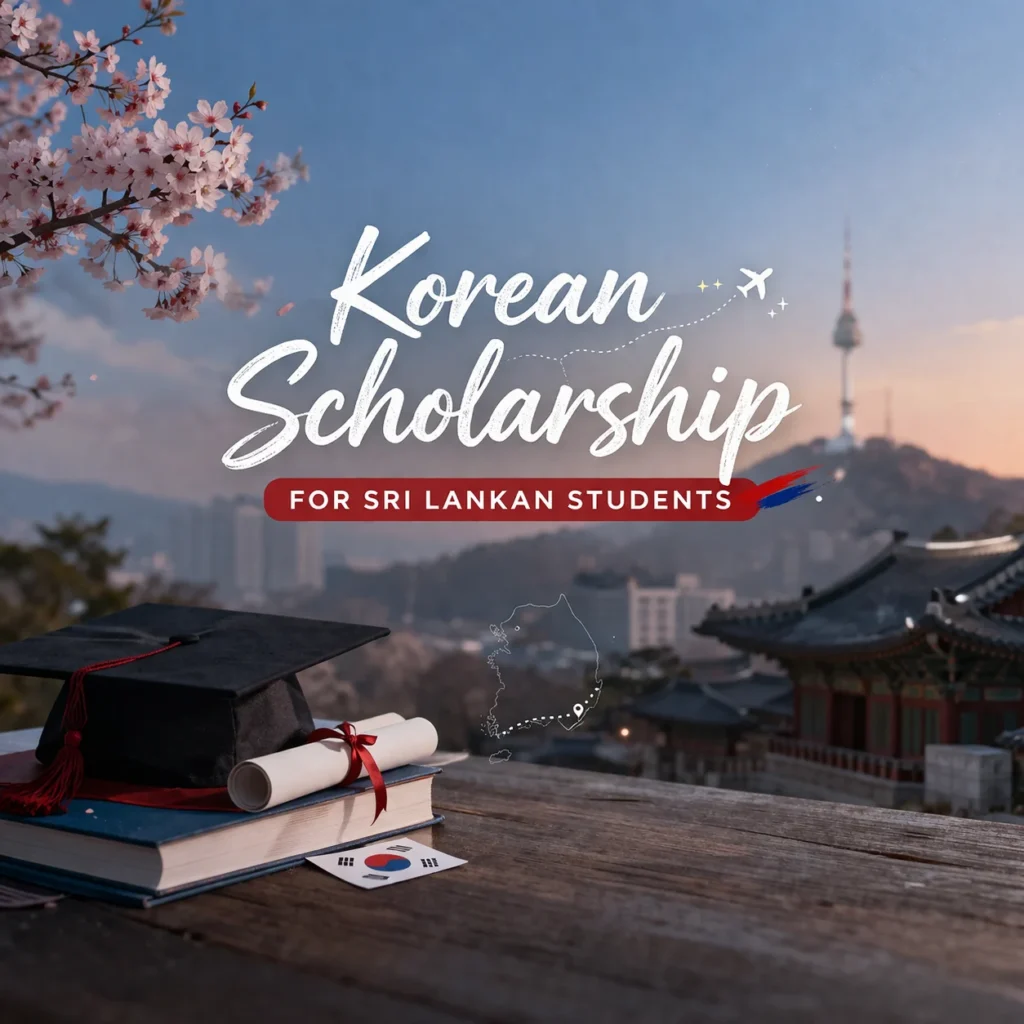
Korean Scholarships for Sri Lankan Students (2026–27): GKS Deadlines, Stipend and How to Apply
Updated 12 November 2026 · Prepared by the GIEC Global study abroad team, Galle · Checked against the GKS guidelines (NIIED / Study in Korea) and the Korean Embassy in Colombo
The main fully funded Korean scholarship open to Sri Lankans is the Global Korea Scholarship (GKS), run by Korea's National Institute for International Education (NIIED). It pays your airfare, a year of Korean language training, tuition and a monthly allowance. There are two separate cycles each year: undergraduate (GKS-U) opens around September, and graduate (GKS-G, for master's and PhD) opens around February.
As of November 2026, the 2027 undergraduate embassy-track deadline (30 September 2026) has passed. Some university-track deadlines may still be open, and the 2027 graduate cycle is expected in early 2027. GKS is very competitive: Sri Lanka gets only a handful of embassy-track places each year, so plan a backup route as well.
Quick answer: GKS undergraduate vs graduate
| GKS-U (undergraduate) | GKS-G (master's / PhD) | |
|---|---|---|
| Who it is for | A/L students without a bachelor's degree | Bachelor's holders (master's) or master's holders (PhD) |
| When it opens | Around September | Around February |
| Sri Lanka embassy places | 2 (2027 cycle) | 7 (2026 cycle) |
| Age limit | Under 25 | Under 40 |
| Allowance in the degree | About LKR 300,000 a month (KRW 1,200,000) | About LKR 345,000 a month (KRW 1,380,000) |
| Length | 1 language year + 4 to 6 years | 1 language year + 2 years (master's) or 3 years (PhD) |
LKR at KRW 1 = LKR 0.25 (reference rate, early November 2026). Allowances are from the 2027 GKS-U and 2026 GKS-G guidelines; check the latest guideline before you apply.
What's new for GKS 2027
2027 undergraduate quotas and dates
The 2027 GKS-U programme will select 286 scholars: 156 through the embassy track and 130 through the university track. The embassy track took applications online from 15 to 30 September 2026, and university-track deadlines run from September to November 2026, set by each university. Final results are expected in early January 2027.
Higher allowances than older guides show
Many websites still quote KRW 900,000 or KRW 1,000,000 a month. The current guidelines set the allowance as a yearly amount: for 2027 GKS-U, KRW 13,560,000 a year in the language year and KRW 14,400,000 a year in the degree; for 2026 GKS-G, KRW 16,560,000 a year in the degree. Always check the guideline for your cycle.
GKS scholarship Sri Lanka: how the two tracks work
Sri Lankans can apply through one of two tracks. You cannot apply to both in the same cycle.
- Embassy track: you apply through the Korean Embassy in Colombo, which shortlists and interviews candidates before sending them to NIIED. You can usually choose up to three universities from the approved list. Sri Lanka's quota is small: 2 places for the 2027 undergraduate cycle and 7 for the 2026 graduate cycle.
- University track: you apply directly to one designated Korean university, which screens you before NIIED's final selection. Undergraduate university-track places are in the UIC (industry-cooperation) and associate-degree programmes; the UIC programme is open to applicants from countries without an embassy quota too.
Embassy notices for Sri Lanka are published by the Embassy of the Republic of Korea in Sri Lanka (98 Dharmapala Mawatha, Colombo 7). The full guidelines and online application are on Study in Korea. Read your cycle's notice carefully: past Sri Lankan graduate rounds asked for printed copies to be delivered to the embassy as well as online forms.
Not sure whether the embassy track or the university track gives you a better chance? Tell us your results and field, and we will compare both for you.
Compare My TracksWhat GKS covers
| Benefit | Undergraduate (GKS-U 2027) | Graduate (GKS-G 2026) |
|---|---|---|
| Airfare | Economy ticket to Korea and home after completion | Economy ticket to Korea and home after completion |
| Korean language year | Programme fee paid (KRW 5,200,000) | Programme fee paid |
| Tuition | Paid (NIIED pays up to its cap; the university covers the rest) | Paid (NIIED pays up to its cap; the university covers the rest) |
| Allowance, language year | About LKR 282,500 a month (KRW 1,130,000) | About LKR 300,000 a month (KRW 1,200,000) |
| Allowance, degree | About LKR 300,000 a month (KRW 1,200,000) | About LKR 345,000 a month (KRW 1,380,000) |
Formula: LKR = KRW × 0.25 (reference rate, early November 2026), rounded. Monthly figures are the guideline's yearly amounts divided by 12. Scholars already living in Korea at the final announcement do not receive the entry airfare. Older guides list extra items such as a settlement allowance or TOPIK bonus; check the current guideline to see which still apply.
GKS eligibility checklist for Sri Lankans
- Citizenship: you and both parents must not hold Korean citizenship.
- Age (GKS-U 2027): under 25, born after 1 March 2002.
- Age (GKS-G): under 40 (for 2026, born on or after 1 September 1986).
- Grades (GKS-G): at least 80% average, a top-20% class rank, or a CGPA of at least 2.64/4.0 (or the equivalent on other scales). Undergraduate grade rules are set in the GKS-U guideline.
- Degree status: undergraduate applicants must not already hold a bachelor's degree; graduate applicants must hold the degree below the one they apply for.
- Health: you must be in good physical and mental health and submit the medical form.
- Previous GKS: past GKS scholars usually cannot apply again at the same level. Check the restrictions in your guideline.
Check your age, grades and degree status against the current GKS rules before you spend time on documents.
Check My GKS EligibilityHow to apply for GKS from Sri Lanka: step by step
- Pick your cycle and track: undergraduate (September) or graduate (February); embassy or university track.
- Choose universities and fields: only from the designated list in that year's guideline.
- Prepare documents: application form, personal statement, study plan, recommendation letters, certificates and transcripts, passport copy and medical form. Sri Lankan certificates may need an apostille or embassy confirmation; follow the guideline exactly.
- Add language scores if you have them: TOPIK or English test results are not required but can strengthen your file.
- Submit on time: online through Study in Korea, plus any printed copies the Colombo embassy asks for.
- Interview and screening: embassy or university first round, then university admission (embassy track), then NIIED's final selection.
- Visa and arrival: selected scholars receive admission documents for the student visa and usually start with the Korean language year.
Your personal statement and study plan often decide the result. Write them yourself, link your goals to Sri Lanka and to Korea, and make every date and detail match your documents.
Want honest feedback on your personal statement and study plan before you submit? We will review both against the GKS evaluation criteria.
Review My StatementCommon reasons GKS applications fail
- Missing the right cycle: applying in February for an undergraduate place, or in September for a master's place.
- Incomplete or unverified documents: missing apostilles, translations or signatures, or transcripts without grade explanations.
- A generic study plan: one that could be about any country or university, with no clear link to your chosen field and your career in Sri Lanka.
- Weak recommendation letters: short letters that do not show the referee knows your work.
- Choosing the wrong universities: picking only the most competitive universities, or fields your grades do not support.
- Breaking the rules: applying to both tracks, or missing the age or grade limit by a small margin.
Other Korean scholarships for Sri Lankans
Outside GKS, most Korean scholarships are partial tuition waivers given by universities to international students, based on grades and Korean or English test scores. Many universities renew them each semester only if you keep a minimum GPA. They rarely cover living costs.
- Check each university's international admissions page for the exact scholarship name, percentage and renewal rules for your intake.
- Graduate students in science and engineering can sometimes join a professor's lab, where tuition and a research stipend are paid from research funds. Contact professors directly with your CV and research interests.
- Exchange programmes may be available if your Sri Lankan university has a partnership with a Korean university.
Compare Korea with other countries in our guide to scholarships available for Sri Lankan students, or see our study abroad scholarship support.
Need a university and field shortlist that matches your grades, budget and scholarship chances in Korea? We will prepare one with you.
Get My ShortlistLife and money in Korea for Sri Lankan students
The GKS allowance is designed to cover a modest student life. Rent in Seoul is usually higher than in regional cities, so many scholars share rooms or live in university dormitories. For full living costs, universities and student visa steps, see our guide to studying in South Korea from Sri Lanka.
Part-time work rules (2026)
- You need a part-time work permit from Korean immigration before you start any job.
- Undergraduates who meet the Korean-language requirement (TOPIK 3 in years 1 to 2, TOPIK 4 in years 3 to 4) can work up to 25 weekday hours a week; others are limited to 10.
- Graduate students who meet TOPIK 4 can work up to 30 weekday hours a week; others are limited to 15.
Check the current rules on HiKorea and with your university, and confirm whether your scholarship has its own conditions on work.
Winter is real: temperatures in Seoul can fall well below zero, so budget for warm clothes in your first months.
If you do not get GKS
Most applicants are not selected, because places are few. That does not have to end your Korea plan:
- Apply to universities directly and ask about their international student scholarships.
- Build a realistic budget for tuition and living costs, then look at loans, family support and partial scholarships. Our guide on ways to fund your study abroad plans can help.
- Reapply for GKS in the next cycle with stronger language scores and a sharper study plan.
- Compare Korea with other options in our guide to the best country to study abroad from Sri Lanka.
For full self-funded options, fees and university choices, our South Korea study service covers the whole process.
Want a self-funded or partial-scholarship plan for Korea with a clear LKR budget? We will build one around your course and intake.
Plan My Korea BudgetKorean scholarship FAQs
Is there a Korean scholarship for Sri Lankan students in 2026–27?
Yes. The Global Korea Scholarship (GKS) is open to Sri Lankans. The 2027 undergraduate embassy-track deadline was 30 September 2026, some university-track deadlines run to November 2026, and the 2027 graduate cycle is expected around February 2027.
How many GKS places does Sri Lanka get?
Sri Lanka has 2 embassy-track places in the 2027 undergraduate cycle and had 7 in the 2026 graduate cycle. University-track places are separate and shared with applicants from other countries.
How much does the GKS scholarship pay?
For 2027 undergraduates, the allowance is KRW 14,400,000 a year in the degree (about LKR 300,000 a month at KRW 1 = LKR 0.25). For 2026 graduates, it is KRW 16,560,000 a year in the degree (about LKR 345,000 a month). Airfare, the Korean language year and tuition are also covered.
What is the age limit for GKS?
Undergraduate applicants must be under 25 (for 2027, born after 1 March 2002). Graduate applicants must be under 40, with the exact birth date set in each year's guideline.
Do I need TOPIK or IELTS to apply for GKS?
No language test is required to apply, but TOPIK or English scores can strengthen your application. Most scholars complete a Korean language year before starting their degree.
Can I apply for GKS through both the embassy and a university?
No. You must choose one track in each cycle. The embassy track goes through the Korean Embassy in Colombo; the university track goes directly to one designated university.
Can I work part-time while studying in Korea?
Yes, with a part-time work permit. In 2026, undergraduates who meet the TOPIK requirement can work up to 25 weekday hours a week and graduate students up to 30; others have lower limits. Check whether your scholarship adds its own conditions.
What can I do if I do not get GKS?
You can apply directly to Korean universities for partial tuition scholarships, plan a self-funded budget, or reapply for GKS in the next cycle with stronger language scores and a better study plan.
Prefer to talk first? Contact our Sri Lanka study abroad team by phone, WhatsApp or email.
Get Help With Your Korean Scholarship Plan
Tell us your study level, A/L results or GPA, preferred field and intake. A GIEC Global counsellor will reply with your GKS options and next steps. Your first enquiry is free.
