 Skip to content

Profile for Study Abroad from Sri Lanka (2026): Build It in 3–6 Months
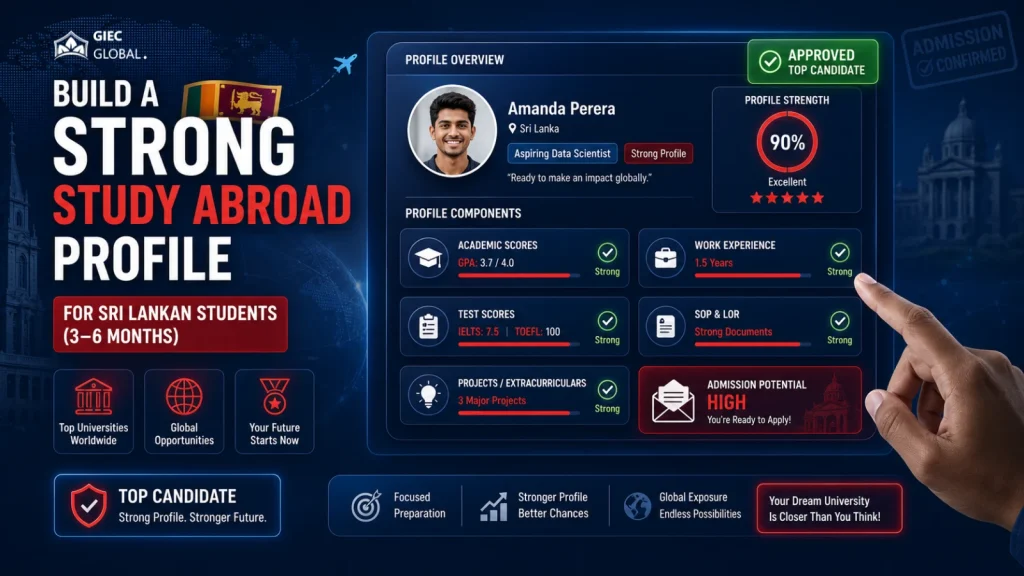
A strong profile for study abroad is a clear mix of good academics, an English test score, relevant experience, a focused Statement of Purpose (SOP) and complete documents. You can build one in 3–6 months if you start with the right course and country and fix the biggest gaps first.
Many Sri Lankan students lose time because they collect random certificates, apply to the wrong course, or start documents too late. Universities and visa officers want a story that makes sense: what you studied, why you want this course, and how you will fund it.
This guide shows how to study abroad from Sri Lanka step by step, which documents you need, and how to build each part of your profile. If you want a counsellor to check your profile, use the free profile review form at the end.
Quick Answer: How to Study Abroad from Sri Lanka
- Month 0–1: Choose your course and 2–3 countries.
- Month 1–3: Book and prepare for IELTS, TOEFL or PTE. Gather academic documents.
- Month 2–4: Add relevant experience, a short course or a project.
- Month 3–5: Write your SOP and request recommendation letters.
- Month 4–6: Apply, accept your offer, prepare funds and documents, then file your student visa.
Budget: Tuition, living costs and visa fees differ for every country and university. Check the current figures on the university and government websites, or ask a counsellor, before you plan your savings.
What Universities Look for in a Study Abroad Profile
Universities do not decide on marks alone. They check if you can complete the course, if your English is strong enough, and if your plan is genuine.
| Profile part | What they check | How to show it |
|---|---|---|
| Academics | A/L results, degree GPA or class, subject match | Official transcripts, and a short explanation for any low or gap year |
| English | IELTS, TOEFL, PTE or accepted equivalent | Test report that meets the course requirement |
| Goals | Why this course, country and university | A clear SOP with short and long-term plans |
| Experience | Internship, job, volunteering, projects | Letters, certificates, a simple portfolio |
| Documents | Complete, consistent and genuine | Same names, dates and details in every paper |
| Funds | Proof you can pay fees and living costs | Sponsor letter, bank documents, income proof |
Consistency matters more than size
A student with a simple, matching profile is often safer than a student with many unrelated achievements. If you studied Commerce and now apply for IT, explain the change in your SOP and show a short course or project.
Step 1: Choose the Right Course and Country
This is the base of your whole profile. Everything else, from your test score to your SOP, depends on this choice.
Start with the course, not the country
- Pick a course that fits your A/L stream or degree, or has a clear bridge from it.
- Write down the job you want after the course. If you cannot, the SOP will be weak.
- Check if the course is practical and linked to industry.
Compare 2–3 countries
Compare education quality, total cost, part-time work rules, post-study work options and visa requirements. These rules change, so confirm them on official sites before you decide. You can read our country pages for studying in Australia, studying in the UK, studying in Canada and studying in Germany.
Not sure which course and country fit your results? Get a free eligibility check.
Check My EligibilityStep 2: Improve Your Academic Profile Fast
You cannot change old results, but you can show progress and subject strength.
If your A/L or degree results are average
- Choose courses and universities with entry levels that match your results.
- Take a short certificate in a subject linked to your course. Choose recognised providers and keep the certificate.
- Show improvement. A rising trend in semester results helps.
- Explain gaps honestly in your SOP. A visa officer sees unexplained gaps as a risk.
If you have just finished A/L
Some countries accept A/L results for a bachelor’s course directly, while others ask for a foundation year or a diploma first. Check this for each country. Our blog on study abroad vs studying in Sri Lanka helps you compare both paths.
If you have a degree
Postgraduate courses look at your degree class or GPA, subject match and work experience. A 3-year degree may be accepted for some master’s courses and not for others, so confirm this before you apply.
Step 3: Prepare for IELTS, TOEFL or PTE
Most universities ask for an English test. Many courses need an overall IELTS score around 6.0 to 6.5, but the exact score depends on the course and university. Always check the course page.
A simple English test plan
- Check which tests your target university accepts.
- Take one full mock test to find your starting level.
- Study 1–2 hours a day on your weakest skill first.
- Take a mock test every 2 weeks and fix repeated mistakes.
- Book your real test early so you have time for a retake.
GIEC offers coaching for IELTS, TOEFL and PTE.
Need a talk with a counsellor about test scores, timelines and intakes?
Book a Counsellor CallStep 4: Add Relevant Experience and Projects
You do not need a big résumé. You need experience that relates to your course.
Easy ways to build experience in 3–6 months
- Internship or part-time work: even 1–3 months in a related field counts. Ask for an experience letter.
- Volunteering: choose work that uses a skill linked to your course.
- A small project: a research paper, a simple app, a business plan or a design portfolio.
- Online short courses: pick one or two and finish them, with certificates.
- Clubs and competitions: keep it limited and show a real role.
Keep proof for everything: letters, certificates, photos of work, links. Avoid claims you cannot prove, because documents may be checked.
Step 5: Write a Clear SOP
Your SOP should answer three questions: why this course, why this country and university, and what you will do after graduation.
SOP structure that works
- Opening: what sparked your interest in the subject.
- Academic background: subjects and results linked to the course.
- Experience: what you did and learned, not just a list.
- Why this university: specific modules, labs or industry links.
- Future plan: a realistic short-term and long-term goal.
Write in simple English, in your own words. Never copy a sample SOP. Universities and visa officers can spot copied or generic text. Ask a teacher or counsellor to review it before you submit.
Step 6: Get Strong Letters of Recommendation
- Choose a teacher, lecturer or manager who knows your work well, not just the most senior person.
- Share your CV, SOP and course details so the letter is specific.
- Ask at least 4–6 weeks before the deadline.
- Most courses ask for 1–3 letters. Check each university’s rule.
Want a counsellor to review your SOP, CV and documents before you apply?
Get a Profile ReviewDocuments You Need to Study Abroad from Sri Lanka
Many students in Colombo, Galle, Kandy and other cities ask what documents they need. The list below is the common base. Each university and country adds its own rules, so confirm the final list before you apply.
| Stage | Common documents |
|---|---|
| University application | Passport, O/L and A/L results or degree transcripts and certificate, English test report, SOP, CV, recommendation letters, portfolio if the course needs it |
| Financial proof | Sponsor details, bank documents, income or business proof, property or savings proof as the country requires |
| Student visa | Offer letter or acceptance, passport, photos, application forms, health and character documents as required, insurance where required |
Requirements change by country and by year. Always check the official immigration website of your destination before you submit.
Profile checks before you file a visa
Visa officers compare your profile with your plan. These are common reasons for refusal, so check them before you apply:
- The course does not match your past studies and there is no explanation.
- Unexplained study or work gaps.
- Funds that are unclear, new or not linked to your sponsor.
- Different dates, names or details in different documents.
- An SOP that sounds copied or does not match your answers in the interview.
Prepare for questions you may be asked
- Why did you choose this course and this university?
- How does this course fit your earlier studies?
- Who is paying for your studies and how?
- What will you do after you finish?
Practise your answers with someone who knows student visa files.
Request a Mock InterviewScholarships and Funding Your Plan
Scholarships can reduce your costs, but they are competitive and a strong profile helps. Look at your marks, test score, projects and leadership, and apply early. See our study abroad scholarships page for options, and read which US universities give big scholarships if the USA is on your list.
Never accept a promise that a scholarship or visa is guaranteed. Check every offer on the official university or government website.
Courses Abroad: How to Pick Yours
If you are searching for courses abroad, start with your interest, your previous studies and job demand in your home and destination country. Then check if the course has strong industry links, practical work and clear entry rules.
- See popular options in our blog on best courses to study in the USA for Sri Lankan students.
- Browse all destinations on our education consultant page.
Build Your Plan Month by Month
Use this timeline as a starting point. If your deadline is close, do steps in parallel.
| Month | Focus | Output |
|---|---|---|
| 1 | Course and country choice, test booking | Shortlist of 2–3 countries and 5–8 courses |
| 2 | English preparation, document list | Mock test score, scanned documents |
| 3 | Experience, project or short course | Certificates and a project summary |
| 4 | SOP, CV, recommendation requests | Draft SOP and CV, letters requested |
| 5 | Applications | Submitted applications, offers |
| 6 | Funds, acceptance, visa | Visa file ready |
For a wider plan, read our guide on how to create a study abroad plan from Sri Lanka.
Compare Destinations Before You Apply
Your profile may be stronger for one country than another. Compare these pages before you decide:
Compare countries against your budget, results and goals with a GIEC counsellor.
Compare My OptionsFrequently Asked Questions
How can I study abroad from Sri Lanka?
Choose a course and country, take an English test if required, prepare your documents, apply to universities, accept an offer, show your funds and apply for a student visa. A counsellor can guide you through each step.
How long does it take to build a strong profile for study abroad?
With a clear plan, most students can build a solid profile in 3–6 months. If your English test or documents are not ready, you may need more time.
What documents are needed to study abroad from Colombo?
Commonly you need a passport, O/L and A/L results or degree transcripts, an English test report, SOP, CV, recommendation letters and financial documents. Each country and university adds its own rules, so confirm the final list before you apply.
Can I apply with average academic results?
Yes, but choose courses that match your results. A good English score, relevant experience, a clear SOP and a short certificate can make your profile stronger.
How important are IELTS, TOEFL or PTE scores?
They are very important because most universities and visa systems need proof of English. The required score depends on the course and country.
Do internships and activities matter?
Yes. Relevant internships, projects and volunteering show practical skills and support your course choice. Keep proof of everything you list.
When should I start preparing?
Start at least 6 months before your application deadline. If you have less time, you can still prepare in 3 months by doing the English test, SOP and documents in parallel.
Can GIEC Global help me check my profile?
Yes. GIEC Global Sri Lanka has an office in Galle and can review your results, course choice, documents and funds. Fill in the form below to request a profile review.
Get a Free Profile Review
Tell us your results, intake and budget. A GIEC counsellor will contact you to discuss courses, countries and next steps. No obligation.
Information in this article is general guidance. Fees, test scores, funds and visa rules differ by country, university and year, and can change. Check official university and government websites for current rules. GIEC Global cannot guarantee admission, scholarships or visa outcomes.
