 Skip to content

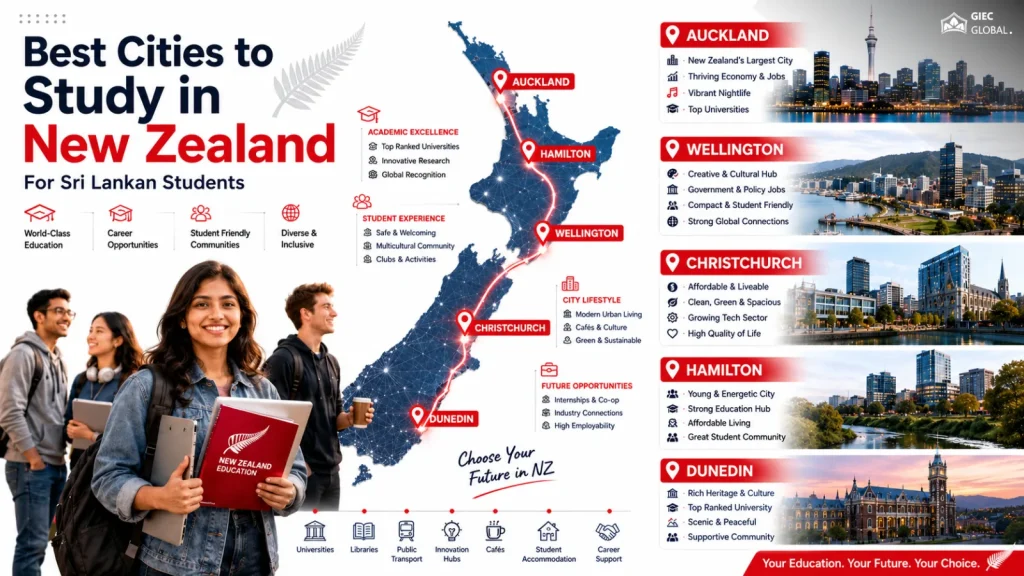
Best Cities to Study in New Zealand for Sri Lankan Students (2026): Universities, Rent and Jobs
Updated 12 November 2026 · Prepared by the GIEC Global study abroad team, Galle · Visa rules checked on Immigration New Zealand; rankings from QS World University Rankings 2027; rents from the Trade Me Rental Price Index
For most Sri Lankan students, the right New Zealand city depends on three things: the university and course you want, how much rent you can afford, and how easily you can find part-time work. Auckland has the biggest job market and the highest-ranked university. Dunedin and Palmerston North are smaller student towns. Wellington, Christchurch and Hamilton sit in between.
Whichever city you choose, the visa rules are the same. You must show NZD 20,000 per year (about LKR 3.74 million) for living costs on top of your tuition. Once you arrive, you can work up to 25 hours a week during study.
Quick answer: which New Zealand city suits you?
| City | Best for | Main universities | Median weekly rent* |
|---|---|---|---|
| Auckland | Jobs, business, IT, widest course choice | University of Auckland, AUT | NZD 625 |
| Wellington | Law, public policy, creative and media courses | Victoria University of Wellington | NZD 650 |
| Christchurch | Engineering, agriculture (Lincoln) | University of Canterbury, Lincoln University | NZD 570 |
| Hamilton | Smaller city, management and science | University of Waikato | NZD 570 |
| Dunedin | Health sciences, a classic student town | University of Otago | NZD 560 |
| Palmerston North | Veterinary, aviation, agriculture | Massey University | NZD 580 |
*Median weekly rent for a whole rental property, Trade Me Rental Price Index, February 2026. Students usually share a flat and pay only for one room. Visa funds rule: NZD 20,000 a year, about LKR 3,740,000 at NZD 1 = LKR 187.
What's new for New Zealand student visas in 2026
Work up to 25 hours a week during study
Since 3 November 2025, new student visas allow up to 25 hours of work a week during term, up from 20. Students who still hold an older 20-hour visa must apply for a variation of conditions to get the extra five hours. Full-time work during scheduled holidays is allowed if your course is worth at least 120 credits. Check the conditions printed on your own visa.
New 6-month Short-Term Graduate Work Visa from 16 November 2026
Immigration New Zealand opens a new Short-Term Graduate Work Visa on 16 November 2026. It gives six months of open work rights to graduates who do not qualify for a Post-Study Work Visa. You must apply within three months of your student visa ending, have at least NZD 5,000 to support yourself, and you can hold it only once.
Post-Study Work Visa now covers Level 7 Graduate Diplomas
From the same date, Post-Study Work Visa eligibility extends to eligible Graduate Diplomas at Level 7 for students who already hold a bachelor's degree. Both graduate work visas are now applied for online only.
How to choose a city in New Zealand
Do not choose a city first and a course second. Shortlist the course, then compare the cities where it is taught. These six points matter most:
- Course and university: the same degree can be stronger at one university than another. Check subject rankings and accreditation, not only the overall rank.
- Course level: your level decides your post-study work rights. Our guide on diploma vs degree programmes in New Zealand explains the difference.
- Rent: rent is the biggest monthly cost and changes a lot by city. A cheaper city can save more than a small scholarship.
- Part-time jobs: bigger cities have more retail, hospitality and warehouse jobs, but also more students looking for them.
- Climate: the South Island (Christchurch, Dunedin) has colder winters than Sri Lanka has ever prepared you for. Budget for heating and warm clothes.
- City size: Auckland is the largest and most diverse city. Smaller cities feel quieter and closer, which suits some students better.
Tell us your course, budget and A/L or degree results. We will shortlist the New Zealand cities and universities that fit.
Get My City ShortlistNew Zealand cities compared for international students
| City | University (QS 2027 rank) | Known for | Median weekly rent (NZD) | In LKR |
|---|---|---|---|---|
| Auckland | University of Auckland (67); AUT (431) | Business, engineering, IT, health | 625 | 116,900 |
| Wellington | Victoria University of Wellington (241) | Law, public policy, earth sciences, design | 650 | 121,600 |
| Christchurch / Lincoln | University of Canterbury (257); Lincoln University (419) | Engineering, agriculture, agribusiness | 570 | 106,600 |
| Hamilton | University of Waikato (293) | Management, science, education | 570 | 106,600 |
| Dunedin | University of Otago (198) | Health sciences, medicine-related fields | 560 | 104,700 |
| Palmerston North | Massey University (215) | Veterinary science, aviation, agriculture | 580 | 108,500 |
Rents are Trade Me median weekly rents for a whole property in February 2026 (Auckland city and Christchurch city figures). LKR = NZD × 187 (approximate mid-market rate, early November 2026), rounded to the nearest 100. Your bank rate will differ. Massey also has campuses in Auckland and Wellington.
Auckland: best for jobs and city life
Auckland is New Zealand's largest city and home to the University of Auckland, the country's highest-ranked university at 67th in the QS World University Rankings 2027, and Auckland University of Technology (AUT). Many private institutes and polytechnic campuses are also here, so course choice is the widest.
The job market is the biggest in the country, which helps with part-time work and graduate jobs. The trade-off is cost: Auckland city's median rent was NZD 625 a week in February 2026, and commuting across the city takes time and money. Many students live further out and travel in by bus or train.
Honest drawback: high rent and long commutes. Budget more than you would for a smaller city.
Wellington: best for law, policy and creative courses
Wellington is the capital. Victoria University of Wellington | Te Herenga Waka (241st in QS 2027) is strong in law, public policy and earth sciences, and Massey University's Wellington campus offers creative arts and design. The city is compact and walkable, with government, policy and creative-industry employers.
Honest drawback: Wellington had the highest median rent in this comparison (NZD 650 a week in February 2026). It is also famous for strong wind and steep streets.
Christchurch and Lincoln: best for engineering and agriculture
The University of Canterbury (257th in QS 2027) is well known for engineering. Lincoln University (419th) is a specialist land-based university in the town of Lincoln, near Christchurch, focused on agriculture, agribusiness and environmental studies. Christchurch is flat, easy to cycle and has a growing construction and technology sector after its post-earthquake rebuild.
Christchurch is often called the cheap option, but in February 2026 Christchurch city's median rent (NZD 570) matched Hamilton's and was about NZD 55 a week below Auckland city's. It is cheaper than Auckland and Wellington, but not dramatically so.
Honest drawback: colder winters and a smaller job market than Auckland.
Hamilton: a quieter, mid-sized option
Hamilton is roughly 1.5 to 2 hours south of Auckland by road. The University of Waikato (293rd in QS 2027) has its main campus here. The city suits students who want a calmer place with easy access to Auckland. The wider Waikato region is a major farming area, which shapes local jobs and research.
Honest drawback: fewer part-time jobs and a smaller student scene than the big cities.
Dunedin: best for health sciences and student life
Dunedin is New Zealand's classic student town. The University of Otago, the country's oldest university (founded 1869) and 198th in QS 2027, is known for health sciences. Students make up a large share of the city, and most live in shared flats near campus.
Honest drawback: many student flats are old, cold and hard to heat. Otago also recorded the largest annual rent increase in New Zealand in April 2026, so do not assume Dunedin will stay cheap.
Palmerston North: best for veterinary, aviation and agriculture
Palmerston North is the main campus of Massey University (215th in QS 2027, its highest rank so far). Massey is the only New Zealand university offering veterinary medicine and aviation programmes. The city is small, central and focused on agriculture and research.
Honest drawback: a small city with limited nightlife and fewer part-time jobs.
Cost of studying in New Zealand in LKR
| Item | LKR (approx.) | NZD |
|---|---|---|
| Living-cost funds for the visa (1 year or more) | 3,740,000 per year | 20,000 per year |
| Living-cost funds (course under 1 year) | 311,700 per month | 1,667 per month |
| Fee Paying Student Visa application | From 159,000 | From 850 |
| Tuition | Depends on course and provider. You must show tuition paid for one year or one course, whichever is shorter. | |
Formula: LKR = NZD × 187 (approximate mid-market rate, early November 2026). The rupee moves, so recalculate with your bank's rate before you transfer money. Visa fee and funds from Immigration New Zealand's Fee Paying Student Visa page. Travel and health insurance is also compulsory.
For tuition ranges by course, see our New Zealand study options and fees for Sri Lankan students. To lower the cost, look at scholarships for Sri Lankan students in New Zealand and our guide on ways to fund your study abroad plans.
Want to know the real yearly cost for your course in your chosen city? We will build an LKR estimate with tuition, rent, insurance and visa costs.
Get My LKR EstimateWork while studying and after graduation
During your studies
- Up to 25 hours a week during term, on visas granted from 3 November 2025.
- Full-time during scheduled holidays, if your course is worth 120 credits or more.
- Students aged 16 or 17 at a tertiary provider need written permission from a parent and the provider.
Part-time pay helps with daily costs, but it will not cover tuition. Immigration New Zealand still expects you to show the full NZD 20,000 a year before you arrive.
After graduation
- Post-Study Work Visa: open work rights for eligible graduates. The length depends on your qualification level and how long you studied in New Zealand. Bachelor's and master's degrees can lead to up to three years.
- Short-Term Graduate Work Visa: six months of open work, from 16 November 2026, for eligible graduates whose course does not lead to a Post-Study Work Visa.
Neither visa is permanent residence. Moving to a longer work visa or residence depends on finding a suitable job, so choose a course with real demand in New Zealand.
Not sure whether your course will give you post-study work rights? Send us the course name and level and we will check it.
Check My CourseStudent visa rules every Sri Lankan should know
- Who can sponsor you: if you apply from Sri Lanka, only immediate family can sponsor you or give a financial undertaking. Funds from an uncle, a family friend or a loan in someone else's name can be a problem.
- Show real, explainable funds: large, sudden deposits with no clear source are a common refusal reason. Read our guide to student visa rejection in Sri Lanka before you apply.
- Apply early: Immigration New Zealand processes 80% of applications within 5 weeks, but asks you to apply at least 3 months before travel. October to March is the busiest period.
- English test: most universities ask for IELTS or PTE. If you still need a score, see our IELTS preparation classes or PTE preparation classes.
- Changing course or provider: moving to a new provider or a lower study level needs a new visa, not a simple change of conditions.
Worried about funds, sponsors or bank statements? We will check your financial documents against Immigration New Zealand's rules before you apply.
Check My Visa FundsReality check before you choose New Zealand
- Funds are strict: NZD 20,000 a year plus tuition is a large amount in LKR. Plan the full course, not only the first year.
- Housing can be poor quality: older flats, especially in Dunedin and Wellington, can be cold and damp. Visit university accommodation pages before you sign anything.
- Jobs are not guaranteed: smaller cities have fewer part-time jobs, and graduate jobs depend on your field.
- Distance and flights: there are no direct flights from Colombo, so trips home are long and expensive.
If New Zealand looks too expensive, compare it with studying in Australia or read our guide to the best country to study abroad from Sri Lanka.
Which New Zealand city should you choose?
- You want the widest choice and the most jobs: Auckland.
- You want law, policy or creative courses: Wellington.
- You want engineering or agriculture: Christchurch or Lincoln.
- You want health sciences and a student-town feel: Dunedin.
- You want veterinary science or aviation: Palmerston North.
- You want a quieter city close to Auckland: Hamilton.
Choose the course first, then pick the city that teaches it well at a cost you can prove to Immigration New Zealand.
Still deciding between New Zealand and another country? We will compare costs, work rights and visa rules side by side for your profile.
Compare CountriesFAQs: studying in New Zealand cities
Which city is best for Sri Lankan students in New Zealand?
It depends on your course and budget. Auckland has the most jobs and the highest-ranked university, Dunedin suits health sciences, Christchurch suits engineering, Wellington suits law and policy, and Palmerston North suits veterinary science and aviation.
Which New Zealand city is cheapest for students?
In February 2026, Dunedin had the lowest median weekly rent of the main student cities at NZD 560, followed by Christchurch and Hamilton at NZD 570. The gap is small, and Otago rents rose fastest in New Zealand in April 2026, so compare current rents before you decide.
Which universities are in each New Zealand city?
Auckland has the University of Auckland and AUT, Wellington has Victoria University of Wellington, Christchurch has the University of Canterbury with Lincoln University nearby, Hamilton has the University of Waikato, Dunedin has the University of Otago, and Palmerston North has Massey University's main campus.
How much money do I need for a New Zealand student visa?
You must show NZD 20,000 per year for living costs (about LKR 3.74 million at NZD 1 = LKR 187), or NZD 1,667 per month for courses under one year, plus tuition paid for one year or one course. The visa application fee starts from NZD 850.
How many hours can international students work in New Zealand?
Student visas granted from 3 November 2025 allow up to 25 hours a week during term, and full-time work in scheduled holidays if the course is worth at least 120 credits. Older 20-hour visas need a variation of conditions to get 25 hours.
Can I work in New Zealand after graduation?
Eligible graduates can apply for a Post-Study Work Visa, which can last up to three years depending on the qualification. From 16 November 2026, graduates who do not qualify can apply for a 6-month Short-Term Graduate Work Visa within three months of their student visa ending.
Who can sponsor a Sri Lankan student for a New Zealand visa?
If you apply from Sri Lanka, Immigration New Zealand only accepts immediate family members as sponsors or for a financial undertaking.
How long does a New Zealand student visa take?
Immigration New Zealand processes 80% of Fee Paying Student Visa applications within 5 weeks, but recommends applying at least 3 months before you travel, because October to March is the busiest period.
Prefer to talk first? Contact our Sri Lanka study abroad team by phone, WhatsApp or email.
Get Your Free New Zealand City and Course Shortlist
Tell us your results, preferred course, intake and budget. A GIEC Global counsellor will reply with suitable cities, universities and a realistic LKR budget.
