 Skip to content

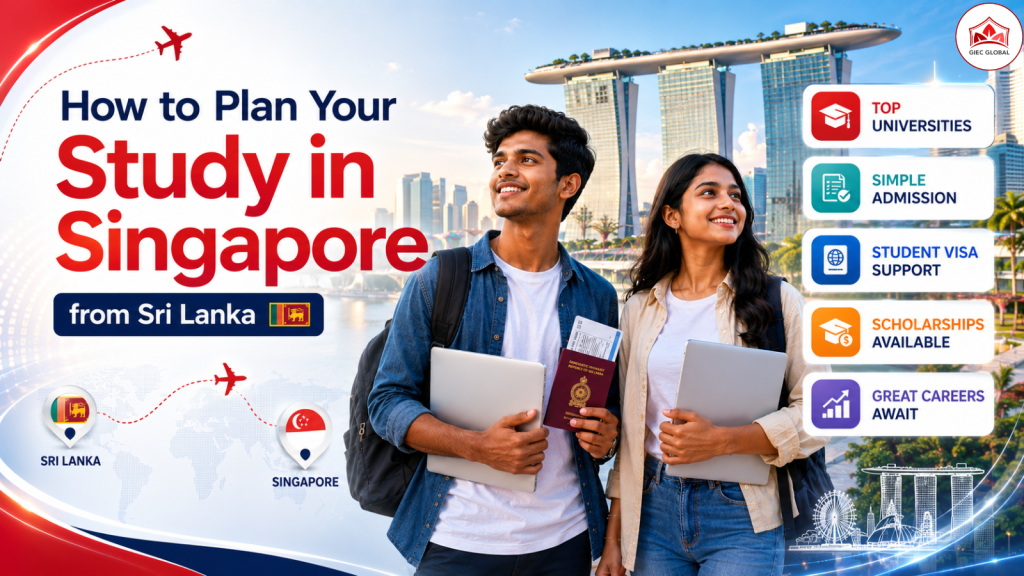
Study in Singapore from Sri Lanka (2026): Costs, Student's Pass and Public vs Private
Updated 11 November 2026 · Fees and pass rules checked against ICA, MOM, MOE, SkillsFuture Singapore and university fee pages.
Planning to study in Singapore from Sri Lanka? Start with one decision: a public university (NUS, NTU, SMU and others) or a private institution. Public universities are very competitive but let you work part-time and stay a year after graduating to look for a job. Most private institutions are easier to enter after O/L or A/L, but their students usually cannot work at all.
Budget-wise, a first year costs about LKR 9.5 to 15 million, depending on the route. Singapore is worth it if your family can fund the full course without relying on part-time income, and if you choose your institution carefully.
Quick answer: your route from Sri Lanka to a Singapore campus
- Choose your route: a public university or polytechnic, or an EduTrust-certified private institution.
- Apply and get an offer: NTU, for example, took Sri Lanka A-Level applications from mid-October to mid-March for its August 2026 intake.
- Your institution registers you with the Immigration & Checkpoints Authority (ICA).
- Apply online for your Student's Pass two to three months before your course starts and pay the S$45 processing fee.
- Receive your In-Principle Approval (IPA) letter. If your nationality needs a visa, it is built into the IPA letter.
- Travel to Singapore with your IPA letter.
- Complete formalities with ICA and pay the S$60 issuance fee to get your digital Student's Pass.
First-year budget: about LKR 9.5–11.1 million (S$36,800–42,800) at a public university with the Tuition Grant, or LKR 12.6–15.0 million without it or at a private institution. Start 10–12 months before your intake.
What's New and What's Changed for 2026
1. New university fees for the 2026-27 intake
At NUS, international students who accept the MOE Tuition Grant pay S$21,400 a year for most humanities, science, computing and engineering degrees (S$18,050 for ASEAN students). Without the grant, the same degrees cost S$36,650 to S$39,700 a year.
2. Work pass salaries rise from 2027
Singapore will raise the minimum qualifying salary for new Employment Pass applications from S$5,600 to S$6,000 a month from 1 January 2027, and for the S Pass from S$3,300 to S$3,600. If you graduate in 2027 or later, plan your job search around these higher thresholds.
3. The Student's Pass processing fee is S$45
Many older guides still say S$30. ICA now charges a non-refundable S$45 processing fee, plus a S$60 issuance fee and, if you need a visa, S$30 for a Multiple Journey Visa.
Public University or Private Institution? The Biggest Decision
After A/L: public universities
NUS lists the Sri Lanka A-Level as an accepted qualification, and NTU publishes a separate application window for it. Entry is very competitive, there is usually one intake a year (August at NTU), and international students who accept the MOE Tuition Grant must work for a Singapore entity for three years after graduating.
After O/L or A/L: private institutions
Private institutions offer foundation, diploma and degree pathways, often with several intakes a year, so they suit students who miss public-university entry or want a faster start. Only EduTrust-certified private institutions can enrol international students, and ICA will not issue a Student's Pass for a non-certified school. Always check the official EduTrust register before you pay a deposit.
After a degree: master's study
Public universities offer coursework master's, but many are self-funded and expensive, with no Tuition Grant. Compare the full programme fee, not just the yearly fee, before you apply.
English tests
Most institutions ask for an English test or strong English results, and each sets its own minimum score. NTU, for example, asks new undergraduates to take its own Qualifying English Test unless they meet the exemption rules. Many Sri Lankan students prepare through IELTS coaching or PTE exam preparation.
Not sure whether your O/L or A/L results fit a public university, a polytechnic or a private pathway? We will check your profile and tell you which route makes sense.
Check My PathwayCost of Studying in Singapore in Sri Lankan Rupees
The table compares three real 2026 examples: an NUS degree with and without the Tuition Grant, and a private bachelor's at James Cook University Singapore. LKR figures use the mid-market rate of 1 SGD = LKR 259 (10 November 2026). Formula: LKR amount = SGD amount × 259.
| Cost item | Public, with Tuition Grant | Public, no Tuition Grant | Private (JCU example) |
|---|---|---|---|
| Tuition, per year | LKR 5,542,600 (S$21,400) | LKR 9,492,350 (S$36,650) | LKR 8,638,686 (S$33,354)* |
| Living costs, per year (S$1,275–1,775 a month) | LKR 3.96–5.52 million (S$15,300–21,300) | LKR 3.96–5.52 million (S$15,300–21,300) | LKR 3.96–5.52 million (S$15,300–21,300) |
| Student's Pass fees | LKR 27,195–34,965 (S$105–135) | LKR 27,195–34,965 (S$105–135) | LKR 27,195–34,965 (S$105–135) |
| First-year total | LKR 9.53–11.09 million | LKR 13.48–15.04 million | LKR 12.63–14.19 million |
*JCU Singapore lists S$66,708 for its two-year Bachelor of Business for international students, shown here per year. Public fees are NUS humanities and sciences rates for the 2026-27 intake; computing and engineering are higher without the grant (S$39,700). Living costs use NTU's published student estimate. Student's Pass fees are S$45 processing plus S$60 issuance, plus S$30 if you need a visa. Banks in Sri Lanka sell foreign currency above the mid-market rate, so add 2–3% when you transfer money.
Showing Funds as a Sri Lankan Family
Your Student's Pass application asks about your financial support, and private institutions usually want fees paid before they release your IPA letter. Before you apply:
- Keep the full first-year tuition and living costs ready, and show where the money comes from.
- If parents are paying, keep their bank statements and income proof together and consistent.
- Read the refund policy and student contract before you pay any private institution.
If your family is still working out the money side, read our guide on ways families fund study abroad plans.
Get a personal Singapore budget in LKR, based on your route, course and intake, before you pay any deposit.
Get My LKR EstimateInstitutions: Which Fit Sri Lankan Students?
The old idea of a single "best universities" list hides the most important difference: whether you can work and stay after graduating. This table shows that clearly.
| Institution | Type | Entry for Sri Lankans | Part-time work? | 1-year job-search pass after graduating? |
|---|---|---|---|---|
| NUS, NTU, SMU | Public autonomous universities | Strong A/L results; very competitive | Yes, up to 16 hours a week in term | Yes |
| Local polytechnics (e.g. Singapore Polytechnic) | Public, diploma level | Check each polytechnic's international entry rules | Yes, up to 16 hours a week in term | Yes |
| James Cook University Singapore | Private, EduTrust-certified branch campus | Foundation, diploma or degree after O/L or A/L | No, says JCU | Check ICA's list; private institutions are generally not on it |
| Other private institutions | Private, must be EduTrust-certified | Often diploma-to-degree pathways | Usually no | Usually no; check ICA's list |
Tuition Grant and Scholarships
The MOE Tuition Grant is not a scholarship, but it cuts public-university fees a lot. In return, you must work full-time for a Singapore entity for three years after you graduate. If you do not, you must repay the subsidy. Universities also offer merit scholarships, which are highly competitive.
For private institutions, there are no Singapore government bursaries or scholarships for international students; any award comes from the school itself. See our list of scholarships open to Sri Lankan students, or get help through our study abroad scholarship guidance. No grant or scholarship is guaranteed.
Get a shortlist of EduTrust-certified institutions and the grants or scholarships you could realistically apply for.
Get My ShortlistThe Student's Pass Process from Sri Lanka
The Student's Pass is issued by ICA, but the process starts with your institution. The usual order is:
- Accept your offer and send the documents your institution asks for.
- Your institution registers you with ICA and gives you a reference number.
- Complete the online application and pay the S$45 fee, two to three months before your course starts.
- Wait for ICA's decision. For public universities and other institutes of higher learning, ICA says this takes within 1 week, or within 2 weeks if you need a visa. For private institutions, ICA says new applications take up to one month.
- Receive your IPA letter, pay the S$60 issuance fee and travel to Singapore.
- Complete formalities at ICA (including any medical report listed in your IPA letter) to get your digital Student's Pass.
For the full document checklist, see our Singapore Student's Pass service from Sri Lanka.
Documents and checks
There is usually no visa interview, so the details in your application must be complete and match your documents. You cannot attend classes until your Student's Pass is approved.
Common reasons for refusal or delay
- Enrolling at a private school that is not EduTrust-certified.
- Unclear funding, or study gaps with no explanation.
- Mismatched details between your application and your documents.
- Applying too late before the course starts.
Learn how to avoid these mistakes in our guide to student visa refusals in Sri Lanka.
Let a counsellor check your documents and timeline before your institution submits your Student's Pass application.
Book a Document CheckWork and Stay After Graduation
Part-time work while studying
You can work without a separate work pass only if you study full-time at an institution on the Ministry of Manpower's approved list, and only up to 16 hours a week during term. Students at most private institutions are not allowed to work. Working illegally can lead to your pass being cancelled and a ban from Singapore.
The job-search pass
Singapore has no automatic post-study work visa. Graduates of institutes of higher learning on ICA's list, such as NUS, NTU, SMU and the polytechnics, can apply for a one-year, non-renewable Long-Term Visit Pass to look for a job. It does not give you the right to work by itself.
Getting a work pass
To work, your employer must apply for an Employment Pass or S Pass for you. In 2026, the Employment Pass needs at least S$5,600 a month (higher for older applicants) plus 40 points under the COMPASS framework, and the S Pass needs at least S$3,300 a month.
Permanent residence: be realistic
Employment Pass and S Pass holders can apply to ICA for permanent residence, but there is no published points system and no guaranteed timeline. Treat PR as a possible long-term outcome, not a plan.
Reality Check Before You Commit
- Public universities are very selective. Apply widely and have a backup plan.
- Private students usually cannot work. Your family must cover all living costs for the whole course.
- The Tuition Grant comes with a 3-year bond. It lowers fees, but it ties your first job to Singapore.
- Living costs are high. NTU estimates S$1,275–1,775 a month for a student.
- Check EduTrust and refund terms first. Never pay a private school before checking the official register.
Singapore vs Australia vs the UK vs Ireland
Many Sri Lankan families compare Singapore with other English-speaking destinations. Here is a quick view of how they differ for most students.
| Country | Main advantage | Main trade-off | Read more |
|---|---|---|---|
| Singapore | Close to home; English-taught; strong public universities | Private students usually cannot work; no automatic post-study work visa | This guide |
| Australia | Part-time work allowed for most students; dedicated post-study work visa | Further from home; higher overall cost | Study in Australia |
| UK | Shorter degrees; dedicated post-study work route | High living costs in many cities | Study in the UK |
| Ireland | English-speaking EU country; post-study stay option | Housing pressure in Dublin | Study in Ireland |
Rules and costs change often in every country, so compare the latest figures before you decide. Our guide to the best country to study abroad from Sri Lanka covers more options.
Still choosing between Singapore, Australia, the UK and Ireland? Get a side-by-side comparison for your course and budget.
Compare My OptionsFrequently Asked Questions
Is studying in Singapore worth it for Sri Lankan students in 2026?
It can be, if your family can fund the full course. Public universities are strong but very competitive, and most private-institution students cannot work, so plan your budget without part-time income.
How much does it cost to study in Singapore from Sri Lanka?
A first year costs about LKR 9.5 to 11.1 million at a public university with the Tuition Grant, and about LKR 12.6 to 15 million without the grant or at a private institution, at 1 SGD = LKR 259.
Can I study at NUS or NTU with Sri Lankan A/L results?
Yes, both accept the Sri Lanka A-Level for undergraduate applications, but entry is very competitive. NTU took Sri Lanka A-Level applications from mid-October 2025 to 19 March 2026 for its 2026 intake.
Can I study in Singapore after O/L?
Yes, many EduTrust-certified private institutions offer foundation and diploma programmes after O/L. Check that the institution is EduTrust-certified, because ICA will not issue a Student's Pass for a non-certified school.
How long does the Singapore Student's Pass take?
For public universities and other institutes of higher learning, ICA says within 1 week, or within 2 weeks if you need a visa. For private institutions, new applications can take up to one month.
Can international students work part-time in Singapore?
Only students at institutions on the Ministry of Manpower's approved list can work, up to 16 hours a week during term. Students at most private institutions are not allowed to work.
Can I stay in Singapore after graduation?
Graduates of institutes of higher learning on ICA's list can apply for a one-year, non-renewable Long-Term Visit Pass to look for a job. To work, your employer must get you an Employment Pass or S Pass.
Can I get PR after studying in Singapore?
Employment Pass and S Pass holders can apply for permanent residence, but ICA publishes no points system or timeline, so PR is never guaranteed.
Prefer to talk first? Contact our Sri Lanka study abroad team by phone, WhatsApp or email.
Get Your Free Singapore Study Plan
Tell us your current level, intake and budget. A GIEC Global counsellor will reply with the right route, a realistic LKR budget and your next steps.
