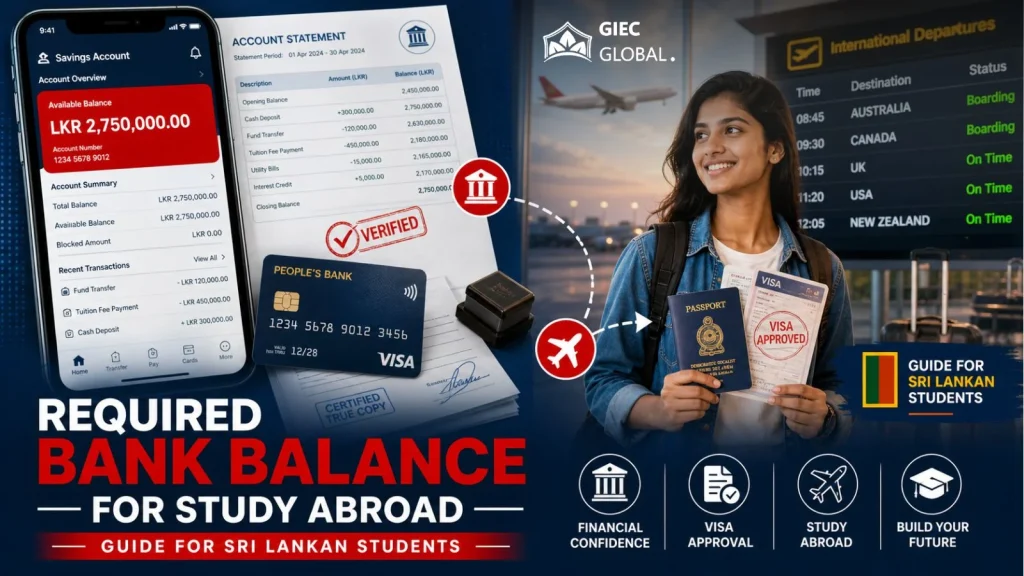
Introduction: How Much Bank Balance Is Required to Study Abroad from Sri Lanka
Planning to study abroad is exciting, but one of the biggest questions students face is simple: how much money is actually required to study abroad? Whether you’re aiming for countries like Australia, Canada, or the UK, understanding the study abroad budget is the first step toward turning your dream into reality.
The truth is, there isn’t a fixed number. The money required to study abroad depends on multiple factors such as your chosen country, university fees, course duration, and living expenses. On top of that, most student visas require you to show a minimum bank balance as proof that you can support yourself during your studies.
Many students from Sri Lanka underestimate this requirement, which can lead to visa delays or even rejections. That’s why having a clear financial plan is not just helpful—it’s essential. From tuition fees to accommodation, food, travel, and insurance, every cost should be calculated in advance to avoid surprises later.
This is where professional guidance makes a real difference. Working with experienced study abroad consultants can help you understand exact financial requirements based on your destination and profile. We specialize in visa services, and our expert consultants are focused on helping students secure their visas smoothly and in the shortest possible time. With the right support, you can plan your finances better and improve your chances of success.
In this guide, you’ll learn exactly how to estimate your study abroad budget, what bank balance you need to show, and how to prepare financially for your journey abroad.
Why Bank Balance Proof Is Important for Student Visas
Bank balance proof is a key part of the visa process when you plan to study abroad. It shows that you have enough money required to study abroad and can manage your tuition and living expenses without financial stress. A clear and well-maintained financial record also reflects a strong study abroad budget, which builds trust with visa officers. With proper guidance from experienced study abroad consultants, you can present your financial proof correctly and improve your chances of visa approval.
Mandatory requirement for study abroad visas
Every country requires financial proof to ensure students can support themselves while they study abroad.
Shows you can cover total expenses
Bank balance proof confirms you have enough money required to study abroad, including tuition, living costs, travel, and insurance.
Reduces visa rejection risk
Insufficient or unclear funds are one of the most common reasons for visa refusal.
Builds trust with visa officers
A well-planned study abroad budget reflects financial stability and serious intent.
Prevents dependency concerns
Authorities want to ensure you won’t rely on illegal work or external support during your stay.
Validates your financial planning
Proper documentation shows that you’ve realistically calculated your expenses before applying.
Highlights consistency of funds
Maintaining a stable bank balance over time is important—not just showing a sudden deposit.
Supports faster visa processing
Clear and complete financial documents can speed up approval timelines.
Guidance from experts improves accuracy
Experienced study abroad consultants help you understand exact fund requirements and acceptable documents.
Increases overall visa success rate
Strong financial proof directly strengthens your application and improves approval chances.
Minimum Bank Balance Requirements by Country
Understanding the minimum bank balance is a key part of planning your study abroad journey. The money required to study abroad varies by country, as each government sets its own financial requirements based on tuition fees and living costs. Below is a general overview to help you estimate your study abroad budget:
Canada
You typically need to show tuition fees for one year plus around CAD 10,000–20,000 for living expenses. This amount proves you can manage basic costs while you study abroad.
Australia
Students must show funds covering tuition fees and approximately AUD 24,000–30,000 per year for living expenses, depending on lifestyle and city.
United Kingdom (UK)
You need to show tuition fees plus living expenses of about £1,300 per month (London) or £1,000 per month (outside London) for up to 9 months.
United States (USA)
There is no fixed rule, but generally you must show one year of tuition fees plus $10,000–$20,000 for living expenses, depending on the university.
Germany
Students are required to open a blocked account with around €11,000–€12,000 per year to cover living costs.
New Zealand
You must show tuition fees plus around NZD 15,000–20,000 per year for living expenses.
Ireland
Students need to show tuition fees and at least €10,000–€12,000 per year for living expenses.
France
The requirement is relatively lower, with proof of around €7,000–€10,000 per year for living expenses, along with tuition fees.
Dubai (UAE)
You need to show tuition fees and around AED 10,000–15,000 for living expenses, depending on the university and city.
Singapore
Students should show tuition fees plus SGD 10,000–15,000 annually for living costs.
How to Calculate Your Total Required Funds
To estimate your total funds, add your tuition fees, living expenses, travel costs, and other essential charges like visa and insurance. Always include a small buffer for unexpected expenses and currency changes to ensure your budget is realistic and complete.
Start with tuition fees
Check your university’s official fee structure for one academic year. This is usually the biggest expense and should be your base amount.
Add living expenses
Include accommodation, food, transportation, utilities, and personal spending. Costs vary depending on the city and lifestyle.
Include accommodation setup costs
Don’t forget initial expenses like security deposits, advance rent, or hostel booking charges.
Calculate travel expenses
Add flight tickets, local transport from the airport, and any travel-related costs.
Factor in visa and application fees
Include visa charges, biometric fees, and university application costs.
Add health insurance
Many countries require mandatory health coverage, which should be included in your total.
Include study materials
Books, software, and other academic resources can add to your expenses.
Consider emergency funds
Keep a buffer amount for unexpected situations like medical needs or price increases.
Check currency exchange impact
Exchange rates can affect your total amount, so always calculate with a slightly higher margin.
Sum up all expenses for a final estimate
Combine all the above costs to get your total required funds and plan accordingly.
Review country-specific requirements
Some countries have fixed minimum fund requirements, so ensure your total meets or exceeds those limits.
Consult experts for accurate planning
Professional guidance can help you avoid underestimating costs and ensure your financial planning is complete and realistic.
Types of Financial Proof Accepted for Visa Applications
When applying to study abroad, submitting the right financial documents is crucial to prove you have enough money required to study abroad. Different countries may have slightly different rules, but most accept the following types of financial proof:
Bank Statements
Recent 3–6 months of bank statements showing a stable balance are the most common proof. This supports your overall study abroad budget.
Savings Account Balance Certificate
An official letter from the bank confirming your current balance adds credibility to your application.
Fixed Deposits (FDs)
Fixed deposits are widely accepted as proof of funds, as they show secured savings.
Education Loan Sanction Letter
Approved student loans from recognized banks can cover tuition and living costs, proving you have access to the required funds.
Scholarship Letters
If you have received a scholarship, the official award letter can be used as financial proof.
Sponsor Letter with Financial Documents
If a parent or guardian is sponsoring you, their bank statements, income proof, and a sponsorship letter are required.
Income Proof (Salary Slips / Tax Returns)
Documents like salary slips, income certificates, or tax returns help validate the source of funds.
Blocked Account (for certain countries)
Some countries require you to deposit a fixed amount in a blocked account, which you can access monthly after arrival.
Property or Asset Documents (in some cases)
These may be considered as supporting documents but are usually not accepted as primary financial proof.
Business Income Proof (for self-employed sponsors)
Business registration documents, profit statements, and tax filings help establish financial stability.
Provident Fund (PF) or Retirement Funds
In some cases, these can be shown as additional financial support.
Guidance from study abroad consultants:
Experienced study abroad consultants can help you choose the right combination of documents based on your profile and destination, ensuring your study abroad budget is properly justified and aligned with visa requirements.
Can Education Loans or Sponsors Be Used?
Yes, education loans and sponsors are both accepted as valid financial support for visa applications in most countries. If you don’t have enough personal savings, you can still manage your finances through a combination of loan funding and sponsorship support. However, immigration authorities carefully check the source, credibility, and documentation of these funds. Whether you choose a loan, a sponsor, or both, the key is to present clear, consistent, and verifiable financial proof that shows you can cover your expenses without difficulty.
Education loans are widely accepted
Approved loans from recognized banks can be used to cover tuition and sometimes living expenses.
Official loan sanction is required
A proper sanction letter with all details is mandatory for visa processing.
Sponsors can fund your education
Parents, guardians, or close relatives can support your expenses.
Proof of relationship is necessary
Documents must clearly show your connection with the sponsor.
Sponsor’s financial strength matters
Income proof, bank statements, and tax returns are required.
Sponsorship letter must be included
A written declaration confirming financial support is essential.
Funds should be stable and genuine
Sudden or unclear transactions can raise concerns.
Combination of sources is allowed
You can use savings, loans, and sponsors together to meet requirements.
Some funds may need to be liquid
Certain countries prefer easily accessible money in bank accounts.
Complete documentation is critical
Proper paperwork increases approval chances and avoids delays.
Common Mistakes When Showing Bank Balance
When applying to study abroad, your financial proof plays a major role in visa approval. Even if you have enough money required to study abroad, small mistakes in how you present your bank balance can lead to delays or rejection. Many applicants focus only on the amount and ignore documentation quality, consistency, and alignment with their study abroad budget. Understanding these common errors can help you prepare a stronger application and avoid unnecessary risks. Guidance from experienced study abroad consultants can also make a big difference in presenting your financial profile correctly.
Showing insufficient funds
Not maintaining the required balance for your study abroad plan is one of the main reasons for visa rejection.
Last-minute large deposits
Sudden high-value transactions without a clear source can create doubts about your money required to study abroad.
Ignoring a proper study abroad budget
Failing to plan a realistic study abroad budget often leads to incorrect fund estimation.
Submitting incomplete bank statements
Missing pages or unclear transaction history can weaken your application.
Not maintaining funds consistently
Authorities check if your balance is stable over time, not just at the time of submission.
Using unclear or unacceptable financial sources
Funds from unverifiable sources can raise red flags during verification.
Ignoring currency exchange impact
Exchange rate changes can affect the total money required to study abroad.
Lack of supporting financial documents
Only showing bank balance without income proof or sponsor details can reduce credibility.
Improper loan or sponsor documentation
Missing sanction letters or relationship proof can cause issues.
Not consulting study abroad consultants
Without guidance from experienced study abroad consultants, many avoidable mistakes happen.
Mismatch between funds and expenses
If your funds do not match your declared study abroad budget, it raises concerns.
Submitting outdated documents
Old or expired financial records may not be accepted during visa processing.
Tips to Improve Your Chances of Visa Approval
Getting a visa approved is not just about submitting documents—it’s about presenting a complete, clear, and trustworthy application. Many applicants face rejection due to small errors, lack of preparation, or weak documentation. By focusing on accuracy, consistency, and proper planning, you can significantly improve your chances of approval and avoid unnecessary delays.
- Prepare all documents carefully
Ensure every document is complete, accurate, and matches the required format. - Maintain a clear and consistent financial profile
Your funds should be stable, well-documented, and easy to verify. - Submit genuine and verifiable information
Avoid any false or misleading details, as this can lead to immediate rejection. - Write a strong statement of purpose (SOP)
Clearly explain your goals, study plans, and future intentions. - Choose the right course and institution
Your academic background should align with your selected program. - Apply well in advance
Early applications give you enough time to correct any issues if needed. - Keep all supporting documents ready
Include academic records, financial proofs, identity documents, and any additional requirements. - Be prepared for visa interviews (if required)
Answer confidently and honestly, with clear knowledge of your plans. - Follow country-specific guidelines
Each country has different rules, so make sure you meet all requirements. - Double-check your application before submission
Small mistakes can lead to delays or rejection. - Stay updated with visa rules and changes
Requirements can change, so always refer to the latest guidelines. - Seek professional guidance if needed
Expert advice can help you avoid common mistakes and improve your application quality.
Final Checklist Before Submitting Your Financial Documents
Before you apply to study abroad, your financial documents should be accurate, complete, and aligned with your overall plan. Even if you have enough money required to study abroad, small mistakes in documentation can impact your visa decision. A well-prepared file that clearly reflects your study abroad budget increases trust and speeds up the process. Getting your documents reviewed by experienced study abroad consultants can further ensure everything is in place before submission.
Check required fund amount
Ensure your bank balance meets the minimum money required to study abroad for your chosen country.
Verify bank statements duration
Keep at least 3–6 months of updated and consistent statements.
Maintain stable balance
Avoid sudden large deposits and ensure funds are maintained over time.
Match funds with your study abroad budget
Your financial proof should clearly support your planned study abroad budget.
Include all supporting documents
Add income proof, tax returns, and other required financial documents.
Attach loan sanction letter (if applicable)
Ensure the education loan is officially approved and documented.
Add sponsor documents (if any)
Include sponsor letter, relationship proof, and their financial records.
Check document clarity and format
All documents should be clear, readable, and properly formatted.
Ensure currency conversion accuracy
Convert funds correctly as per the destination country requirements.
Keep documents updated
Avoid using outdated bank statements or expired financial proofs.
Review country-specific requirements
Confirm that your documents meet the exact visa guidelines.
Get expert review before submission
Consulting professional study abroad consultants helps avoid errors and improves approval chances.
FAQs
The required amount depends on your destination country, university fees, and living expenses. In most cases, you need to show one year of tuition fees plus living costs as part of your study abroad budget.
Yes, it is a compulsory requirement. Authorities need proof that you have enough money required to study abroad and can support yourself during your stay.
Yes, an approved education loan from a recognized bank is widely accepted and can cover a major portion of your expenses.
Most countries require you to maintain a stable balance for at least 3–6 months before applying.
Yes, parents or close relatives can sponsor you, but you must provide proper financial documents and proof of relationship.
Common reasons include insufficient funds, unclear source of money, inconsistent bank statements, and poor financial documentation. Working with experienced study abroad consultants can help avoid these issues.