
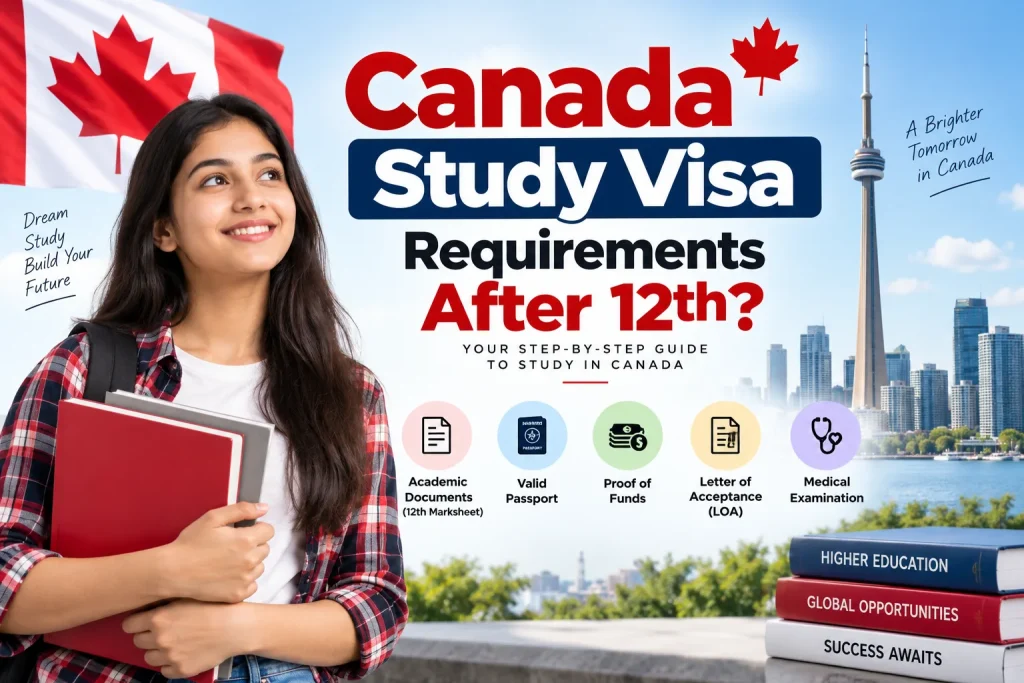
Canada Study Visa Requirements After 12th?
Finishing your A Levels and dreaming of a Canadian campus is a smart move, but the rules changed a lot over the past two years. The Student Direct Stream is gone, the money you must show has nearly doubled, and a new letter from the province is now part of almost every undergraduate file.
- You need a study permit for any course longer than six months, not a visitor visa.
- Acceptance letter from a Designated Learning Institution (DLI) comes first. No offer, no permit.
- Provincial Attestation Letter (PAL) is now required for bachelor, diploma and certificate students. Your college arranges it, not you.
- Proof of funds: CAD 23,448 for first year living costs (single applicant outside Quebec) plus your full first year tuition plus airfare.
- English test: most institutions ask for IELTS 6.0 overall. PTE, TOEFL and Duolingo are widely accepted too.
- The Student Direct Stream closed in November 2024. Every Sri Lankan now uses the regular stream, so a GIC alone no longer buys fast processing.
- Cost to apply: CAD 150 study permit fee plus CAD 85 biometrics. Processing from Colombo runs about 8 to 12 weeks.
- You can work up to 24 hours a week off campus during term, and full time in the breaks.
Do You Need a Canada Study Visa After 12th, or Just an Offer Letter?
Many students think an admission letter is the visa. It is not. A study permit is the document that lets you study at a Canadian school, and anyone taking a programme longer than six months must hold one. An offer letter only starts the process. When the permit is approved from Sri Lanka, the Canadian visa office automatically issues the travel document you need to fly in, so there is no separate application or fee for the entry visa itself.
After 12th you are eligible to apply for a bachelor degree, an advanced diploma, a diploma or a certificate at a DLI. Your O Level and A Level results, plus a matching English score, decide which courses will accept you. The permit stays valid for the length of your programme plus a short grace period, and it lists conditions such as your school and your work rights.
Full Canada Study Visa Requirements After 12th for Sri Lankan Students
Here is the complete checklist a first time applicant from Sri Lanka should build a file around. Every item below is a genuine requirement, not a nice to have.
- Letter of Acceptance from a DLI, with a valid DLI number.
- Provincial or Territorial Attestation Letter (PAL or TAL) for undergraduate level study, unless a listed exemption applies.
- Proof of funds covering first year tuition, living costs and return travel.
- Valid passport covering the full study period.
- English proficiency through IELTS, PTE, TOEFL iBT, CELPIP or, at many schools, Duolingo.
- Statement of Purpose or Letter of Explanation that tells the officer why this course, this school and this country.
- Academic records: O Level and A Level certificates and transcripts.
- Biometrics given at the visa application centre in Colombo.
- Medical exam from an approved panel physician, if required for your case.
- Police clearance if the officer asks for it.
- Passport photos that meet the exact size and format rules.
You can read the official eligibility list on the Government of Canada study permit eligibility page, then match it against the notes below.
How Much Bank Balance Is Required for a Canada Student Visa From Sri Lanka?
This is the single biggest reason strong applications still get refused, so read it slowly. For applications made on or after 1 September 2026, a single student heading outside Quebec must show CAD 23,448 for first year living costs. That figure is living expenses only. On top of it you must show your full first year tuition and the cost of flying to and from Canada. So the money you actually prove is well above 23,448 once tuition is added.
| What you must cover | Amount (single applicant, outside Quebec) |
|---|---|
| Living expenses, first year | CAD 23,448 |
| First year tuition | Your actual fee, stated in your offer letter (often CAD 15,000 to 40,000) |
| Return airfare | Budget roughly CAD 2,000 to 3,000 |
| Study permit fee | CAD 150 |
| Biometrics fee | CAD 85 |
The living cost figure is tied to Statistics Canada data and rises every 1 September, so always confirm the live number before you apply. It sat at CAD 20,635 in 2024 and CAD 22,895 through most of 2026.
A common worry is who is allowed to provide the money. A parent or close relative can sponsor you, but the officer wants to see that the funds are genuine and already available, not borrowed the week before you apply. Show four to six months of steady bank statements, and be ready to explain any large deposit. Fixed deposits, an education loan sanction letter and a Guaranteed Investment Certificate all count as acceptable proof. The full list is on the Government of Canada proof of funds page.
How Many IELTS Bands Are Required for a Canada Student Visa After 12th?
There is no single band set by the visa office itself. The bar is set by the school you apply to. For most bachelor programmes that means IELTS 6.0 overall, with no band below 5.5 or 6.0. Competitive courses like engineering, nursing or business at strong universities often want 6.5 overall. Diploma programmes at colleges sometimes accept 5.5. PTE Academic, TOEFL iBT and CELPIP are accepted by many institutions, and a growing number of DLIs now take Duolingo English Test scores as well.
Even though the visa office no longer runs a dedicated language stream for Sri Lanka, your score still matters enormously. A weak or borderline result raises doubts about whether you can cope with study in English, and that feeds directly into refusals. Aim comfortably above the minimum rather than scraping past it.
Can You Get a Canada Study Visa After 12th Without IELTS?
Sometimes, yes. A few colleges waive IELTS if you studied in an English medium school and can prove it, or if you pass the institution’s own English test. Some also accept a Medium of Instruction letter. But an English test remains the safest route and the one that opens the widest choice of DLIs. Treat a no IELTS offer with care, since a cheap school with loose entry rules can weaken your genuine student case in the officer’s eyes.
How Much Study Gap Is Accepted for Canada After 12th?
A gap does not sink your application on its own. Canadian officers accept study gaps when they are explained with evidence. After 12th, a break of up to about two years is usually fine if you can show what you did, such as language exam preparation, a short job, a family reason or a diploma. Longer gaps need a stronger story and documents to back it. What actually hurts you is an unexplained gap, or a course choice that ignores everything you did during that time. Fold the gap into your Statement of Purpose and attach proof, and it stops being a red flag.
What Is a Provincial Attestation Letter (PAL) and Why Every Undergraduate Needs One
The PAL is the newest hurdle and it trips up students who plan around old guides. Since 2024, Canada runs a national cap on new study permits, and each province gets a fixed share. A Provincial Attestation Letter proves you hold a spot inside that share. For bachelor, diploma and certificate students the PAL is mandatory, and the visa office will return your application as incomplete without it.
The good news is that you do not apply for it yourself. Once a DLI accepts you, the institution requests the PAL from its province and sends it to you to upload with your permit application. The catch is timing. Each province can run out of its allocation, and smaller provinces have hit their limit early in past intakes. Apply as soon as you have your offer, because a late file can miss the province’s quota for that intake.
What Documents Are Required for a Canada Student Visa From Sri Lanka?
Getting the paperwork right is half the battle. Officers refuse files for missing or mismatched documents more often than for weak profiles. Prepare these before you open the online form.
| Document | What to check |
|---|---|
| Letter of Acceptance | Valid, from a DLI, with the DLI number and start date |
| PAL or CAQ | Uploaded with the application, matching your school and province |
| Passport | Valid for the whole programme, with clear scans of all pages |
| Proof of funds | Four to six months of statements, sanction letter, GIC or sponsor proof |
| English score | IELTS, PTE, TOEFL, CELPIP or Duolingo report |
| Academic records | O Level and A Level certificates and transcripts |
| Statement of Purpose | Clear course logic and a genuine plan to return home |
| Photos and forms | Correct photo format and complete IRCC forms |
| Medical and police | Only if requested or required for your case |
Any document not in English or French needs a certified translation. Make sure your name, dates and spellings match exactly across your passport, certificates and bank letters, because tiny mismatches cause delays.
How to Apply for a Canada Student Visa From Sri Lanka Step by Step
The whole process runs online, and the only in person step is giving your biometrics in Colombo.
- Pick a DLI and a course that fits your grades, budget and goals, then confirm the school is on the official DLI list.
- Apply and get your Letter of Acceptance. Pay any deposit the school asks for.
- Receive your PAL from the institution once you are accepted.
- Arrange your funds so your statements are clean and settled well before you apply.
- Sit your English test if you have not already, and get a result that clears your course.
- Create an IRCC online account and complete the study permit application, uploading every document.
- Pay the fees: CAD 150 for the permit and CAD 85 for biometrics.
- Give biometrics at the visa application centre in Colombo after you get the request letter.
- Complete a medical exam with a panel physician if it is required.
- Wait for the decision, then collect your passport with the entry document once approved.
Choosing the right school and province for your budget and your long term plan is where most avoidable mistakes happen. Our Canada student visa team in Sri Lanka handles this end to end, from shortlisting DLIs to filing a refusal proof application
Is There an Age Limit for a Canada Student Visa After 12th?
There is no official upper age limit for a study permit. A student who finished 12th at 17 and one returning to study at 30 are both eligible. What the officer really assesses is whether you are a genuine student whose course makes sense for your age and background. If there is a long gap between your last study and now, explain it clearly. Age by itself is not a reason for refusal.
Can You Work While Studying in Canada After 12th?
Yes, and this is a big reason Canada is popular with Sri Lankan students. With a valid study permit and full time enrolment you can work up to 24 hours a week off campus during academic terms, and full time during scheduled breaks such as the summer and winter holidays. On campus work has its own rules. The 24 hour cap is a hard limit across all jobs combined, and going over it, even by accident, can put your future permits and your Post Graduation Work Permit at risk. Treat work as a top up, never as your funding plan, which is exactly why the proof of funds rule exists.
Why Canada Student Visas Get Refused After 12th, and How to Avoid It
Refusal rates for young first time applicants have been high, so it pays to know what officers look for. The most common reasons a file is refused are:
- Weak proof of funds: not enough money, or funds that appear suddenly with no clear source.
- Unconvincing study plan: a course that does not match your past studies or your stated goals.
- Doubt about leaving Canada: the officer is not satisfied you intend to return after studies.
- Low or borderline English: a score that raises doubts about coping with the course.
- Missing or mismatched documents: a gap the officer cannot explain.
The fix for almost all of these is the same. Show genuine, well sourced money, write a purpose letter that ties your A Level stream to your chosen course and your plans back home, and submit a complete file with no loose ends. If you were refused before, a fresh application must address the exact reasons in the officer’s notes, not just try again.
After Graduation: Work Permit and PR Pathway From a Canada Study Visa
Canada attracts students partly because study can lead to work and, for some, permanent residence. After you finish an eligible programme of at least eight months at an eligible DLI, you may qualify for a Post Graduation Work Permit, issued for up to three years depending on your programme length. You must apply within 180 days of finishing, meet a language benchmark, and, for some credentials, study a field that appears on the eligible list. Canadian work experience can then feed into Express Entry or a Provincial Nominee Program for PR. None of this is automatic, so choose a DLI and a programme with the end goal in mind from the very start.
FAQs
You need a Letter of Acceptance from a DLI, a Provincial Attestation Letter for undergraduate study, proof of funds covering tuition and CAD 23,448 in living costs, a valid passport, an English test score, a Statement of Purpose, your O and A Level records, and biometrics given in Colombo. A medical exam and police clearance are added only when required.
For applications from 1 September 2026, a single student outside Quebec must show CAD 23,448 for first year living costs, plus full first year tuition and return airfare. The living figure rises every September, so confirm the current number before you apply.
The band is set by your school, not the visa office. Most bachelor programmes want IELTS 6.0 overall with no band below 5.5 to 6.0. Competitive courses often ask for 6.5. Some diplomas accept 5.5. PTE, TOEFL, CELPIP and Duolingo are widely accepted alternatives.
A few colleges waive IELTS for English medium schooling with a Medium of Instruction letter, or run their own English test. However an accepted English test opens far more schools and strengthens your genuine student case, so it remains the safest route.
A gap of up to about two years is usually accepted after 12th if you explain it with evidence, such as exam preparation, work or a diploma. Longer gaps need stronger documents. An unexplained gap is what causes problems, not the gap itself.
No. The Student Direct Stream closed in November 2024. Every Sri Lankan applicant now uses the regular study permit stream. A GIC still counts as proof of funds, but it no longer gives you faster processing.
A PAL confirms your spot within a province’s share of the national cap. It is mandatory for bachelor, diploma and certificate students. Your DLI requests it after accepting you, and you upload it with your application. Without it, the visa office returns your file as incomplete.
Applications from Sri Lanka currently take roughly 8 to 12 weeks after full submission, and longer in peak months. Apply up to three months before your intake and submit a complete file to avoid delays.
The study permit application fee is CAD 150 and biometrics are CAD 85. A medical exam and English test are paid separately. Tuition and living proof are your largest costs by far.
No. There is no official upper age limit. Officers assess whether you are a genuine student and whether your course fits your background, so explain any long study gap clearly.
Yes. With a valid permit and full time enrolment you may work up to 24 hours a week off campus during term and full time during scheduled breaks. Going over the 24 hour cap can harm your future permits.
A spouse may still apply to accompany you, but the open work permit for spouses is now limited mainly to partners of master, doctoral and some professional degree students. Spouses of undergraduate students are generally not eligible for an open work permit unless they qualify on their own.
Weak or unexplained proof of funds, an unconvincing study plan, a low English score, and missing or mismatched documents. Names and dates must match across your passport, certificates and bank letters.
Study can lead to PR, but not automatically. After an eligible programme you may qualify for a Post Graduation Work Permit, and Canadian work experience can feed into Express Entry or a Provincial Nominee Program. Choose your course and DLI with this goal in mind.
No. Courses of six months or less can be taken on a visitor visa or an Electronic Travel Authorization. Anything longer than six months needs a study permit, which is what after 12th degree and diploma students apply for.